
LSA-1623
Base for statue of Lucius Tiberius Maefanas Basilius, local notable and defensor. Clusium (Tuscia et Umbria). Early fourth century.
Record details
Photographs
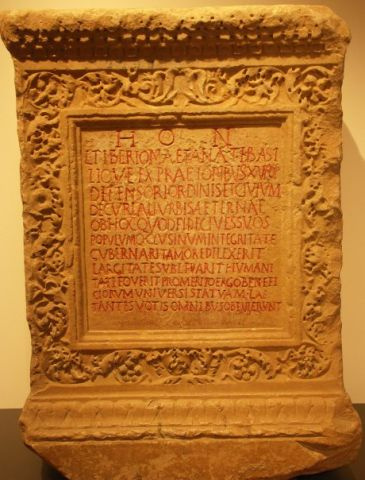
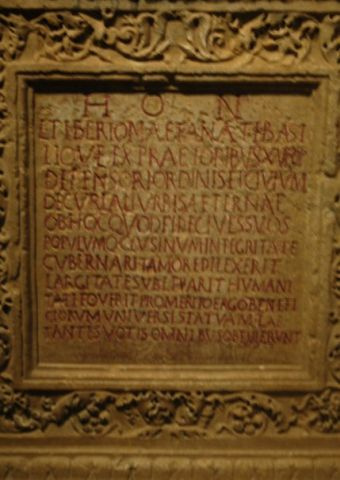
Inscription
Hon(orii). / L(ucio) Tiberio Maefanati Basi/lio, v(iro) e(gregio), ex praetoribus XV pop(ulorum), / defensori ordinis et civium, /(5) decuriali urbis aeternae, / ob hoc quod fide cives suos / populumq(ue) Clusinum integritate / gubernarit, amore dilexerit, /(9) largitate sublebarit, humani/tate foverit, pro merito ergo benefi/ciorum universi statuam lae/tantes votis omnibus obtulerunt.
Inscription translation
[Statue] of Honorius. To Lucius Tiberius Maefanas Basilius, of egregius rank, former praetor of the Fifteen Peoples, defensor of the council and citizens, decurialis of the eternal City; because he governed faithfully and with integrity his citizens and the people of Clusium, cherished them with love, raised them through [his] generosity, [and] fostered them with his kindness. And so, as a reward for his good deeds, everyone, at the urgent request of all, have offered [this statue].
Bibliography
- Corpus Inscriptionum Latinarum; , XI, 2115
- Inscriptiones Latinae Selectae, , 6611
Discussion
INSCRIPTION
In twelve lines.
Hon(orii). / L(ucio) Tiberio Maefanati Basi/lio, v(iro) e(gregio), ex praetoribus XV pop(ulorum), / defensori ordinis et civium, /(5) decuriali urbis aeternae, / ob hoc quod fide cives suos / populumq(ue) Clusinum integritate / gubernarit, amore dilexerit, /(9) largitate sublebarit, humani/tate foverit, pro merito ergo benefi/ciorum universi statuam lae/tantes votis omnibus obtulerunt.
'[Statue] of Honorius. To Lucius Tiberius Maefanas Basilius, of egregius rank, former praetor of the Fifteen Peoples, defensor of the council and citizens, decurialis of the eternal City; because he governed faithfully and with integrity his citizens and the people of Clusium, cherished them with love, raised them through [his] generosity, [and] fostered them with his kindness. And so, as a reward for his good deeds, everyone, at the urgent request of all, have offered [this statue].'
DESCRIPTION (CIL and photograph)
White marble base, damaged at the bottom. The front is framed by wide band containing a decorative leaf motif. The left side has an urceus and the right side has a patera. The epigraphic field is rough, showing signs of erasure of an earlier inscription.
PROVENANCE AND LOCATION
The base was discovered in Chiusi (ancient Clusium), on the road leading from the main square to the upper part of town (CIL). It is now in the Museo Archaoelogico Nazionale.
HONORAND
The honorand, Lucius Tiberius Mefanas Basilius is only known through this inscription. He was a man of egregius rank and a member of the civic elite of Chiusi. He was defensor of the city, here described as consisting of the ordo and the citizens, whom he governed (Cecconi 1994, 191 n. 68). He was also a praetor of the 15 peoples of Etruria, a regional association of Etruscan origins (Torelli 1995, 90). It is not clear what was the function of this praetor in the fourth century, and Lepelley (1992, 360) associates him with the imperial cult. This is possible, since it is known that the leaders of provincial assemblies also had this same function. We should not exclude the possibility that such associations still retained some of their ethnic and political functions, however, as other known praetores went on to have a successful career in the imperial administration (e.g., CIL XIV, 172 and 5345).
AWARDER
The inscription refers to the decision of 'everyone', probably the councillors and the citizens of Clusium.
DATE
Although it is impossible to specify a date for this inscription, the type of object, style of letters and irregularity of the layout strongly suggest a late antique date. Lepelley (1992, 360 with note 19) observes that the reference to Basilius as decurialis urbis aeternae confirms its fourth century context, but he also notes that no viri egregii are known after the reign of Constantine.
Discussion references
- Cecconi, G. A., Governo imperiale e élites dirigenti nell'Italia tardoantica. Problemi di storia politico-amministrativa (270-476 d.C.), Como 1994
- Lepelley, C., "Permanences de la cité classique et archaïsmes municipaux en Italie au Bas-Empire", Institutions, société et vie politique dans l'empire romain au IVe siècle ap. J.-C. Actes de la table ronde autour de l'oeuvre d'André Chastagnol, Rome 1992
- Torelli, M., Studies in the Romanization of Italy, Edmonton 1995
Cite: Last Statues of Antiquity, LSA-1623 (Carlos Machado).