
LSA-1636
Base for statue of Volusius Volusianus, local notable. Interamna Nahars (Tuscia et Umbria). Late third to early fourth century
Record details
Photographs
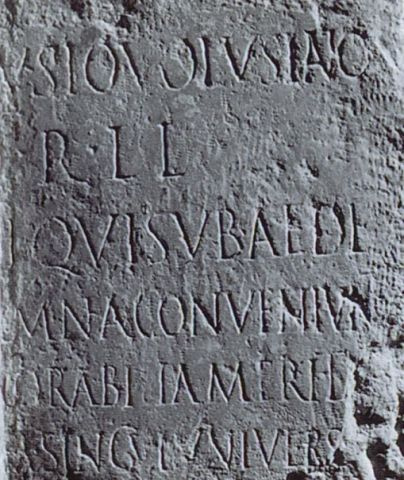
Inscription
[Vol]usio Volusiano, / [e]q(uiti?) R(omano), L(aurenti) L(avinati), / [---]i qui sub aede / [--- Intera]mna conveniun[t], / [ob memo]rabilia merita / [erg]a sing(ulos) univers[(os)q(ue)].
Inscription translation
To Volusius Volusianus, of the equestrian order, [priest] of Laurentum and Lavinium, … that meet in the temple ... at Interamna; on account of [his] remarkable services towards individuals and all.
Bibliography
- Andreani, C. and M. Fora, "Interamna Nahars", Supplementa Italica, N.S. 19, Rome 2002, n. 3
- L'Année épigraphique, , 1996, 603
Discussion
INSCRIPTION
In six lines. Letter height 5 cm.
[Vol]usio Volusiano, / [e]q(uiti?) R(omano), L(aurenti) L(avinati), / [---]i qui sub aede / [--- Intera]mna conveniun[t], /(5) [ob memo]rabilia merita / [erg]a sing(ulos) univers[(os)q(ue)].
'To Volusius Volusianus, of the equestrian order, priest of Laurentum and Lavinium, (…) that meet in the temple ... at Interamna, on account of the remarkable services towards individuals and all.'
In l. 1, ´[Vol]usio' could also be '[Vib]usio', but Volusius was more usual in Etruria and Umbria (SupIt). In l. 2 the priesthood at Laurentum et Lavinium was usually performed by members of municipal elites, normally of equestrian rank. Andreani and Fora (2002, n. 3) suggest associating the dedication with the corpus fabrum subaedianorum, and reading ll. 3-4 as 'fabri qui sub aede/ Interamna conveniunt'.
The paleography and style of the inscription suggest a third century date, probably towards the end of the century (AE).
DESCRIPTION (SupIt)
Limestone base, cut on the left side for re-use. 70 x 40 x 43 cm. The moulding on the top was cut back.
PROVENANCE AND LOCATION
The provenance of our base is unknown. It was probably dedicated in the unnamed temple, mentioned in the inscription, or perhaps (more unusually) in the house of the honorand. The base was found re-used as building material in a wall of the church of Sant'Alò, and it is still there.
HONORAND, AWARDER AND DATE
Our base was dedicated to a Volusius (or, less likely, to a Vibusius) Volusianus, a local notable and benefactor. The identity of the awarder is uncertain, but it is certainly a local association - possibly a local guild.
The date is suggested by the paleography and style of the inscription.
Cite: Last Statues of Antiquity, LSA-1636 (Carlos Machado).