
LSA-1638
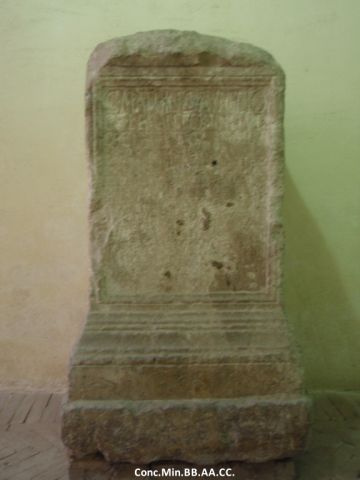
Base for statue of Caius Matrinius Aurelius Antoninus, local notable and patron. Hispellum (Tuscia et Umbria). Mid-fourth century.
Record details
Photographs
Inscription
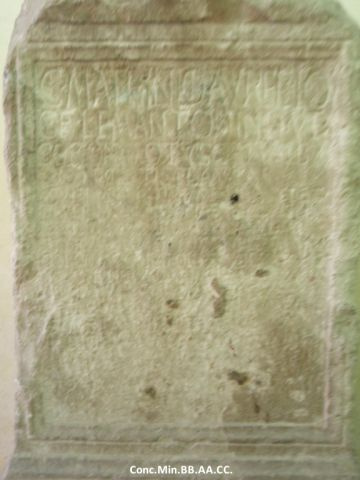
C(aio) Matrinio Aurellio, / C(ai) f(ilio), Lem(onia), Antonino, v(iro) p(erfectissimo), / coronato Tusc(iae) et Umb(riae), / pont(ifici) gentis Flaviae, /(5) abundantissimi muneris sed et / praecipuae laetitiae theatralis ẹḍịṭoṛị, / aedili, quaestori, duumviro / iterum q(uin)q(uennali) i(ure) d(icundo) huius splendissimae / coloniae, curatori r(ei) p(ublicae) eiusdem /(10) colon(iae) et primo principali, ob meritum / benevolentiae eius erga se, / [ple]bs omnis urbana Flaviae / Constantis patrono /(14) dignissimo.
Inscription translation
To Caius Matrinius Aurelius Antoninus, son of Caius, of the Lemonia tribe, of perfectissimus rank, garlanded priest of the province of Tuscia and Umbria (coronatus Tusciae et Umbriae), priest of the family of the Flavians (pontifex gentis Flavia), sponsor of most abundant spectacles and of extraordinary rejoicing in the theatre, aedilis, quaestor, twice member of the board of two with judicial powers for five years (duumviro iterum quinquennali iure dicundo) of this most splendid city (colonia), curator of the city, and first notable; on account of the services of his kindness towards it, the whole urban populace (plebs urbana) of Flavia Constans [set this up] to a most worthy patron.
Bibliography
- Corpus Inscriptionum Latinarum; , XI, 5283
- Gregori, G. L., Epigrafia Anfiteatrale dell'Occidente Romano, vol. 2: Regiones Italiae VI-XI, Rome 1989, n. 21
- Inscriptiones Latinae Selectae, , 6623
Discussion
INSCRIPTION
In 14 lines. Letter height 2-5.5 cm.
C(aio) Matrinio Aurellio, / C(ai) f(ilio), Lem(onia), Antonino, v(iro) p(erfectissimo), / coronato Tusc(iae) et Umb(riae), / pont(ifici) gentis Flaviae, /(5) abundantissimi muneris sed et / praecipuae laetitiae theatralis ẹḍịṭoṛị, / aedili, quaestori, duumviro / iterum q(uin)q(uennali) i(ure) d(icundo) huius splendissimae / coloniae, curatori r(ei) p(ublicae) eiusdem /(10) colon(iae) et primo principali, ob meritum / benevolentiae eius erga se, / [ple]bs omnis urbana Flaviae / Constantis patrono /(14) dignissimo.
'To Caius Matrinius Aurelius Antoninus, son of Caius, of the Lemonia tribe, of perfectissimus rank, garlanded priest of the province of Tuscia and Umbria (coronatus Tusciae et Umbriae), priest of the family of the Flavians (pontifex gentis Flavia), sponsor of most abundant spectacles and of extraordinary rejoicing in the theatre, aedilis, quaestor, twice member of the board of two with judicial powers for five years (duumviro iterum quinquennali iure dicundo) of this most splendid city (colonia), curator of the city, and first notable; on account of the services of his kindness towards it, the whole urban populace (plebs urbana) of Flavia Constans [set this up] to a most worthy patron.'
This inscription has a strong 'antiquarian' flavour, and it is important evidence for the continuity of civic life in fourth-century Italy (Lepelley 1992, 355-360).
DESCRIPTION (personal inspection)
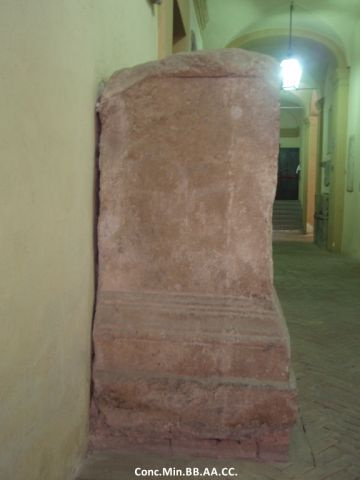
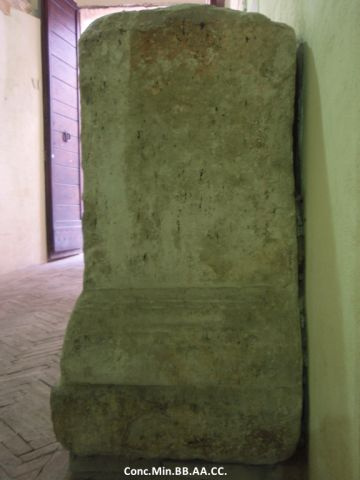
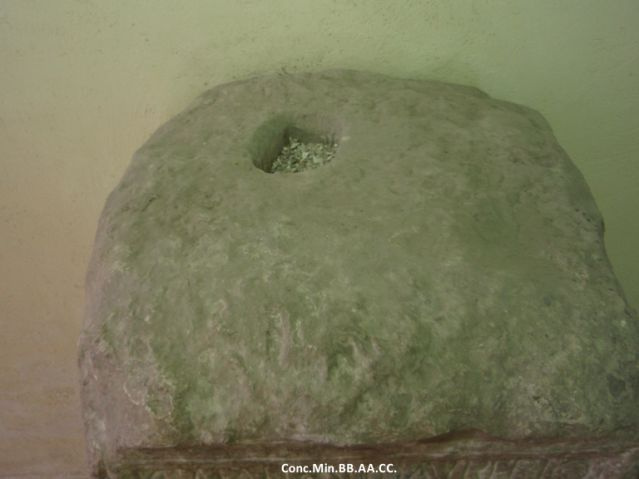
Large limestone base, with mouldings on top and bottom. 143 x 83 x 73 cm. The inscription is badly corroded at parts, sometimes almost illegible. The epigraphic field is rough, but it is not clear whether from erasure of a previous inscription or the natural corrosion of the stone (more likely). The top moulding is damaged. The right and left sides are plain, and the back could not be inspected. The top is badly weathered. It, has one large hole on the left side towards the rear corner, and a very shalow mark of hole towards front right corner.
PROVENANCE AND LOCATION
The base was found outside Spello, on the road to Perugia, near the church of S. Pietro (CIL). The content of the inscription, referring to the spectacles and theatrical displays sponsored by Antoninus, as well as to the cult of the gens Flavia, confirms that our base was related to the sanctuary excavated in the area of Villa Fidelia, where the famous 'Rescript of Hispellum' (CIL XI, 5263; EDR136860) was discovered (Sisani 2006, 112-115). Our base is now in the courtyard of the Palazzo Comunale. The city of Hispellum is here identified as Flavia Constans, following the promotion of its status (CIL XI, 5265).
HONORAND, AWARDER AND DATE
Our statue was dedicated to Caius Matrinius Aurelius Antoninus, of perfectissimus rank. He was a member of the civic elite of Hispellum, having fulfilled a variety of magistracies. As the inscription informs us, he reached the top of the local ordo, and he was elected coronatus of the province of Tuscia et Umbria, presiding ceremonies that involved cities of both regions. He was also a priest of the recently instituted cult of the gens Flavia, which was based in Hispellum (Clauss 2011; Cecconi 1994, 87-96). The dating of our base is uncertain, and it is generally accepted that it should have taken place sometime in the middle of the fourth century (PLRE I, 75 Antoninus 8). It is more likely that it was set up soon after the institution of the cults for which Antoninus was responsible, in the 330s.
The base was dedicated by the whole 'plebs urbana'.
Discussion references
- Cecconi, G. A., Governo imperiale e élites dirigenti nell'Italia tardoantica. Problemi di storia politico-amministrativa (270-476 d.C.), Como 1994
- Jones, A. H. M. et al., The Prosopography of the Later Roman Empire. Vol. I 260-395, Cambridge et al. 1971 (1975), p. 75 (Antoninus 8)
- Lepelley, C., "Permanences de la cité classique et archaïsmes municipaux en Italie au Bas-Empire", Institutions, société et vie politique dans l'empire romain au IVe siècle ap. J.-C. Actes de la table ronde autour de l'oeuvre d'André Chastagnol, Rome 1992, p. 355-360
- Sisani, S., Umbria, Marche (Guide Archeologiche Laterza), Bari 2006
Cite: Last Statues of Antiquity, LSA-1638 (Carlos Machado).