
LSA-1641
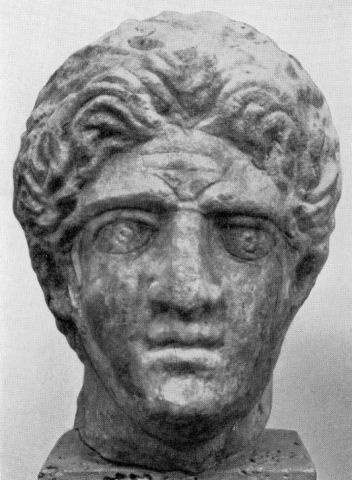
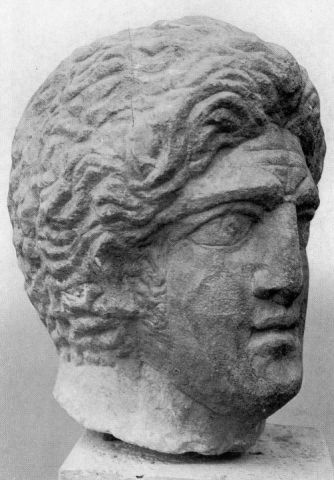
Head of Alexander the Great (?). From Ostia. Fifth century.
Record details
Photographs
Bibliography
- Calza, R. (ed.), Scavi di Ostia. v.5. I Ritratti, pt. 1. Ritratti greci e romani fino at 160 circa d.C., Rome 1964, 22, no. 13, pl. 8
Discussion
DESCRIPTION (Object)
Under life-size head. H: 21 cm. Italian ‘colonnario’ marble
The head has broken through the middle of the neck. It has been re-cut from another sculpted head. An attempt has been made to fashion a right ear out of hair. The line beneath the eyebrows continues until the sides of the head and indicates a broader surface level than that of the face below it. The ridge of the nose has been taken down so as to give the figure a straight ‘Roman’ nose.
The hair has been roughly chiselled, especially at the back. Around the brow are more finished locks and in the hair over the right eye some drill work is preserved. The irises are represented as engraved complete circles and the pupils are drills point within them. A large drill channel separates the lips.
PROVENANCE
Ostia. Possibly from a marble workshop near the Theatre where it was found with two other sculptures in 1911.
DESCRIPTION (Subject)
The head turns to its right. It depicts a youth with a leonine mane of hair and a slightly open mouth. It has been heavily and crudely re-cut from an earlier head and may well have been intended to represent Alexander the Great.
The hair springs upwards on either side of a central part. It then falls backwards in soft waves over most of the ears which have not been fully rendered. In front of the ears, a long sideburn has been depicted in relief.
The brow is broad and traversed by two creases. It furthermore features a V-shaped crease over the bridge of the nose. The brow overhangs the lower face. The eyes are disproportionately large with an almost straight upper lid and a sagging lower lid. The nose is straight but flat. The mouth is bow-shaped and slightly open.
IDENTIFICATION
The clean-shaven face, the full hair springing from an anastole, the creased forehead, and the open mouth are elements of the heroic vocabulary. The head, in fact, features most of the iconography of Alexander the Great and was probably intended to represent Alexander.
DATE
The crude re-carving and the idealized subject make this head difficult to date. It seems likely to belong to the fourth through sixth centuries on the basis that it is re-worked and that the eyes are so emphasized and marked. Alexander was popular throughout late antiquity, and at least one marble portrait of Alexander is attested in the fourth to fifth centuries (see LSA-213).
Cite: Last Statues of Antiquity, LSA-1641 (J. Lenaghan).