
LSA-165
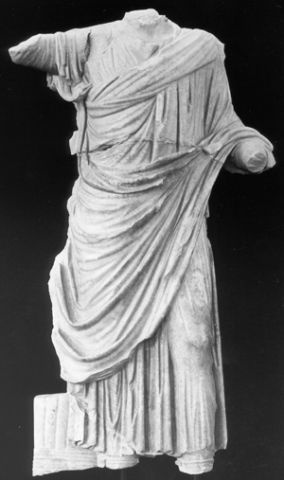
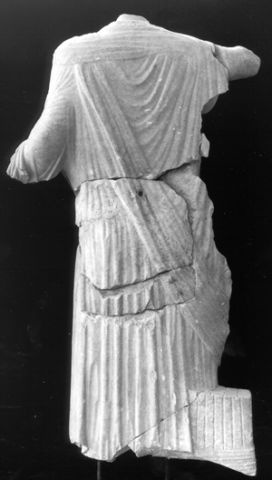
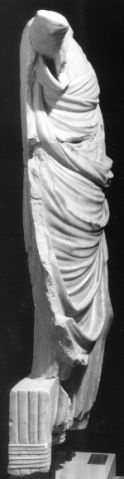
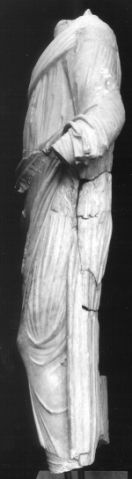
Headless togate statue of emperor (Valentinian II, Arcadius, or Honorius). Aphrodisias (Caria). 388-392.
Record details
Photographs
Bibliography
- Smith, R.R.R., "Statue life in the Hadrianic Baths at Aphrodisias, AD 100-600: Local context and historical meaning", in F.A. Bauer, C. Witschel (eds.), Statuen und Statuensammlungen in der Spätantike - Funktion und Kontext (Spätantike, Frühes Christentum, Byzanz: Kunst im ersten Jahrtausend), Wiesbaden 2007, 228, no. A 38
- Smith, R.R.R. 'Late antique portraits in a public context: Honorific statuary at Aphrodisias in Caria, AD 300-600' , Journal of Roman Studies, 89 (1999), 155-89, pl. 1.1
Discussion
DESCRIPTION (Object)
Life-size statue missing head. H: 147 cm. White marble.
High quality statue made in one piece from plinth to head. Preserved from base of neck to lower shins. Missing: head, right forearm, left hand.
PROVENANCE
Excavated in 1975 in the norther section of the west stoa of the South Agora. Columnar statue bases for Arcadius (LSA-164), Valentinian II (LSA-166), and Honorius (LSA-167) as well as an imperial statue of the Theodosian period (LSA-165) were found in the same stoa and in the adjacent, northern part of the forecourt of the Hadrianic Baths.
DESCRIPTION (Subject)
The statue wears closed and cross-strapped boots, a sleeved tunic, colobium, and a variation of the short late-antique toga. He probably held a mappa in his raised right hand and sceptre in his left hand. The figure is supported by a scroll bundle.
DATE
The associated bases bear inscriptions that date the statue (LSA-164 , LSA-166, LSA-167) precisely.
TOGA
The toga has a rolled edge that runs from under the right armpit to the left shoulder; another accumulation of drapery that runs from the right hip to the left forearm; and a deep sinus which falls to the right knee and rises to the left arm. This form of the toga differs from the more common variation of the late antique toga which has (1) a flat contabulatio that creates looping folds under the right armpit and that broadens over the left shoulder, and (2) has a marked vertical fold down the centre of the body: see for example, LSA-147,LSA-149 and LSA-198. This variation is preserved in three other examples at Aphrodisias: < l>154">LSA-154, LSA-164, and unpublished fragmentary statue from the South Agora.
Cite: Last Statues of Antiquity, LSA-165 (J. Lenaghan).