
LSA-1655
Fragmentary plaque, probably from base for statue, with dedication to Maximian or Maxentius, emperors. Ostia (hinterland of Rome). Late third-early fourth century.
Record details
Photographs
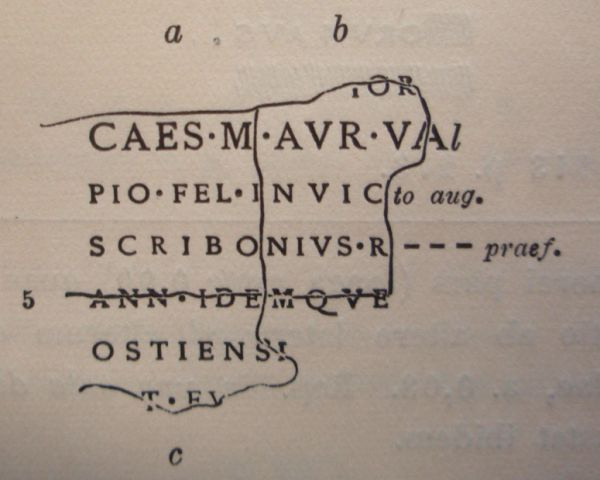
Inscription
[---]ỊỌR[---] / Caes(ari) M(arco) Aur(elio) Vạ[lerio Maximiano(?)], / pio, fel(ici), invic[to, Aug(usto)]. / Scribonius R[---, praef(ectus)] /(5) ann(onae), idemque [---] / ostiensi[um ---] / [---]T EV[---].
Inscription translation
To... Caesar Marcus Aurelius Valerius Maximianus (?), pious, fortunate, unconquered Augustus. Scribonius R(...), prefect of the annona, and at the same time … of Ostia…
Bibliography
- Corpus Inscriptionum Latinarum; , XIV, 4403
Discussion
INSCRIPTION:
Parts of seven lines survive. Letter height 7-5.5 cm.
[---]ỊỌR[---] / Caes(ari) M(arco) Aur(elio) Vạ[lerio Maximiano(?)], / pio, fel(ici), invic[to, Aug(usto)]. / Scribonius R[---, praef(ectus)] /(5) ann(onae), idemque [---] / ostiensi[um ---] / [---]T EV[---].
'To... Caesar Marcus Aurelius Valerius Maximianus (?), pious, fortunate, unconquered Augustus. Scribonius R(...), prefect of the annona, and at the same time … of Ostia…'
The inscription might refer either to Maximian or to his son Maxentius.
CIL suggests supplementing l. 1 as [---restitutor]i or[bis---], and ll. 5-7: [--- praef(ectus)] /(5) ann(onae) idemque [a(gens) v(ices) praeff(ectorum) praet(orio) eemm(inentissimorum) vv(irorum), patr(onus) col(oniae)] / Ostiensi[um ---] / [---]T EV[---]. This suggestion is based on the comparison with the text of LSA-1661.
DESCRIPTION (CIL):
Fragment of marble slab, broken in three, 3 cm deep.
PROVENANCE AND LOCATION:
Each part of the inscription was found at a different place: the horrea Epagathiana, the decumanus maximus and an 'isola ad est del gran tempio'. They were all recorded at different locations in 1930 (CIL).
HONORAND, AWARDER AND DATE:
The inscription records a dedication to an emperor, either Marcus Aurelius Valerius Maximianus or his son, Marcus Aurelius Valerius Maxentius, who ruled between 286 and 312. The awarder, a praefectus annonae, is not attested otherwise (PLRE I, 761 Scribonius R...). Wickert, in CIL, suggested identifying him as simultaneously prefect of the annona and acting praetorian prefect. This suggestion is accepted by Porena (2003), p. 160, who observes that during the tetrarchy praetorian prefects did not live in Rome, and it was common to make the prefect of the annona a representative of the prefects.
Discussion references
- Porena, P., Le origini della prefettura del pretorio tardoantica, Rome 2003, p. 160
Cite: Last Statues of Antiquity, LSA-1655 (Carlos Machado).