
LSA-1667
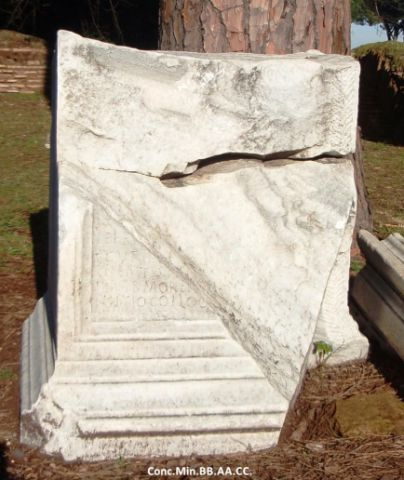
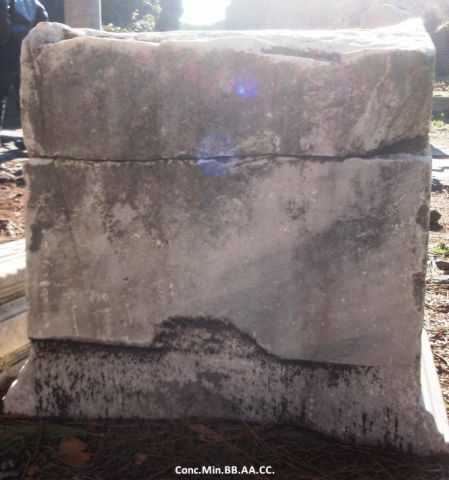
Badly damaged base for statue. Ostia (hinterland of Rome). Fourth century (?)
Record details
Photographs
Inscription
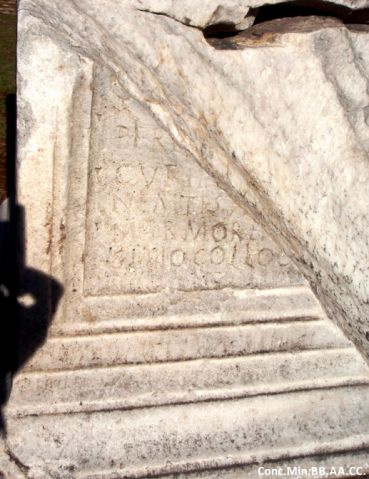
------ / c[---] / peri[---] / curia[---]/nem tes[---] /(6) marmorea[---]/simo colloc[---].
Inscription translation
The fragmentary state of this inscription makes it impossible to offer a translation.
Bibliography
- Corpus Inscriptionum Latinarum; , XIV, 4696 (with a different reading)
Discussion
INSCRIPTION:
Fragments of six lines survive. Letter height 2 cm.
------ / c[---] / peri[---] / curia[---]/nem tes[---] /(5) marmorea[---]/simo colloc[---].
The fragmentary state of this inscription makes it impossible to offer a translation.
The inscription is very faded. The text was carved over a rough surface, and the carving is very shallow and not easy to read. Wickert (CIL XIV, 4696) offers a different reading for l. 4: 'testa[---], but it is wrong. Lines 3-4 could be supplemented as [ob dispositio]/nem tes[tamenti], which would be completed by Wickert's suggestion for ll.4-6: '[statuam cum basi] / marmorea [patrono dignis]/simo colloc[ari iussit].
The reference to a will ('testamentum'), probably of the honorand, suggests that this is a posthumous dedication.
The re-use of the base, and especially the style of the letters, suggests a fourth century date. A later date is also possible, but unlikely due to the disappearance of dedications in Ostia at the beginning of the fifth century.
DESCRIPTION:
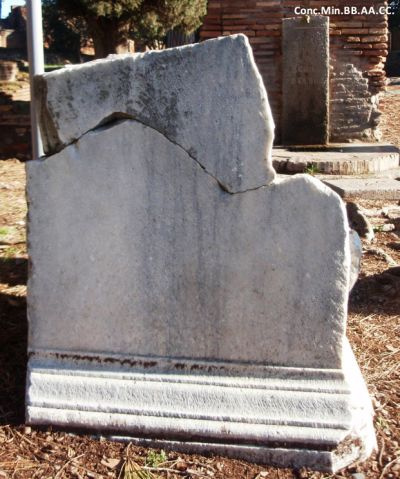
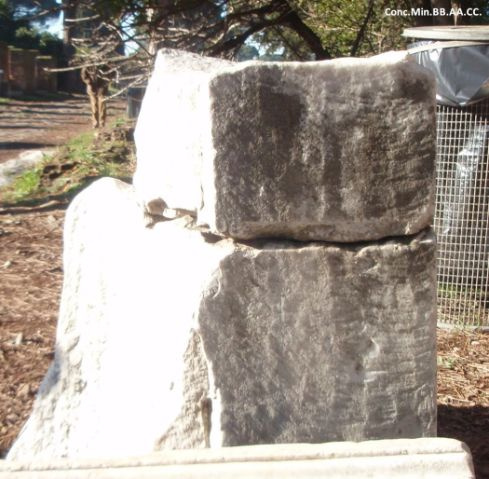
White marble base, of which only two pieces fitted together survive; 86 x 75 x 54 cm. The upper part is lost. The inscription is badly damaged, the letters are small and the carving is light and unclear. The front has a rough surface, due to the erasure of an earlier inscription. The right side is badly damaged towards the front, whereas the left side is better preserved but its upper part is missing.
PROVENANCE AND LOCATION:
The inscription is recorded as having been found off the decumanus maximus, by the via dei molini. It is still in the same area, on the decumanus maximus between via dei molini and the theatre.
HONORAND, AWARDER AND DATE:
The identity of the honorand and awarder remain unknown. The area where our monument was discovered, the vicinity of via dei molini, has a number of productive and commercial structures, including horrea. the monument in question could have been dedicated in one of these structures, to a patron of a guild.
Cite: Last Statues of Antiquity, LSA-1667 (Carlos Machado).