
LSA-1668
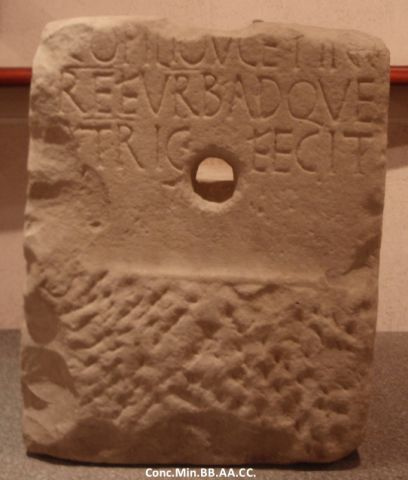
Fragmentary base, possibly for statue, set up by Opilio, prefect of the City and patricius. From Ager Laurentinus (Campania). Mid fifth century.
Record details
Photographs
Inscription
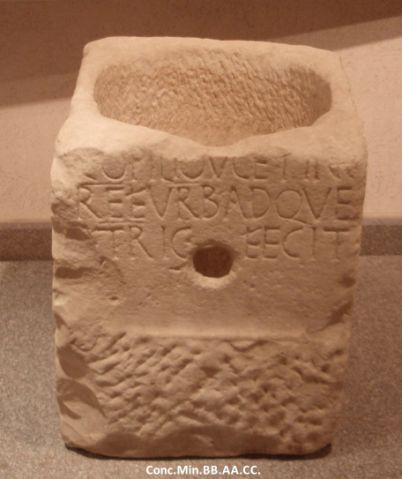
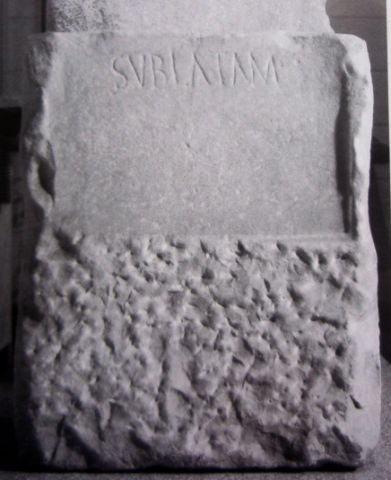
------? / Opilio, v(ir) c(larissimus) et inl(ustris), / pr(a)ef(ectus) Urb(i) adque / [pa]tric[ius] fecit. [on the left side] ------ / sublatam.
Inscription translation
... Opilio, of clarissimus and illustrious rank, prefect of the City and patricius, made [it]. [on the left side] ...elevated.
Bibliography
- Corpus Inscriptionum Latinarum; , XIV, 2046
- Granino Cerere, M. G. (ed.), Supplementa Italica, Imagines. Latium Vetus 1, Rome 2005, n. 5
Discussion
INSCRIPTION
In three lines. Letter height 5-4.5cm.
------? / Opilio, v(ir) c(larissimus) et inl(ustris), / pr(a)ef(ectus) Urb(i) adque / [pa]tric[ius] fecit. [on the left side] ------ / sublatam.
'... Opilio, of clarissimus and illustrious rank, prefect of the City and patricius, made [it]. [on the left side] ...elevated.'
The verb 'fecit' on l. 3 seems to suggest a public work, carried out by the prefect of the City. However, the type of object (see below) indicates that either the work referred to was accompanied by the dedication of a statue, or that it was actually the setting up of a statue. The inscription on the side is shallower and it might have been carved on a different occasion.
DESCRIPTION
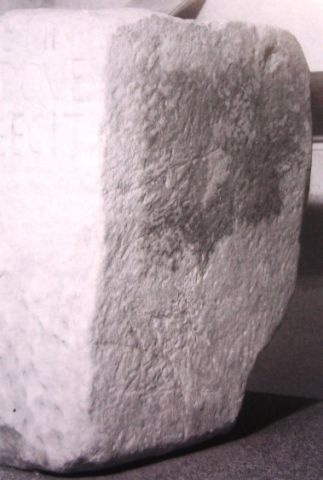
White marble base, cut at the top. 59 x 44 x 46cm. The top was removed and the base was hollowed out, possibly for later re-use as measure for grains. There is a hole at the front. There is another inscription on the left side, possibly of a different date.
PROVENANCE AND CURRENT LOCATION
Our base was discovered in Castel Porziano (Ager Laurentinus) in 1865. However, the fact that it was dedicated by an urban prefect suggests that it might have come from Rome. It is now in the Terme di Diocleziano, Museo Nazionale Romano, sezione epigrafica (inv. 27205).
For Castel Porziano (Castelporziano) see http://www.trismegistos.org/geo/detail.php?tm=32306; for Ager Laurentinus see http://www.trismegistos.org/geo/detail.php?tm=23504.
HONORAND, AWARDER AND DATE:
Our base was dedicated by an urban prefect Opilio, of clarissimus and illustrious rank and patricius. He was probably called Flavius Rufius Opilio, and he was master of the offices in 449-450 and consul in 453 (PLRE II, 807 Opilio 1). Our inscription does not mention his consulship, and therefore should fall between 450 and 452 (Orlandi (1997) p. 38, with reservations).
ACKNOWLEDGMENT:
I would like to thank Silvia Orlandi, Rome, for discussing this base with me.
Discussion references
- Orlandi, S., "Salvo Domino Nostro", Mélanges de l'École Française de Rome. Antiquité, 109 (1), 1997, p. 38
Cite: Last Statues of Antiquity, LSA-1668 (Carlos Machado).