
LSA-1669
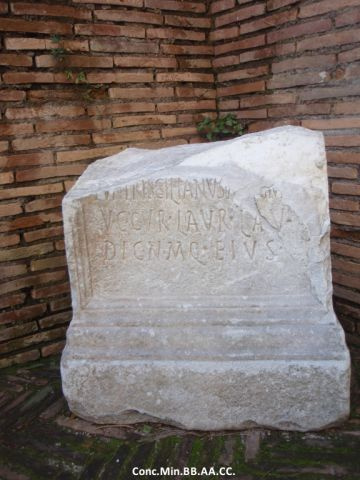
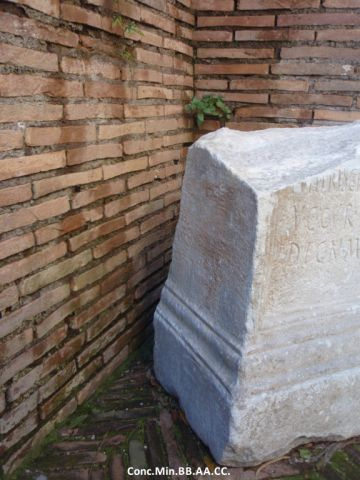
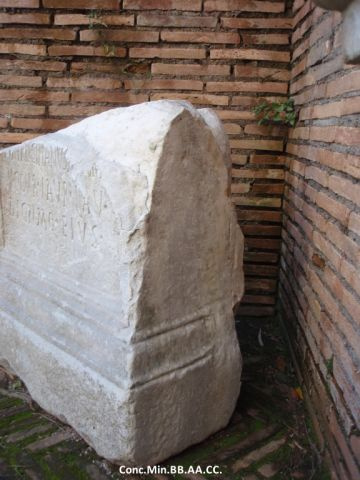
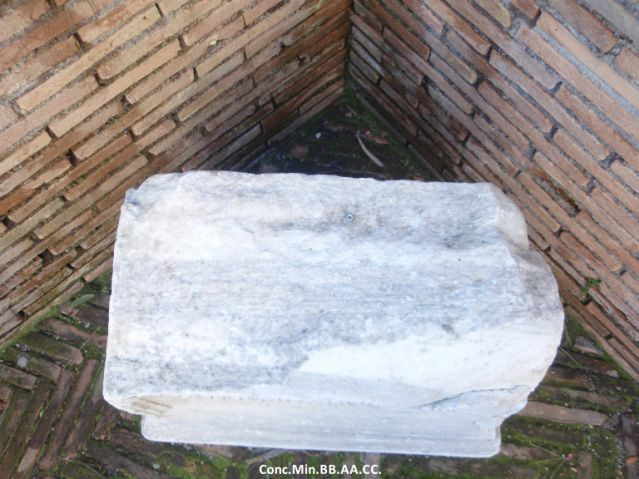
Lower part of base for statue of unknown emperor. Lavinium (Campania). Late third-early fourth century.
Record details
Photographs
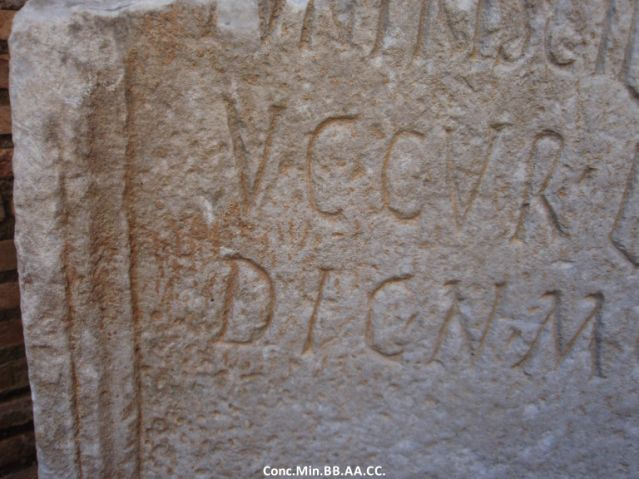
Inscription
------/ [---]rom[---] / Iun(ius) Priscilianus Maximus, / v(ir) c(larissimus), cur(ator) Laur(entum) Lav(inatium), / dic(atus) n(umini) m(aiestati)q(ue) eius.
Inscription translation
To (...) Iunius Priscilianus Maximus, of clarissimus rank, curator of Laurentum and Lavinium, dedicated to his divine spirit and majesty, [set this up].
Bibliography
- Corpus Inscriptionum Latinarum; , XIV, 2074
- Granino Cerere, M. G. (ed.), Supplementa Italica, Imagines. Latium Vetus 1, Rome 2005, n. 28
Discussion
INSCRIPTION
In four surviving lines. Letter height 4.5-5 cm.
------/ [---]rom[---] / Iun(ius) Priscilianus Maximus, / v(ir) c(larissimus), cur(ator) Laur(entum) Lav(inatium), / dic(atus) n(umini) m(aiestati)q(ue) eius.
To (...) Iunius Priscilianus Maximus, of clarissimus rank, curator of Laurentum and Lavinium, dedicated to his divine spirit and majesty, [set this up].
The inscription records a dedication to an emperor, whose name does not survive.
DESCRIPTION (personal inspection)
Marble base, 75 x 72 x 45 cm. Only the lower part survives. The top was cut. The moulding at the bottom survives. The epigraphic field is framed by moulding. It is deep and rough, indicating erasure of an earlier inscription. The inscription is damaged towards the right side. The right and left sides are smooth. The back was cut.
PROVENANCE AND CURRENT LOCATION
The base was found in the borgo of Pratica di Mare (comune di Pomezia); this is the area of ancient Lavinium (http://www.trismegistos.org/place/23504). It is now in the gardens of the Borghese Palace.
HONORAND, AWARDER AND DATE
Although the name of the honorand does not survive, l.4 shows that it was an emperor. The awarder, Iunius Priscilianus Maximus, was a senator, of clarissimus rank, who held priesthoods in Rome and was sent as legate to Asia (LSA-1674; PLRE I, 589 Maximus 45). He was also a patron of Lavinium (http://www.trismegistos.org/place/23504). where he was appointed curator . It was probably in this position that he dedicated our statue, certainly together with (LSA-1670 to Constantius I and LSA-1672 to Galerius, both as Caesar). These dedications allow us to date his term in office to the period between 293 and 305.
Discussion references
- Jones, A. H. M. et al., The Prosopography of the Later Roman Empire. Vol. I 260-395, Cambridge et al. 1971 (1975), p. 589 (Maximus 45)
Cite: Last Statues of Antiquity, LSA-1669 (Carlos Machado).