
LSA-1677
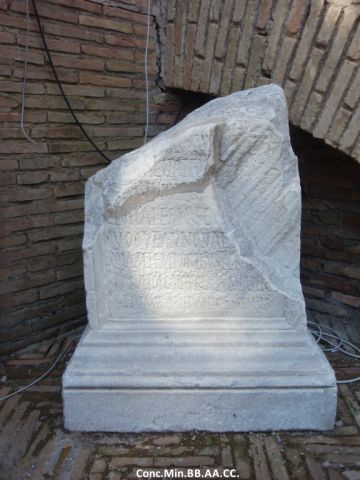
Base for statue of emperor, probably Constantine. Lavinium (Campania). 312-337.
Record details
Photographs
Inscription
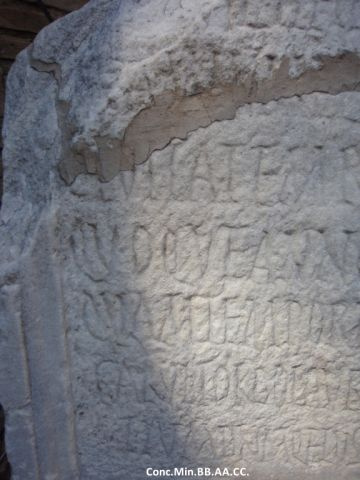
------ / [ob p]r(a)ecipu[am? ---] / [libe]ṛạlitatem ̣[ac reform]/[at]am in melio[rem statum] / civitatem recip[erata?] /(5) quoque annonae c̣[opia?] / quam temporibus tyraṇ[ni] / caruit, ordo Laurentum Lavinạ/ṭium d(icatus?) n(umini) m(aiestati)q(ue) eius devotissimus.
Inscription translation
… because of [his] exceptional liberality and [because] the city was brought back to a better state [and] also an abundant grant of corn restored, which had been lacking in the time of the tyrant, the council (ordo) of Laurentum and Lavinium, dedicated and most devoted to his divine spirit and majesty, [set this up].
Bibliography
- Ephemeris Epigraphica, , IX, 592
- Granino Cerere, M. G. (ed.), Supplementa Italica, Imagines. Latium Vetus 1, Rome 2005, n. 26
Discussion
INSCRIPTION
In eight surviving lines. Letter height 4-4.5 cm.
------ / [ob p]r(a)ecipu[am? ---] / [libe]ṛạlitatem ̣[ac reform]/[at]am in melio[rem statum] / civitatem recip[erata?] /(5) quoque annonae c̣[opia?] / quam temporibus tyraṇ[ni] / caruit, ordo Laurentum Lavinạ/ṭium d(icatus?) n(umini) m(aiestati)q(ue) eius devotissimus.
'… because of [his] exceptional liberality and [because] the city was brought back to a better state [and] also an abundant grant of corn restored, which had been lacking in the time of the tyrant, the council (ordo) of Laurentum and Lavinium, dedicated and most devoted to his divine spirit and majesty, [set this up].'
DESCRIPTION (personal inspection)
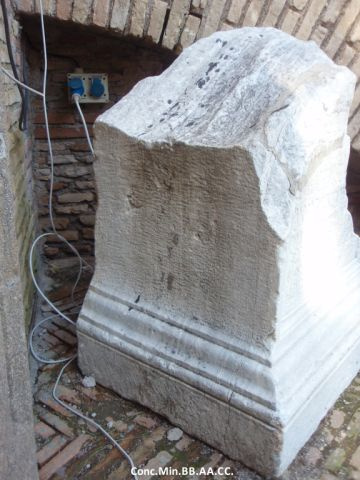
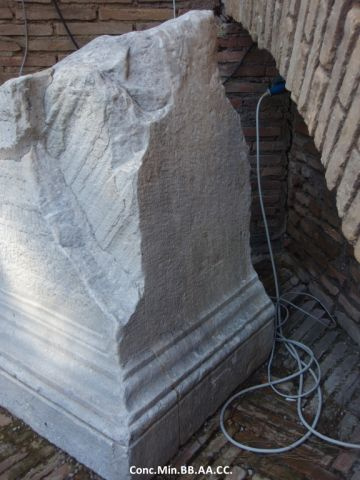
White marble base, 96 x 76 x 63 cm. The base is broken at the top and damaged on the front and sides. The inscription was damaged in recent years, and parts of it cannot be read anymore. the epigraphic field was framed by moulding, mostly lost. It is deep and rough, indicating the erasure of an earlier inscription. the right and left sides are plain. the back is smooth.
PROVENANCE AND CURRENT LOCATION
The precise provenance of our base is not known. It was found in Pratica di Mare, area of the ancient Lavinium (http://www.trismegistos.org/place/23504). It is now in the Pratica di Mare, in the gardens of the Borghese Palace.
HONORAND, AWARDER AND DATE
Our statue was dedicated by the ordo of Lavinium to an emperor whose name is not preserved. The imperial identity of our honorand is confirmed by the closing line of the inscription. The text records that, among the benefits bestowed by this emperor, he restored the city to its former condition and took care of its supply, which had suffered during the time of a 'tyranny'. The reference to a 'tyrant' suggests that the emperor honoured was Constantine, who openly referred to his rival Maxentius in this way. If this is correct, the dedication would most likely have been carried out soon after the defeat of Maxentius in 312.
Cite: Last Statues of Antiquity, LSA-1677 (Carlos Machado).