
LSA-168
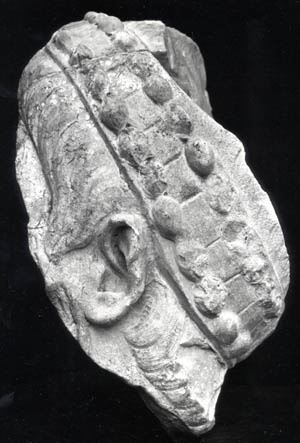
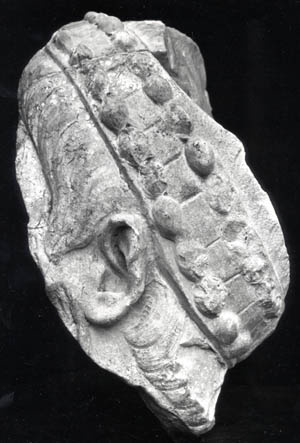
Fragment of imperial male portrait head, wearing pearl-edged diadem. Aphrodisias (Caria). 388-392.
Record details
Photographs
Bibliography
- Smith, R.R.R., "Statue life in the Hadrianic Baths at Aphrodisias, AD 100-600: Local context and historical meaning", in F.A. Bauer, C. Witschel (eds.), Statuen und Statuensammlungen in der Spätantike - Funktion und Kontext (Spätantike, Frühes Christentum, Byzanz: Kunst im ersten Jahrtausend), Wiesbaden 2007, 229 no. A 42
Discussion
DESCRIPTION (Object)
Fragmentary life-size head. H:, W:, D: cm. Fine- grained white marble.
Fragment, in two pieces, preserves upper back left side of head, including ear, part of forehead, fringe, and diadem.
PROVENANCE
Found in the West stoa of the south agora in 1988.
DESCRIPTION (Subject)
The head shows an emperor wearing a pearl-edged diadem and a straight brushed forward hairstyle.
DATE
The head probably belongs to one of the statues from the group of Theodosian emperors of Valentinian II, Arcadius, and Honorius, (see LSA-163, LSA-164, LSA-165, LSA-166, and LSA-167). It therefore dates between AD 388-392. It most likely belongs to the headless torso LSA-165.
Cite: Last Statues of Antiquity, LSA-168 (J. Lenaghan).