
LSA-1681
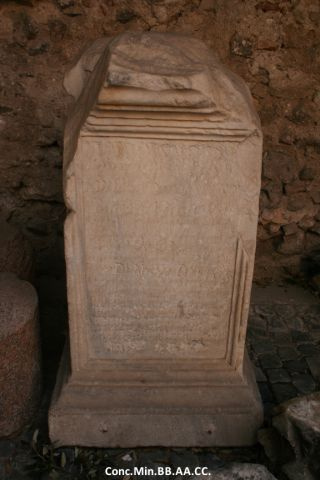
Base for statue of Maximian, emperor. From Labicum (Campania). 286-305.
Record details
Photographs
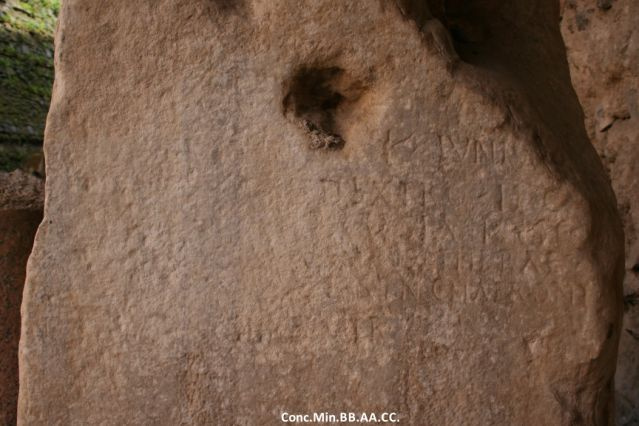
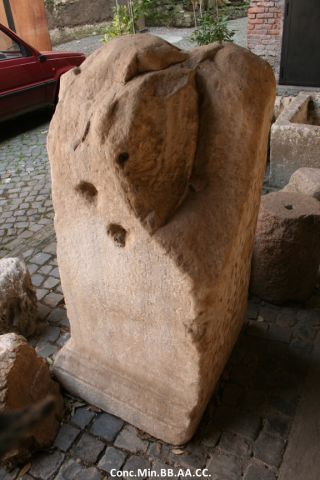
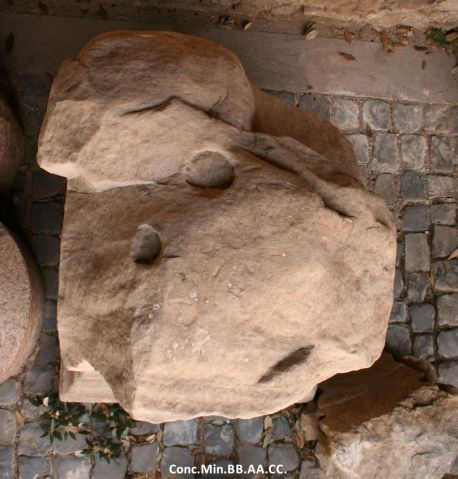
Inscription
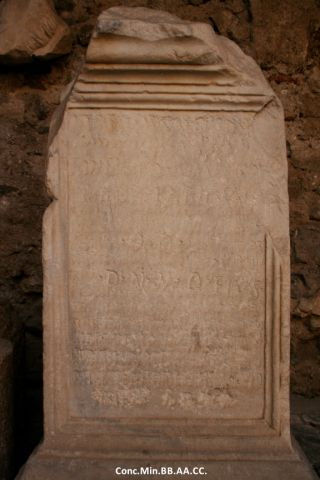
Imp(eratore) C(aesare) M(arco) Valerio / Maximiano, pio, / felici, / inbicto (sic, for ‘invicto’) Aug(usto), /(5) ordo Labican(orum) / QQ(uintanensium), / d(evotus) n(umini) m(aiestati)q(ue) eius.
Inscription translation
To the emperor Caesar Marcus Valerius Maximianus, pious, fortunate, unconquered Augustus; the council of Labicum Quintanense, devoted to his divine spirit and majesty [set this up].
Bibliography
- Ephemeris Epigraphica, , IX, 722
- Granino Cerere, M. G. (ed.), Supplementa Italica, Imagines. Latium Vetus 1, Rome 2005, n. 404
Discussion
INSCRIPTION
In seven lines. Letter height 2.5-4 cm.
Imp(eratore) C(aesare) M(arco) Valerio / Maximiano, pio, / felici, / inbicto (sic, for ‘invicto’) Aug(usto), /(5) ordo Labican(orum) / QQ(uintanensium), / d(evotus) n(umini) m(aiestati)q(ue) eius.
'To the emperor Caesar Marcus Valerius Maximianus, pious, fortunate, unconquered Augustus; the council of Labicum Quintanense, devoted to his divine spirit and majesty [set this up].'
The inscription is very irregular and only lightly carved.
In l. 6, QQ(uintanensium), Ashby 1902, 256 observes that our base was found at the same spot where a funerary inscription referring to the 'reibuplicae Lavicanorum Quintanensium' was found. This is also where station 'Ad Quintanas' appears on Itineraries; it was the first station of the Via Labicana.
DESCRIPTION (personal inspection)
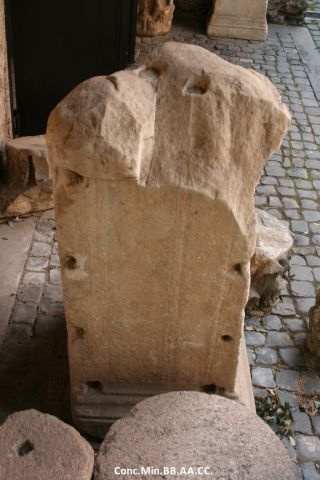
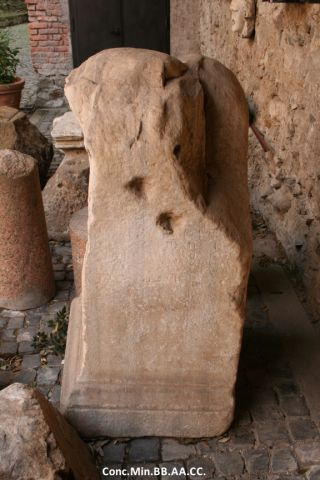
Marble base, 140 x 77 x 68 cm. The base has mouldings on top and bottom. It is broken on the upper left corner. The epigraphic field is framed by moulding, damaged on the right side. Its surface is rough, indicating the erasure of an earlier inscription. The erasure was not complete, and the original text, datable to 196, is still partly legible. The right side is rough, with two holes and traces of an earlier inscription. The left side has four holes towards the front edge and four more towards the back. The top of the base is badly damaged, but two dowel holes can still be seen.
PROVENANCE AND CURRENT LOCATION
The precise provenance of our base is unknown. It is reported as being from Labicum, possibly Colonna, in the province of Rome (http://www.trismegistos.org/place/30633). It is now in Frascati, in the Museo Comunale (Scuderie Aldobrandini), inv. 511466.
HONORAND, AWARDER AND DATE
The inscription records a dedication to the emperor Maximian by the ordo of Labicum. Maximian was Augustus from 286 until 305.
Discussion references
- Ashby, T., "Classical Topography of the Roman Campagna 1", Papers of the British School at Rome 1, 1902, 125-281
Cite: Last Statues of Antiquity, LSA-1681 (Carlos Machado).