
LSA-1689
Base for statue (subject unstated), erected in the baths. From Tibur (Flaminia et Picenum). 330-350
Record details
Photographs
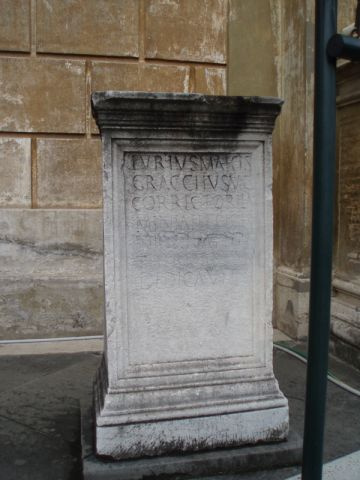
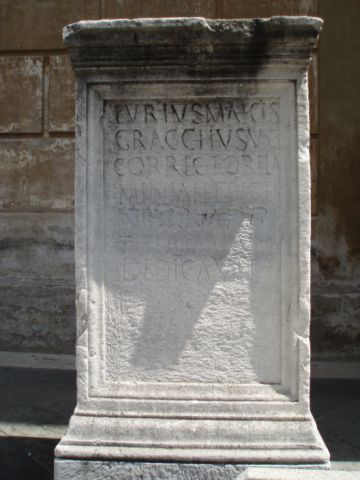
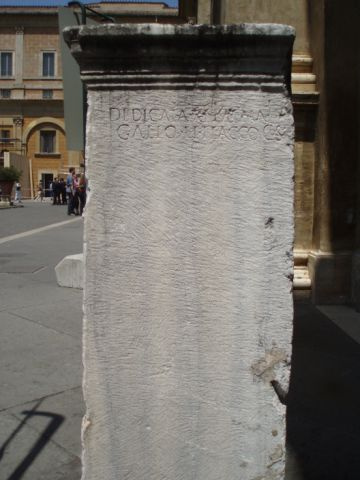
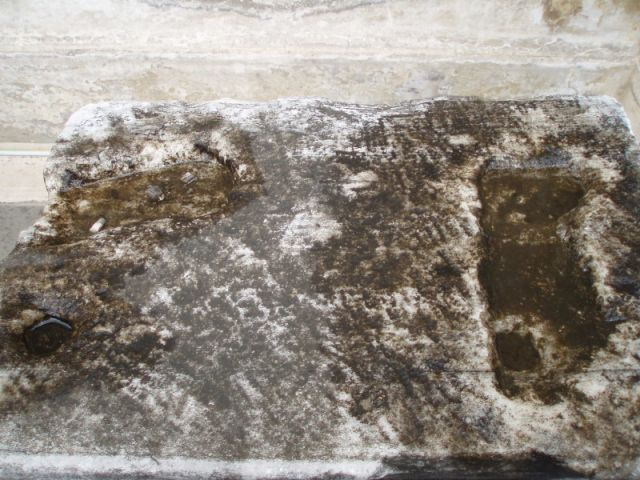
Inscription
Furius Maecius / Gracchus, v(ir) c(larissimus), / corrector Fla/miniae et Pice/ni, ornatui / thermarum, dedicavit.
Inscription translation
Furius Maecius Gracchus, of clarissimus rank, governor (corrector) of Flaminia and Picenum, for the embellishment of the baths, dedicated [this].
Bibliography
- Corpus Inscriptionum Latinarum; , XIV, 3594
- Inscriptiones Italiae, Rome 1931-, IV.1, 151
- Granino Cerere, M. G. (ed.), Supplementa Italica, Imagines. Latium Vetus 1, Rome 2005, n. 885
- Inscriptiones Latinae Selectae, , 5717
Discussion
INSCRIPTION
In seven lines:
Furius Maecius / Gracchus, v(ir) c(larissimus), / (3) corrector Fla/miniae et Pice/ni, ornatui / (6) thermarum,/ dedicavit.
'Furius Maecius Gracchus, of clarissimus rank, governor (corrector) of Flaminia and Picenum, for the embellishment of the baths, dedicated [this].'
Letter height 4 - 5.8 cm.
DESCRIPTION (CIL, Epigraphic Database Roma (EDR), and the published images)
Rectangular marble base moulded at top and bottom; H 117, W 63, D 43 cm. On the top face there are fittings for a bronze statue.
On the right lateral face (from viewer) there is a dedicatory inscription datable to April 174 by consular date.
PROVENANCE AND CURRENT LOCATION
The inscription was found in Tivoli, ancient Tibur, during construction works on the piazza in front of Sant‘ Andrea, in 1778.
It is now in the Vatican, Musei Vaticani, Cortile della Pigna 25 (inv. no. 5132).
HONORAND, AWARDER AND DATE
The subject of the statue is not made explicit in our inscription. It was probably a deity or mythological figure, or an emperor of the earlier imperial period, as in similar cases (see below, Further Discussion).
The statue was set up Furius Maecius Gracchus, governor (corrector) of Flaminia and Picenum (to which Tibur belonged at this period) (PLRE I, 400 Furius Maecius Gracchus 3). The province was established, as the other Italian provinces, after 290/1 and probably in the early 4th century (Chastagnol 1982, 170). The office was upgraded to the rank of consularis by 350/2; this is the terminus ante quem for our inscription (PLRE I, 769, Flavius Ro(ma)nus 8, and 999, ....meius, both under Magnentius (Augustus 350/2)).
FURTHER DISCUSSION
According to the late 18t-century scholar Stephane Cabral, the hand of a female statue was found along with the inscription; Cabral suggested that it was from a statue of Venus or Minerva (see CIL)
Furius Maecius Gracchus, the awarder, was the son of Cethegus (LSA-879).
Discussion references
- Chastagnol, A., La carrière sénatoriale du Bas-Empire depuis Diocletien, Epigrafia e ordine senatorio, 1. Atti del Colloquio intenazionale AIEGL, Roma 14 - 20 maggio 1981, pp. 167-92, Roma 1982
- Jones, A. H. M. et al., The Prosopography of the Later Roman Empire. Vol. I 260-395, Cambridge et al. 1971 (1975)
Cite: Last Statues of Antiquity, LSA-1689 (Ulrich Gehn & Carlos Machado, discussion added 3/15 (UG)).