
LSA-169
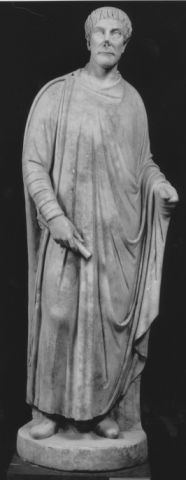
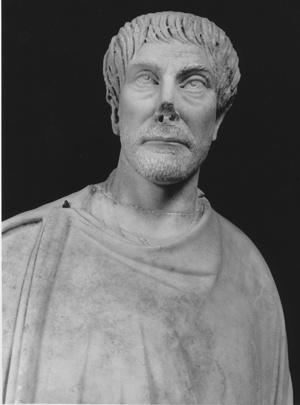
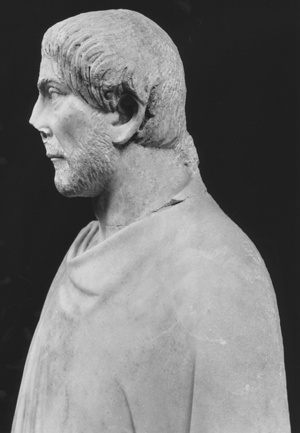
Portrait statue of man (probably governor) in chlamys, so-called 'Elder Magistrate.' From Aphrodisias (Caria). Fifth century.
Record details
Photographs
Bibliography
- Fıratlı, N., La sculpture byzantine figurée au Musée archéologique d'Istanbul, Paris 1990, 10-11, no. 12, pls. 6-7
- Inan, J. and E. Rosenbaum, Roman and Early Byzantine Portrait Sculpture in Asia Minor, Oxford 1966, no. 243
- Mendel, G., Musées Impériaux Ottomans. Catalogue des sculptures grecques, romaines, et byzantines I-III, Constantinople 1912-1914, no. 508
- Smith, R.R.R., "Statue life in the Hadrianic Baths at Aphrodisias, AD 100-600: Local context and historical meaning", in F.A. Bauer, C. Witschel (eds.), Statuen und Statuensammlungen in der Spätantike - Funktion und Kontext (Spätantike, Frühes Christentum, Byzanz: Kunst im ersten Jahrtausend), Wiesbaden 2007, 228 no. A 36
- Smith, R.R.R. 'Late antique portraits in a public context: Honorific statuary at Aphrodisias in Caria, AD 300-600' , Journal of Roman Studies, 89 (1999), 155-89, pl. 1.3
Discussion
DESCRIPTION (Object)
Life-size statue. H: 181, W: 54, D: 30 cm. White marble.
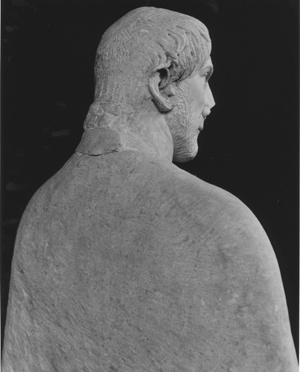
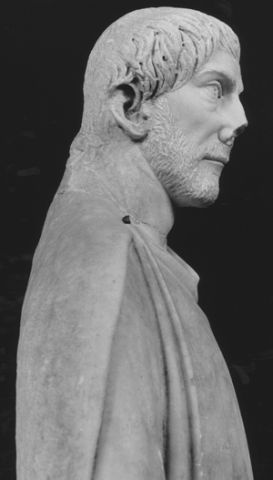
Statue made in one piece with tall rounded plinth. Preserved in two main fragments: head and statue. The figure is surprisingly shallow, flat behind, as if the sculptor did not have a deep enough block. The flatness is skillfully concealed, confined at the back.
PROVENANCE
Found in 1904-1905 in the area of the west stoa of the South Agora, in its northern half.
DESCRIPTION (Subject)
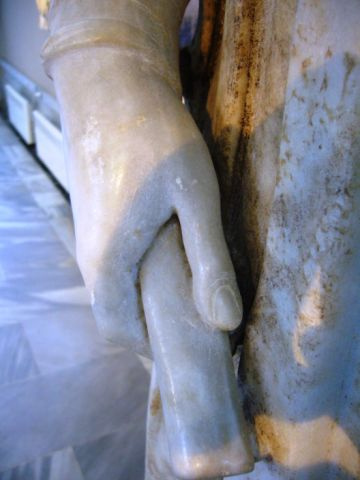
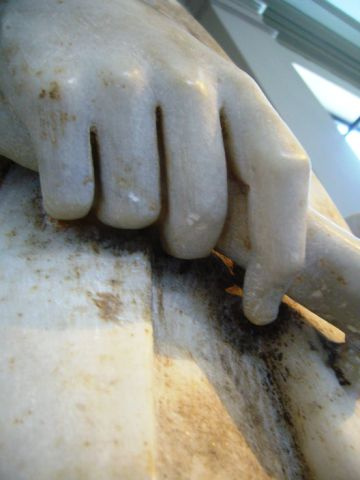
The figure wears a sleeved tunic, long chlamys, and plain closed shoes. It holds a scroll in the right hand is supported by a scroll bundle. The fibula for the chlamys was separately added to the right shoulder. The statue composition is virtually a replica of that of Oecumenius,LSA-150. The head is supported by a thick neck brace.
The portrait is of a mature, bearded man with lined brow and serious expression. The short beard is roughly engraved in short point-chisel strokes onto a slightly raised surface. The hair is brushed forward from the top of the head and from behind the ears onto the temples and brow in heavily drilled, lank locks with frequent ‘bridges’ to break up the deep, dividing channels. The heavy eyebrows are modeled and engraved. The eyes have lightly engraved U-shaped irises, and heavier, rougher U-shaped pupil markings. The inner canthi are deeply drilled out. The broad, thin-lipped mouth and the technically intensified stare of the eyes lend the portrait a memorable and time-specific effect of unbending, grim-faced, political power.
HONORAND
The fully documented statue of Oecumenius LSA-150, a governor wearing a chlamys, combined with the dense presence of governors among the city’s attested honorands makes it likely that this and other chlamydati were most often statues of governors.
DATE
The technique, style, and close relationship to the statue of Oecumenius, LSA-150, indicate a fifth century date, probably one in the first half of the century.
Cite: Last Statues of Antiquity, LSA-169 (R.R.R. Smith).