
LSA-1696
Base for statue of Lucius Annius Rufus, local notable and patron of the city. Canusium (Apulia et Calabria). Third-fourth century.
Record details
Photographs
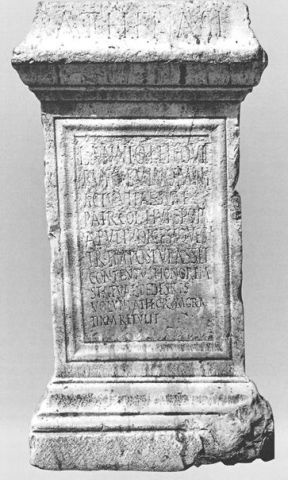
Inscription
Athenasi. / L(ucio) Annio L(uci) f(ilio) Ouf(entina) / Rufo, e(gregio) v(iro) in omni / actu vitae suae, /(5) patr(ono) col(oniae), huic popul(us) / aput (sic) iudices eques/trem postulasset, / contentus honorem (sic, for ‘honore’) / statuae pedestris /(10) voluntati eorum gra/tiam retulit.
Inscription translation
[Statue of] Athenasius. To Lucius Annius Rufus, son of Lucius, from the Oufentina tribe, of egregius rank in every action of his life, patron of the colony; having the people requested an equestrian [statue] to the judges, he [being] satisfied with the honour of a standing statue, returned their favour.
Bibliography
- Chelotti, M. et alii, Le Epigrafi Romane di Canosa, Bari 1990, n. 38
- Christol. M., Magioncalda, A.. 'Contuinuités dans la vie municipale à l’époque tardive d’après l’épigraphie de Canusium (Canosa, Italie). ', La fin de la cité antique et le début de la cité médiévale de la fin du IIIe siècle à l’avènement de Charlemagne. Actes du colloque tenu à Paris les 1, 2 et 3 avril 1993, Bari 1996
- Silvestrini, M., Un itinerario epigrafico lungo la via Traiana. Aeca, Herdoniae, Canusium, Bari 1999, Cc6
Discussion
INSCRIPTION
In eleven lines. Letter height: signum 7.5 cm; dedication: 5-3 cm.
Athenasi. / L(ucio) Annio L(uci) f(ilio) Ouf(entina) / Rufo, e(gregio) v(iro) in omni / actu vitae suae, /(5) patr(ono) col(oniae), huic popul(us) / aput (sic) iudices eques/trem postulasset, / contentus honorem (sic, for ‘honore’) / statuae pedestris /(10) voluntati eorum gra/tiam retulit.
'[Statue of] Athenasius. To Lucius Annius Rufus, son of Lucius, from the Oufentina tribe, of egregius rank in every action of his life, patron of the colony; having the people requested an equestrian [statue] to the judges, he [being] satisfied with the honour of a standing statue, returned their favour.'
The inscription records the dedication of an equestrian statue to the honorand, who refused such honour and opted instead for a standing statue.
DESCRIPTION (From Silvestrini)
Limestone base, 137 x 76 cm. The base was inserted into wall, and only the front is visible. It has mouldings on top and bottom, damaged at the bottom. The epigraphic field is framed by moulding. There are clear traces of an earlier inscription, which was erased to make way for our base.
PROVENANCE AN CURRENT LOCATION
The base was found re-used inserted into wall of private building on Largo S. Sabino. It is still there, inv. no. 40467.
HONORAND, AWARDER AND DATE
The inscription records a dedication by the populus of Canusium to its patron, Lucius Annius Rufus.
The dating of our inscription is very complicated. The presence of the signum at the top and the reference to the tribe of our honorand have led scholars to propose a third century date, as early as the first half of the century (Chelotti et al 1990, n. 38; Silvestrini 1999, Cc6). However, Christol and Magioncalda (1996, 28-42) have argued for a fourth century date. This is based on the fact that the base was re-used, as well as in the praise in ll. 3-4.
The inscription informs us that the people awarded an equestrian statue, and that this decision was referred to the 'judges' (l. 6). The scholars arguing for a third century date tend to identify these with the mid-imperial 'iuridici'. Christol and Magioncalda, however, suggest identifying them with the provincial governors, since 'iudex' was a common designation for governor in fourth century texts. The main difficulty with this identification is the fact that the inscription uses the plural, and not the singular. In any case, the text informs us that a local decision was referred to an external authority connected to the imperial government, which makes a date in the second half of the third century or (if Christol and Magioncalda are correct) even later.
Discussion references
- Christol. M., Magioncalda, A.. 'Contuinuités dans la vie municipale à l’époque tardive d’après l’épigraphie de Canusium (Canosa, Italie). ', La fin de la cité antique et le début de la cité médiévale de la fin du IIIe siècle à l’avènement de Charlemagne. Actes du colloque tenu à Paris les 1, 2 et 3 avril 1993, Bari 1996, pp. 25-42
Cite: Last Statues of Antiquity, LSA-1696 (Carlos Machado).