
LSA-170
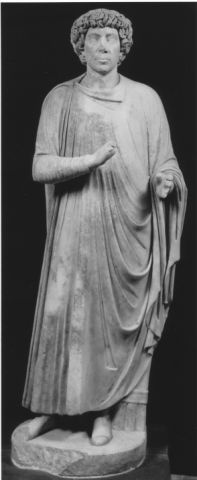
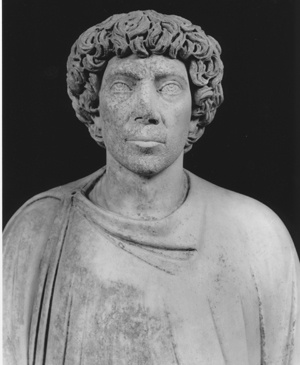
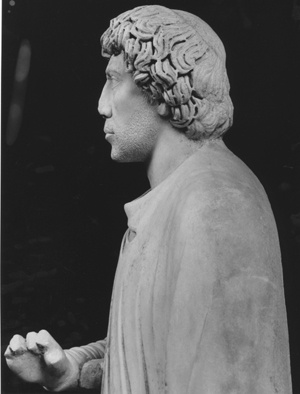
Portrait statue of man (probably governor) in chlamys, so-called 'Younger Magistrate.' From Aphrodisias (Caria). Fifth century.
Record details
Photographs
Bibliography
- Fıratlı, N., La sculpture byzantine figurée au Musée archéologique d'Istanbul, Paris 1990, 11-12, no. 13, pl. 7
- Inan, J. and E. Rosenbaum, Roman and Early Byzantine Portrait Sculpture in Asia Minor, Oxford 1966, 179-180, no. 242, pls. 176.1-2 and 178.1
- Mendel, G., Musées Impériaux Ottomans. Catalogue des sculptures grecques, romaines, et byzantines I-III, Constantinople 1912-1914, no. 507
- Smith, R.R.R., "Statue life in the Hadrianic Baths at Aphrodisias, AD 100-600: Local context and historical meaning", in F.A. Bauer, C. Witschel (eds.), Statuen und Statuensammlungen in der Spätantike - Funktion und Kontext (Spätantike, Frühes Christentum, Byzanz: Kunst im ersten Jahrtausend), Wiesbaden 2007, 228 no. A 35
- Smith, R.R.R. 'Late antique portraits in a public context: Honorific statuary at Aphrodisias in Caria, AD 300-600' , Journal of Roman Studies, 89 (1999), 155-89, pl. 1.3
Discussion
DESCRIPTION (Object)
Life-size statue. H: 176, W: 58. Plinth H: 10-11 cm, H (of head): 22.5 cm. Large grained white marble with bluish tinge.
Statue made in one piece with tall rounded plinth. Preserved in one main piece, with forearms and hands added in several joining fragments. Missing: only ends of fingers and nose.
PROVENANCE
Found in 1904-1905 in the area of the west stoa of the South Agora, in its northern half.
DESCRIPTION (Subject)
The figure wears a sleeved tunic, long chlamys (with separately added fibula), and plain closed boots. It is supported by a belted bundle of scrolls and stands frontally with the right knee bent. It makes an open-handed gesture of address with both hands. He held no attributes.
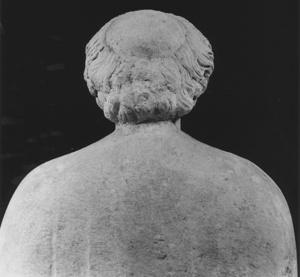
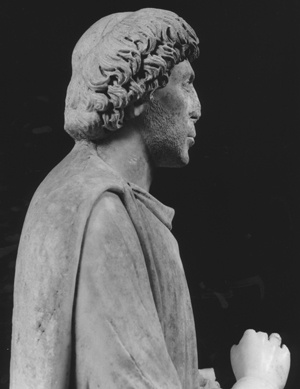
The portrait has a young face with a broad mouth and light beard growth. The growth is much more sensitively rendered than the usual stubble picked into the surface of the face. The face is dominated by a thick heavily-drilled ‘wreath’ of hair, above which the top of the head has a shaved tonsure. The brow is furrowed and the eyebrows are modelled and engraved. The eyes have a heavily engraved U-shaped iris and a deeply carved U-shaped pupil marking.
HONORAND
The fully-documented statue of Oecumenius, LSA-150, a governor wearing a chlamys, combined with the dense presence of governors among the city’s attested honorands makes it likely that this and other chlamydati were most often statues of governors.
If this is correct, the tonsured top of the head is unusual and puzzling in the statue of a government office holder. The tonsure normally signifies a member of the clergy, and between clergy and imperial office-holders there was strict separation. It may have here the wider metaphorical meaning of religious commitment and engagement.
DATE
The technique, style, and broad relationship to the statue of Oecumenius, LSA-150indicate a fifth century date, probably one in the first half of the century.
Cite: Last Statues of Antiquity, LSA-170 (R.R.R. Smith).