
LSA-1707
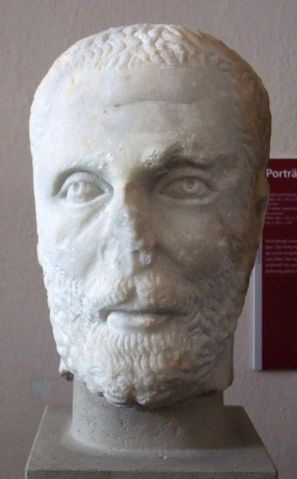
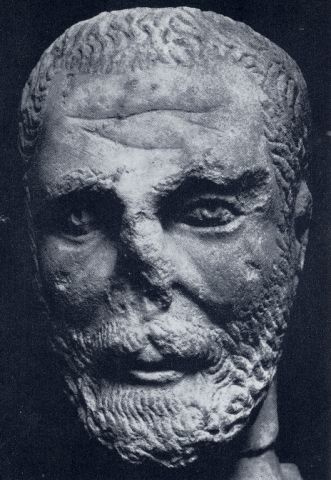
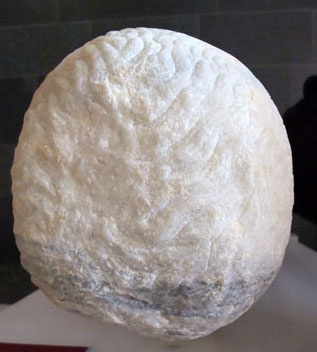
Portrait head of long-faced bearded man. Miletus (Caria). Later third to earlier fourth century.
Record details
Photographs
Bibliography
- Blümel, C., Staatliche Museen zu Berlin. Katalog der Sammlung antiker Skulpturen. Bd. 6. Römische Bildnisse , Berlin 1933, 48, no. R 115, pl. 69 (275-300)
- Inan, J. and E. Rosenbaum, Roman and Early Byzantine Portrait Sculpture in Asia Minor, Oxford 1966, 160, no. 208, pl. 114.2. (275-300)
Discussion
DESCRIPTION (Object)
Over life-size head. H: 29.5 cm. White marble.
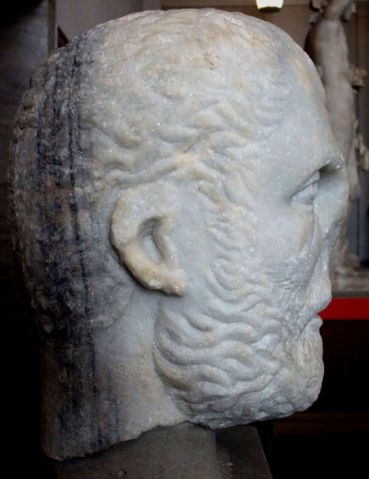
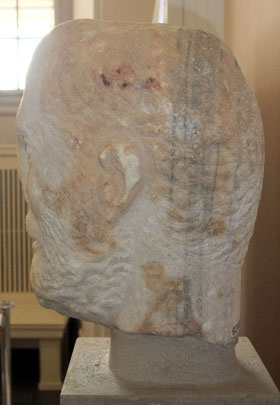
The head is broken through the neck. It probably came from a statue since the neck is thick and has a flat and undraped nape. The nose is mainly missing. The earlobes are chipped.
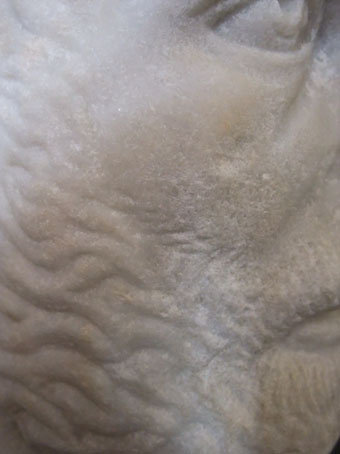
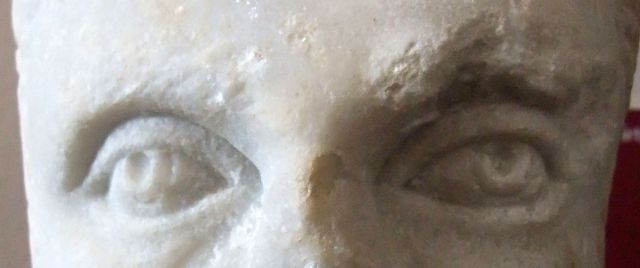
The hair on the head and face is defined with flat chisel work and has been done consistently in the same manner. The pupils of the eyes are drilled, circular, and large. The ring of the irises is engraved with a flat chisel, almost circular, and does not touch the lower lid.
The head has been re-cut from an earlier portrait which had fuller hair. The current hairstyle is rendered in chunky locks except over the brow. High over the brow the new shorter locks end on a raised surface. The sideburns of the beard are too far in front of the ear on the right side. Additional engraved lines to indicate facial hair have been crudely added on the cheeks and upper lip.
PROVENANCE
From Miletus. Found on 22 April 1905 in the Baths of Faustina. It was built into a wall in the room of the Muses.
DESCRIPTION (Subject)
The head shows a mature man with a short, mainly brushed- forward, hairstyle; a moustache; and a beard which is also mainly brushed-forward. The hair ends in short locks which come slightly forward at the centre of the brow. Around the left temple, the hair is brushed back off the face. The moustache parts over the centre of the upper lip leaving a triangular area of skin visible and curls at the corners of the mouth. The beard has a deep drilled parting at the chin.
The face is asymmetrical and probably turned to its right since the left side is fuller. It shows a man with a long face and deep irregular creases on the brow. He also has a deep line running from the corner of the right eye into the cheek; the one on the left side is less pronounced. The naso-labial folds are also marked.
DATE
The fashion style of the medium-length beard and short hair are difficult to date. This style can be found in the later third century, throughout the fourth century, and into the fifth century. In this case the re-cutting of the head gives it an awkward appearance.
Blümel placed this head in the last quarter of the third century, and Inan and Rosenbaum accepted his assessment. Blümel compared it to LSA-801 and LSA-887. To this author the comparisons are valid but the chronology of the comparanda should be widened. The portrait of Caius Caelius Saturninus signo Dogmatius shows a similar style and can be dated securely to 324-337 (LSA-903 and LSA-1266).
Cite: Last Statues of Antiquity, LSA-1707 (J. Lenaghan).