
LSA-1709
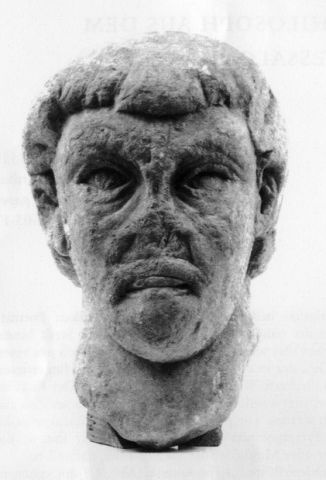
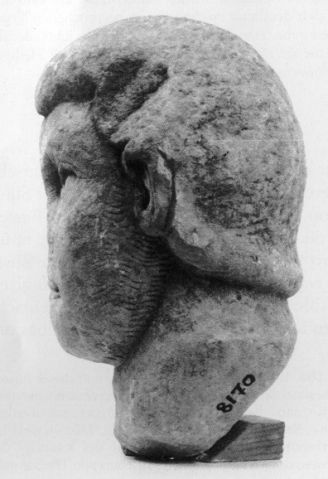
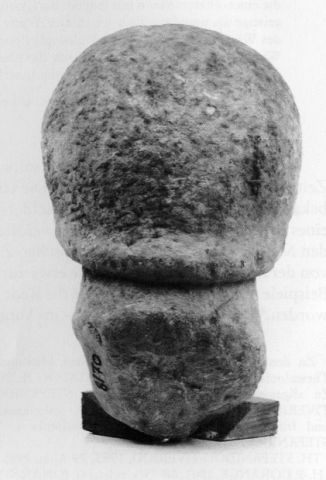
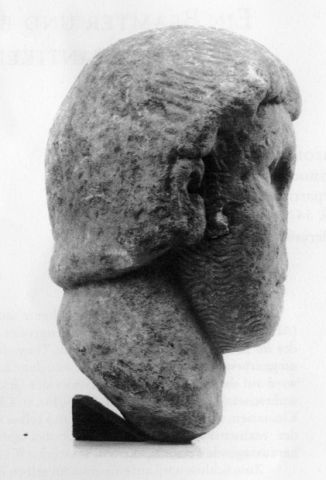
Portrait of bearded man with 'wreath-hairstyle. Thessalonica. Late fourth to early fifth century
Record details
Photographs
Bibliography
- Stefanidou-Tiveriou, T., Ein Beamter und ein Philosoph aus dem spätantiken Thessaloniki, Archaeologica Adriatica 11, 659-69, Zadar 2008, figs. 1-4
Discussion
DESCRIPTION (Object)
Worked for insertion; fine-grained greyish marble, H (overall) 35.5, (chin to crown) 27.5 cm. The nose with a portion of the moustache, both lower lids, a portion of hair above the left temple, and a part of the neck at the left side are broken off. The eyebrows are chipped; the entire surface is battered.
The hair is articulated by few chisel strokes into small crescent shaped locks around the face; above the right temple there are some shallow, parallel incised lines. Behind the ears and at the back it is only roughly finished. The beard is rendered in wavy lines, horizontally directed, incised with a chisel.
The eyeballs are flattened, the iris is circumscribed with an incised line, the pupil is not marked. The lids are bulgy; the eyes are emphasized by a system of lines incised into the cheeks.
The head in its present state is the result of a late-antique re-work; the voluminous hair around the face points to a first use in the Hadrianic period. Further indicators of a re-use are the flattened eyes and the way the ears are embedded into the hair (Stefanidou-Tiveriou 2008, 663-4).
PROVENANCE AND CURRENT LOCATION
The head was found c. 2 km east of the antique city wall; it was possibly set up in an extra-urban villa. It is today in the Thessaloniki Archaeological museum, inv. no. 8170.
DESCRIPTION (Subject)
The portrayed is a man of mature age, as indicated by the full beard and the heavily wrinkled face. He wears the wreath-hairstyle with the hair coiling up into a bulge around the face and in the back. This hairstyle features among the portraits of high ranking state officials on the reliefs of the obelisk-base in Constantinople (dates 390/2). The beard characterizes the portrayed as a ‘man on campaign’; he was probably a high ranking member of the militia like a provincial governor, a vicar, or a praetorian prefect.
DATE
The wreath hairstyle and the heavily emphasized eyes indicate a date not earlier than the late 4th century to our head. The rough outline of the facial features and the emphatically accentuated eyes connect this head with others traditionally dated to the 2nd quarter or mid 5th century (e.g. LSA-169). However, the moderate shape of the wreath points to a date in the late 4th or early 5th century rather than a later date (Gehn 2012, 305-12).
Discussion references
- Gehn, U., Ehrenstatuen in der Spätantike. Chlamydati und Togati, Wiesbaden 2012, 305-12
Cite: Last Statues of Antiquity, LSA-1709 (Ulrich Gehn).