
LSA-171
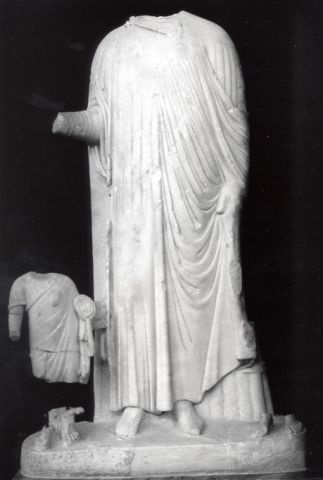
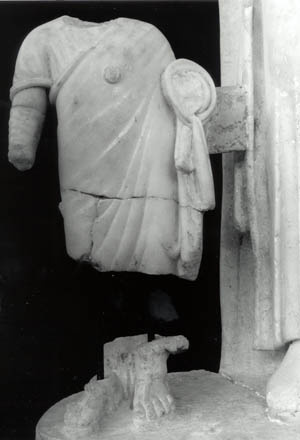
Statue group of man in chlamys and two small children. From Aphrodisias (Caria). Fifth to sixth century.
Record details
Photographs
Bibliography
- Smith, R.R.R., "Statue life in the Hadrianic Baths at Aphrodisias, AD 100-600: Local context and historical meaning", in F.A. Bauer, C. Witschel (eds.), Statuen und Statuensammlungen in der Spätantike - Funktion und Kontext (Spätantike, Frühes Christentum, Byzanz: Kunst im ersten Jahrtausend), Wiesbaden 2007, 227 no. A 28, fig. 27
Discussion
DESCRIPTION (Object)
Life-size statue, missing separately worked head. H: 156 cm. White marble.
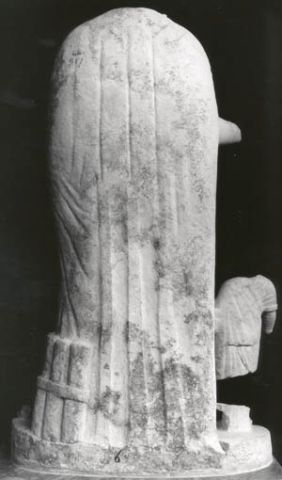
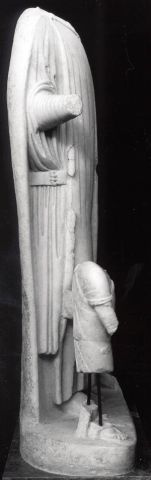
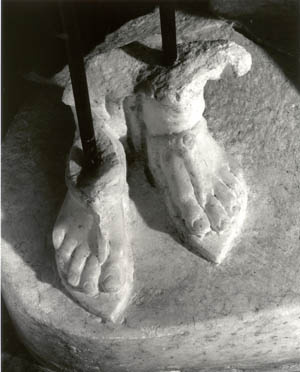
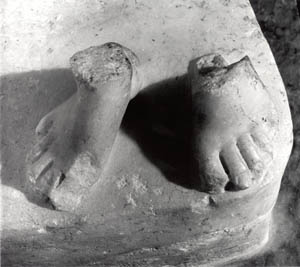
Statue made in one piece with tall broad plinth and two smaller figures at its feet. The small figure on the right is attached to the main figure by a large strut; the figure on the left was probably attached by a strut on the now broken drapery. The head of the main figure was separately worked and is now missing. The concave socket at the neck preserves a large dowel hole. Missing also are: the right hand, an area at the front of plinth between the feet of the main figure; the head, thighs, and hands of the small figure next to the right leg; and the body of the small figure next to the left leg.
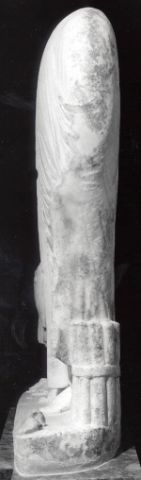
The surface is polished. The back is flatly worked with schematic representational detail; it functions as a supportive sheet of marble behind the figure. This detail repeats in the statue of Oecumenius LSA-150.
PROVENANCE
Found in 1966 in the Hadrianic Baths. It was found on the south side of the Tetrastyle court which is on the northeastern side of the Baths and at the southwestern corner of the North Agora.
DESCRIPTION (Subject)
The honorand wears a sleeved tunic, long chlamys, and plain closed boots. The tunic is belted at the waist, and the belt is visible where the chlamys opens at the right side of the body. The chlamys is fastened by a fibula on the right shoulder. The figure stands frontally with its right forearm projecting outwards and its left arm alongside the body.
On either side of the statue is a small figure. The better preserved figure on the right side wears a long-sleeved tunic, a short-sleeved tunic, a cloak, Greek sandals, and a round medallion (bulla). Of the figure on the left side only bare feet are preserved. Behind this figure and to the left of the main figure are vertical scrolls which are bound by a flat band.
HONORAND
The fully documented statue of Oecumenius, LSA-150, a governor wearing a chlamys, combined with the dense presence of governors among the city’s attested honorands makes it likely that this and other chlamydati were most often statues of governors. The detail of the children is unusual; the base for Tatianus, a resurrected statue, mentions different two to three generations of the same family LSA-191. It was however found at the southern corner of the forecourt of the Baths, and this statue at the northernmost part.
DATE
The technique and broad relationship to the statue of Oecumenius, LSA-150indicate a fifth century date. The separately worked head might indicate that the statue even had a second use.
Cite: Last Statues of Antiquity, LSA-171 (J. Lenaghan).