
LSA-1710
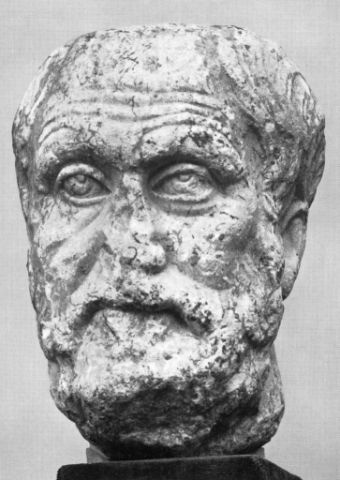
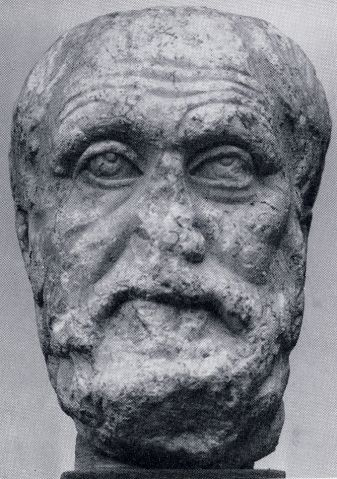
Portrait of long-haired and long-bearded intellectual, probably philosopher Carneades. Unknown provenance. Fourth century.
Record details
Photographs
Bibliography
- Heintze, H. von 'Vir sanctus et gravis. Bildniskopf eines spätantiken Philosophen', Jahrbuch für Antike und Christentum 6, Münster 1963, 35-53, pls. 1-5
- Richter, G.M.A., The Portraits of the Greeks, London 1965, 250, no. 7 and Supplement, 21. fig. 1696a (Karneades)
Discussion
DESCRIPTION (Object)
Over life-size head. H: 28, W: 20 cm. Light grey with dark veins, large-grained ‘Grechetto’marble.
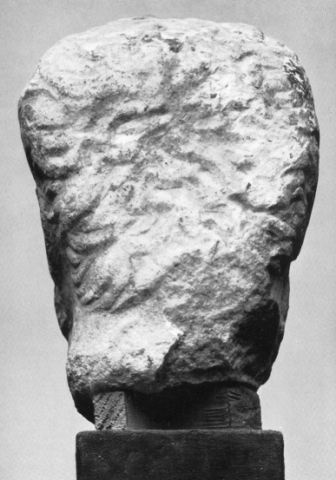
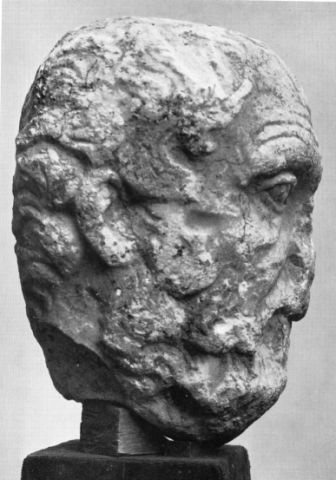
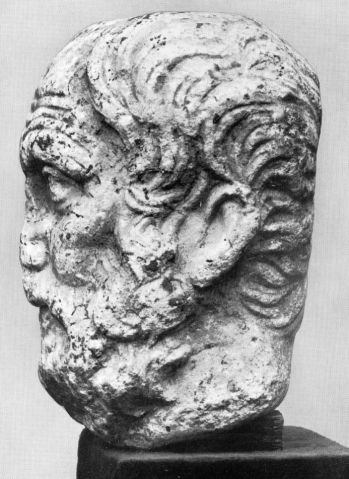
The head has broken unevenly through the top of the neck, some of which is preserved on the left side. The nose is missing; there is a chip in the chin; and the lips and brow are heavily worn. The surface is worn particularly on the right side.
The shape of the block of marble from which the head was carved is still visible. The back of the head was only summarily worked and is rather flat. The top of the head is also flat but smoothly finished with regular tooling which reaches the edge of the brow (von Heintze, p.35). Von Heintze believes that the hair on the top of the head was added in stucco. She also believes the deep groove at the right cheekbone to be a remnant of a carved feature pertaining to a previous use of this marble block.
Without first-handing viewing, it is difficult to assess the top of the head. However, the summary workmanship of the back and top of the head indicate that it probably belonged to a statue. The top of the head was carved as close as possible to the edge of the original block of marble, and the back was probably not visible.
The details have been entirely rendered with the chisel. The eyeballs are marked with two concentric semi-circles which denote the pupil and the iris.
PROVENANCE
Purchased on the art market in 1963 by Theodor Klauser for the Dölger Institut which he directed.
DESCRIPTION (Subject)
The head turns to its left. It depicts an older man with straggly hair over a lined forehead and a full head of hair.
The hair is combed forward from the middle of the top of the head. It recedes at the centre of the row, and the ends on the sides of the head curve gently backwards toward the ears. The beard and full moustache grow in thick disorderly tufts over the cheeks, upper lip, and chin. The corners of the mouth are even concealed by the moustache. Below the lower lip, the beard has an unusual triangular formation.
The brow is sloping and marked by three folds. A fourth fold, below these, follows the two arches of the eyebrows. The eyes are deep-set under the brow and have emphatically defined irises and pupils. The skin below the lower lids is modelled, and below the left eye even features a crease that echoes the line of the lower lid. The cheekbones project over hollow cheeks with loose skin and deep naso-labial folds.
IDENTIFICATION
The emphasis on the brow, the unkempt beard, and the balding hair constitute the time-honoured iconography of classical thinkers. It has a general resemblance in the shape of the face, in the form of the beard, and in the brow to the portrait of the philosopher Carneades, and Richter (accepted by Smith in the 1985 revised edition of the Portraits of the Greeks) consider it likely to be a version of the portrait of Carneades.
DATE
The carving of the eyes of this portrait head place its last use at earliest in the fourth century. It may well be an earlier, hellenistic or high imperial version of the known portrait type, which has been given new, late-antique eyes.
Discussion references
- Danguillier, C., Typologische Untersuchungen zur Dichter- und Denkerikonographie in römischen Darstellungen von der mittleren Kaiserzeit bis in die Spätantike, Oxford 2001, 252, no. 16 (Tetrarchic at earliest)
- Stutzinger, D. (ed.), Spätantike und frühes Christentum. Ausstellung im Liebieghaus, Museum alter Plastik, Frankfurt am Main. 16. Dezember bis 11. März 1984, Frankfurt a.M. (1983), no. 197
Cite: Last Statues of Antiquity, LSA-1710 (J. Lenaghan).