
LSA-1712
Plaque from base for statue of Lucius Publilius Celsus Patruinus, curator of Canusium. From Herdonia (Apulia et Calabria). 260-350.
Record details
Photographs
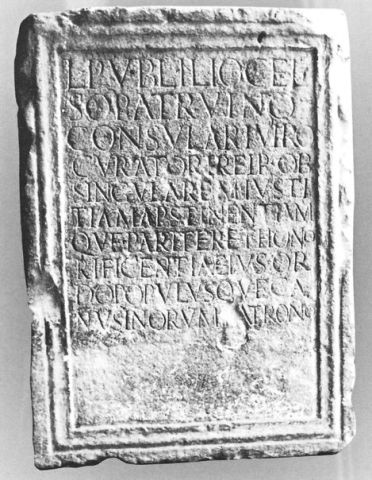
Inscription
L(ucio) Publilio Cel/so Patruino, / consulari viro, / curatori rei p(ublicae), ob /(5) singularem iusti/tiam apstinentiam/que (sic, for ‘abstinentiamque’) pariter et hono/rificentia(m) / eius, or/do populusque Ca/nusinorum patrono.
Inscription translation
To Lucius Publilius Celsus Patruinus, of consular rank, curator of the city (res publica), on account of his unequalled justice and integrity and honour; the council (ordo) and people of Canusium [set this up] to [their] patron.
Bibliography
- Corpus Inscriptionum Latinarum; , IX, 688
- Chelotti, M. et alii, Le Epigrafi Romane di Canosa, Bari 1990, I, App. I,7
- Silvestrini, M., Un itinerario epigrafico lungo la via Traiana. Aeca, Herdoniae, Canusium, Bari 1999, Ca 6
Discussion
INSCRIPTION
In ten lines. Letter height 5.3-4 cm.
L(ucio) Publilio Cel/so Patruino, / consulari viro, / curatori rei p(ublicae), ob /(5) singularem iusti/tiam apstinentiam/que (sic, for ‘abstinentiamque’) pariter et hono/rificentia(m) / eius, or/do populusque Ca/nusinorum patrono.
'To Lucius Publilius Celsus Patruinus, of consular rank, curator of the city (res publica), on account of his unequalled justice and integrity and honour; the council (ordo) and people of Canusium [set this up] to [their] patron.'
DESCRIPTION
Plaque from limestone base, 98 x 70 x 20 cm. The epigraphic field measures 80 x 54 cm. It is framed by moulding, damaged on the right side.
PROVENANCE AND CURRENT LOCATION
Our base was found in Ordona, at località Santa Felicità. It should be noted, however, that it is a dedication by the city of Canusium, and it is possible that the base was moved there at a later date, for re-use. It is now in Cerignola, in the cortile del Palazzo Cirillo (già Coccia), corso Garibaldi, n. 41.
HONORAND, AWARDER AND DATE
The base records a decication to Lucius Publilius Celsus Patruinus, a man of consular rank, curator and patron of Canusium. Patruinus is usually dated to the second half of the third century, but we cannot be certain of this. Curatores of senatorial rank were still appointed by the central government during the reigns of Diocletian and Constantine (Jones 1964, 726). Furthermore, the fact hat he was a patron indicates that he had strong links with the city of Canusium, and we should not rule out the possibility that he was chosen locally because of these links (possibly a property) in the area. The adjectives with which he is praised would fit a fourth century dedication, and for this reason we have to consider the possibility of an honour awarded in the first half of the fourth century, when such decisions by local councils were still common.
The statue was awarded by the councilors and people of Canusium.
Discussion references
- Jones, A. H. M., The Later Roman Empire, 2 vols., Oxford 1964
Cite: Last Statues of Antiquity, LSA-1712 (Carlos Machado).