
LSA-172
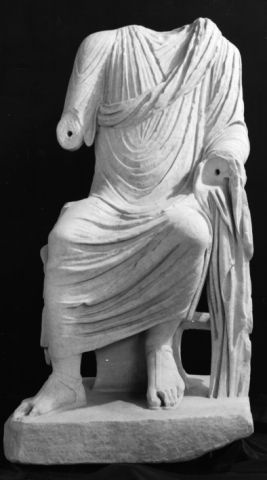
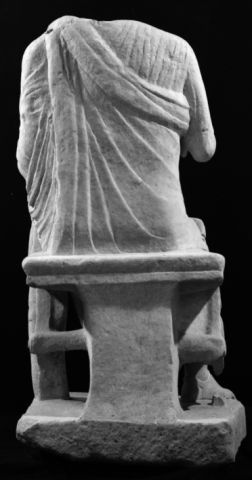
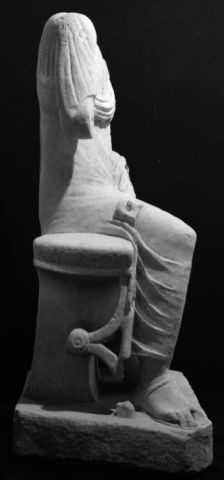
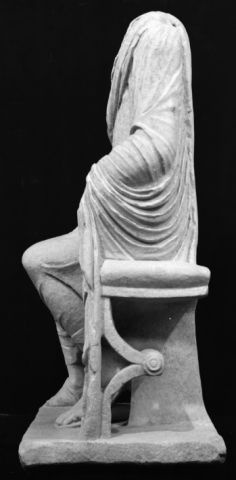
Headless portrait statue of seated man wearing himation. From Aphrodisias (Caria). Fourth to sixth century.
Record details
Photographs
Bibliography
- Smith, R.R.R., "A Late Roman Portrait and a Himation Statue from Aphrodisias" in H. Friesinger and F. Krinzinger (eds.), 100 Jahre Österreichische Forschungen in Ephesos: Akten des Symposions Wien 1995, Vienna 1999, 716-719, pl. 187.1
- Smith, R.R.R., “Archaeological Research at Aphrodisias 1989-1992” Aphrodisias Papers 3. The setting and quarries, mythological and other sculptural decoration, architectural development, Portico of Tiberius and tetrapylon (JRA Supplementary Series 20), Ann Arbor 1996, 13-16, fig. 4
- Smith, R.R.R., "Statue life in the Hadrianic Baths at Aphrodisias, AD 100-600: Local context and historical meaning", in F.A. Bauer, C. Witschel (eds.), Statuen und Statuensammlungen in der Spätantike - Funktion und Kontext (Spätantike, Frühes Christentum, Byzanz: Kunst im ersten Jahrtausend), Wiesbaden 2007, 229, no. A 44
Discussion
DESCRIPTION (Object)
Headless Life-size statue. H: 143, W: 71.5, D: 59. Plinth H: 13 cm. Large grained white marble.
Statue made in one piece with broad and deep plinth. The head, right forearm with hand, and left wrist with hand were added separately with dowels. All were possibly part of a re-use. They are missing.
The carving of the figure is awkward and flat. The back is only schematically worked. A strut near the right thigh seems to have broken and then have been drilled through to receive a dowel.
PROVENANCE
Found in 1989 at the western end of the pool in the South Agora. It was found with several heads (for example, LSA-168, LSA-173, LSA-182).
DESCRIPTION (Subject)
The statue shows a seated man with the right foot placed forward and the left foot drawn back against his chair. Both arms are lowered. The right forearm projected forward away from the body.
The chair has a central, blocky support, no back, and two front legs. The two front legs are connected to the central block by horizontal bars of marble. The legs themselves consist of a central knob or hinge which connects two curving braces. No back legs of the chair have been rendered.
The figure wears a himation, a short-sleeved chiton, and Greek sandals. The upper edge of the himation crosses the body in loose roll from the right armpit to the left shoulder. The excess material is wrapped around the left arm and falls from the arm to the plinth. The edge of the sleeve of the chiton is visible on the right upper arm. The chiton does not appear near the feet.
DATE
The statue recalls two other statues that represent traditional Greek costume but in an awkward and disproportionate fashion , LSA-215 and LSA-218. Both of those statues would seem to have a date in the fourth century when the connection with tradition was strong but a period of limited manufacture yielded less virtuoso products.
This statue however has been repaired and was probably re-used after its original fourth century date. The broken strut with a dowel hole on the outer right thigh shows that the right arm was originally worked with the statue. There would have been no reason to have separately worked the left hand either given its location and the size of the block used. The shallow concave area cut for the reception of the head suggests an after-thought. Smith compared it to the shallow cutting for the neck in the re-used statue of Stephanus in Ephesus LSA-698. The excavators initially thought that the head LSA-173, from the later fifth or early sixth century, found next to the statue was the later addition. The difficulty with the reconstruction is that the neck of the head preserves no ancient dowel hole.
HONORAND
The significant size of this seated statue and the distinctly Greek dress suggest a local man of importance. The re-use of the statue moreover would indicate a date after the sculptural flourish of the fifth century. Bases for local men of the late fifth and more probably sixth century abound in the area: see, Hermias LSA-192,, Rhodopaeus LSA-188 and LSA-194, or Albinus LSA-232 who ‘built’ the west stoa.
Cite: Last Statues of Antiquity, LSA-172 (J. Lenaghan).