
LSA-1721
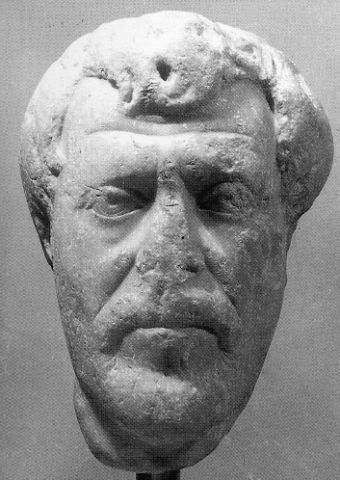
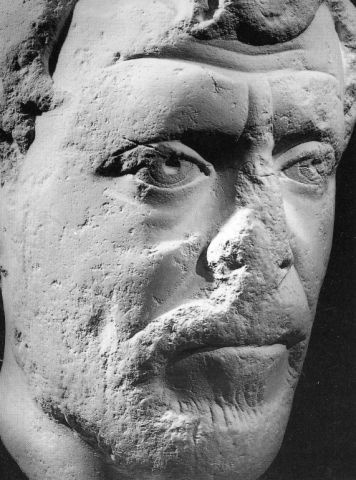
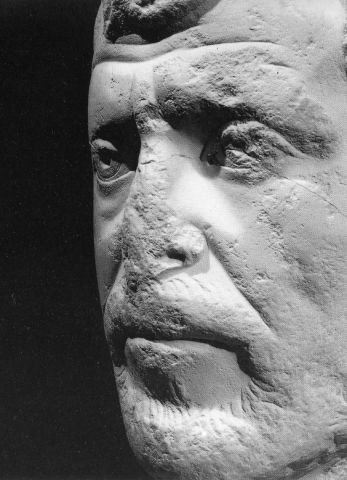
Portrait head of older man with beard and hair receding at temples. From East? Late fourth to early fifth century.
Record details
Photographs
Bibliography
- Oberleitner, W. 'Ein Porträtkopf des 5. (2.) Jahrhunderts n. Chr. in der Wiener Antikensammlung', Festschrift für Jale İnan, Istanbul 1989, 185-9, pl. 79, figs. 1-4 and pls. 80-81, figs. 7-9
Discussion
DESCRIPTION (Object)
Over life-size head. H: 28.8, W: 21.4, D: 21.2 cm. H (chin to crown): 20.9 cm. Medium- to large-grained white sparkling marble.
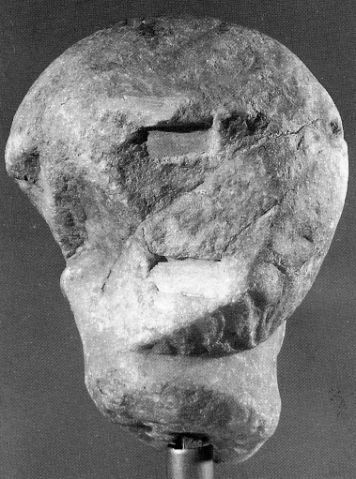
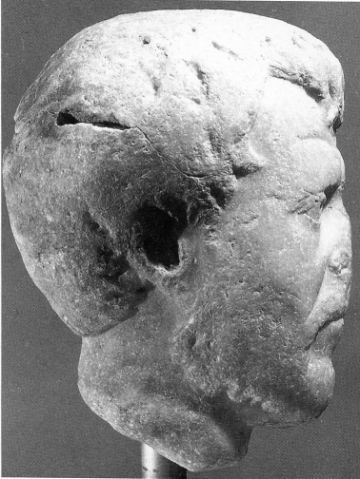
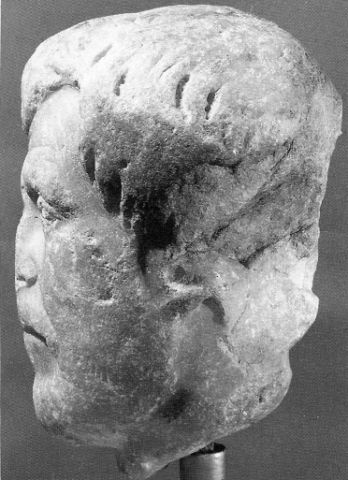
The head is broken through the middle of the neck. More of the neck is preserved on the proper right side. A section on the proper left side of the back of the head has broken off; this includes most of the left ear. Two rectangular cuttings exist in the back of the head next to the broken surface for a large clamp (which possibly fastened the head to a wall). These have been filled with plaster in the modern era. The details of the hair and beard are worn as is the right ear.
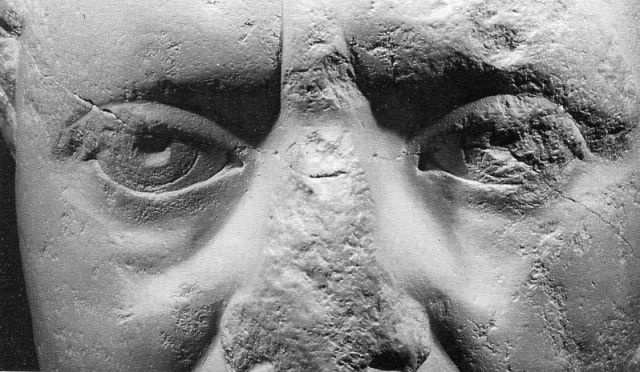
The irises are marked by semi-circular lines of a fine flat chisel that touch the upper lids but not the lower lids. The pupils are deeply drilled holes that touch the upper lids. Some of the hair of the beard and moustache was rendered with a flat chisel. In the hair on the head there are still some traces of deep drill channels, especially over the centre of the brow and between the locks in front and above the ears.
The head has been re-cut from a pre-existing portrait. The beard has been worked down. The hair, also, has been worked down. It is asymmetrical in volume. It is thicker on the left side. Moreover, a variety of deep drill channels remain that attest a thicker hairstyle with more articulation of locks. An especially deep drill hole remains between the two locks at the centre of the brow. At the nape, original, fully defined locks are still visible. The rim of the right ear, though worn, seems to merge into the hair which probably once completely covered it. The inner corner of the left eye has been extended downwards so that the eye ends in a square shape. The upper lid of the right eye has been enlarged so that its defining upper line merges with the eyebrow. According to Oberleitner (p. 185) also the cheeks have been thinned and that here too the right has less volume.
PROVENANCE
Purchased in 1982 by the Antikensammlung des Kunsthistorischen Museums Wien at Sothebys. Allegedly from an old Austrian collection. All of the cited parallels (see below) are from Asia Minor and have led Oberleitner to postulate an eastern provenance.
DESCRIPTION (Subject)
The head depicts mature man with thick hair and a beard, both of which have been cut back from fuller styles. The current asymmetries of the hair and the face are assuredly due to an imprecise re-cutting.
Although little surface detail of the hair on the head is preserved or was ever rendered in its second use, it has significant volume (it is almost helmet-like) and two deeply receding areas at the temples. The hair was cut high on the nape of the neck and fell naturally forward and down around the ears which were originally in part covered. In front of the right ear the ends of hair turn up toward the brow whereas in front of the left ear, the ends fall downward. The beard hair, like that of the head, has mainly lost all surface detail as the result of deliberate thinning. Nonetheless it continues well under the chin and covers most of the cheeks. Around the mouth it grows off the skin in engraved straggly strands. The moustache was also full and still completely conceals the upper lip.
The face is long, an effect which is accentuated by the beard and by a tall brow. The brow is traversed by two creases. Two vertical lines rise from the root of the nose. The eyes have emphatic pupils and are set under downward-sloping brows. The inner corner of the left eye and the right upper lid have been enlarged. The skin below the eyes is modelled and hangs loosely. The naso-labial folds are deep.
IDENTIFICATION AND DATE
The head has been used twice. The second usage was assuredly for a private individual, as was probably also its first use. Traces of deeply-drilled, full hair and a copious beard suggest a late second or early third century date for the original portrait. The rather simple but clear markings in the eyes seem also to belong to this date.
The original Antonine or Severan head has been re-carved to show a man with a shorter but still full beard and a brushed forward hairstyle. This suggests a second use after the middle of the fourth century. This fashion style is represented on the Obelisk of Theodosius. Many male portrait heads of the fourth or early fifth century show a similar hair and beard fashion and have been re-carved from second or third century portraits. These include LSA-161, LSA-200, LSA-540, LSA-692, LSA-704, and LSA-1707.
Cite: Last Statues of Antiquity, LSA-1721 (J. Lenaghan).