
LSA-173
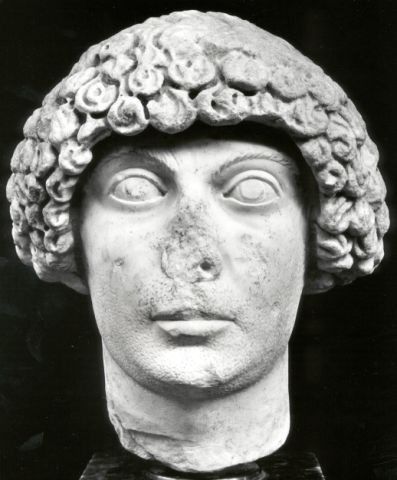
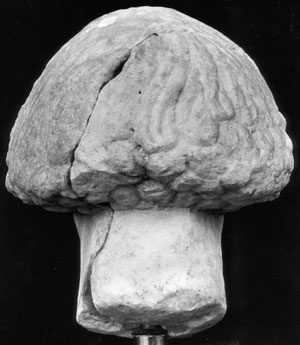
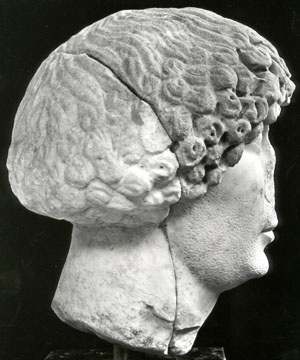
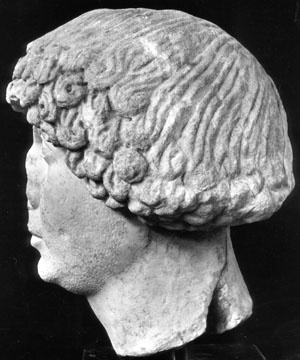
Separately worked portrait head with stubble beard and undercut 'mop' hairstyle. From Aphrodisias (Caria). Late fifth to earlier sixth century.
Record details
Photographs
Bibliography
- Smith, R.R.R., "A Late Roman Portrait and a Himation Statue from Aphrodisias" in H. Friesinger and F. Krinzinger (eds.), 100 Jahre Österreichische Forschungen in Ephesos: Akten des Symposions Wien 1995, Vienna 1999, 714-716
- Smith, R.R.R., “Archaeological Research at Aphrodisias 1989-1992” Aphrodisias Papers 3. The setting and quarries, mythological and other sculptural decoration, architectural development, Portico of Tiberius and tetrapylon (JRA Supplementary Series 20), Ann Arbor 1996, 13-16
- Smith, R.R.R., "Statue life in the Hadrianic Baths at Aphrodisias, AD 100-600: Local context and historical meaning", in F.A. Bauer, C. Witschel (eds.), Statuen und Statuensammlungen in der Spätantike - Funktion und Kontext (Spätantike, Frühes Christentum, Byzanz: Kunst im ersten Jahrtausend), Wiesbaden 2007, 229, no. A. 43
- Smith, R.R.R. 'Late antique portraits in a public context: Honorific statuary at Aphrodisias in Caria, AD 300-600' , Journal of Roman Studies, 89 (1999), 155-89, 183-185
Discussion
DESCRIPTION (Object)
Separately-worked Head. H: 31 cm. White marble.
The head is preserved in two pieces (essentially front and back) with its neck. The nose is broken. The head was clearly worked separately but there is no trace of a dowel. The bottom surface of the neck is convex and must have been placed into shallow socket on a statue.
The hair is deeply drilled off the brow. Around the face some of the curly locks are also deeply drilled, and the curls are connected by ‘bridges’ over the drill channels. At the back and sides of the head, the hair is indicated more schematically. The beard and moustache are indicated by light marks of a small point chisel. In the eyes, the pupil and iris are rendered together as a large raised disc.
PROVENANCE
Found in 1989 at the western end of the pool in the South Agora. It was found with several heads (for example, LSA-168, LSA-182, LSA-184). It probably belonged with a statue on display in the west stoa of the South or in the forecourt of the Baths. It was once thought to go with the seated statue, LSA-173.
DESCRIPTION (Subject)
The head represents an adult male with a thick, tightly curled, ‘mop’ hairstyle and a light stubble beard and moustache. The face is unlined and has regular, immobile, features: arching, rope-like eyebrows, wide open eyes, and full lips. The neck is columnar, and the head faces forward.
DATE
The hairstyle and eye technique are close to that of Flavius Palmatus, LSA-198, who can be dated by his base to the late fifth or early sixth century. Two other portraits from Aphrodisias also show the same disc eyes and mop hairstyle; see LSA-177, and LSA-219. There are also similar examples from Ephesus, LSA-697, and Laodiceia, LSA-385, (which however does not have disc eyes).
Cite: Last Statues of Antiquity, LSA-173 (J. Lenaghan).