
LSA-174
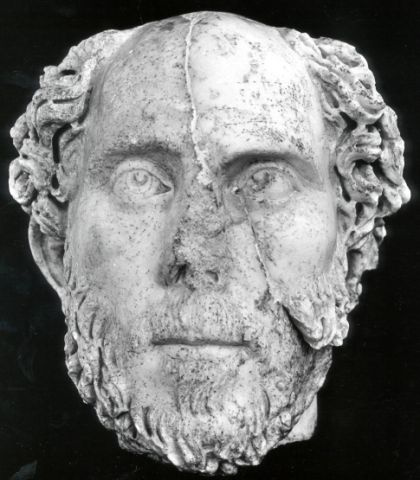
Portrait head of man with squinting left eye. Aphrodisias (Caria). Fifth century.
Record details
Photographs
Bibliography
- Inan, J. & E. Alföldi-Rosenbaum, Römische und frühbyzantinische Porträ̈tplastik aus der Türkei : neue Funde, Mainz 1979, no. 203
- Smith, R.R.R., "Statue life in the Hadrianic Baths at Aphrodisias, AD 100-600: Local context and historical meaning", in F.A. Bauer, C. Witschel (eds.), Statuen und Statuensammlungen in der Spätantike - Funktion und Kontext (Spätantike, Frühes Christentum, Byzanz: Kunst im ersten Jahrtausend), Wiesbaden 2007, 229, no. A 39, fig. 32
Discussion
DESCRIPTION (Object)
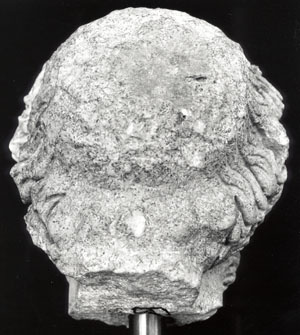
Life-size head broken from statue. H: 26, W: 25, D: 21. Diameter at break is 15 cm. Diameter of neck is 10 cm, plus 5 cm of neck pillar. Fine-grained white marble.
The head is broken through the neck and the neck pillar. It has been restored from two fragments. The crack between the fragments runs from the centre of the brow to the bottom of the left cheek where it ends in a small area of chipped surface. The rim of the left ear is chipped. There are traces of red paint in the hair around the ears and in the beard. The neck and brow preserve traces of a high polish.
The head was worked in one piece with its statue and supported by a neck pillar. The back of the top of the head was never fully finished; it is only roughly picked.
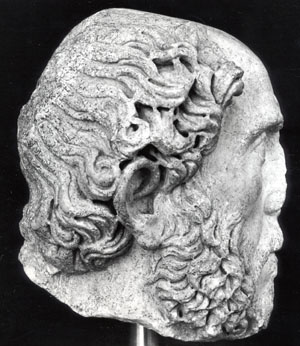
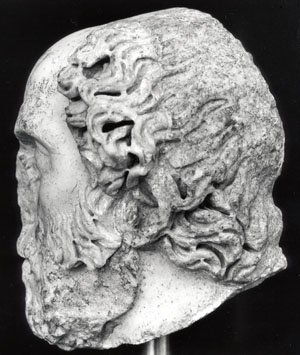
The hair, in front and behind the ears as well as over the brow, and the beard have been given definition, movement, and depth by the use of the drill. Drill channels define strands within the locks and separate the locks. Many bridges over the drill channels (small bars of marble) were never removed. These bridges are especially fine and small in the beard hair. A fine flat chisel was used to define the hair of the eyebrows, moustache, and beard immediately below the lower lip. The eyebrows are rendered on a raised and modelled surface. The circle of the iris was also created with a flat chisel. The iris is a scooped out area with a flat bottom in the shape of a crescent.
PROVENANCE
The smaller fragment which preserves the left eye was found initially by Gaudin in 1904 in the west stoa of South Agora. It was re-discovered by K. Erim in 1967. The larger fragment of the head, preserving the right side, was found in 1984 in the west stoa of the South Agora.
DESCRIPTION (Subject)
The portrait is a high quality work that was made in one piece with a statue. This is indicated by the neck pillar. It shows a balding man whose tall smooth brow has veins and whose left eye squints.
Although the hair recedes markedly over the centre of the brow, it is elsewhere full and curly. It is combed forward from the crown of the head in long locks which gain in volume around the face, creating a ‘wreath-style.’ The locks curl around but do not cover the ears.
The beard is full, again curly, and long, though trimmed under the chin. The moustache, in contrast, is made of fine straight hairs. Most distinctively the hair under the lower lip and above the beard on the chin forms four short tufts.
The tall balding brow features four finely engraved creases and a bulge above the eyebrows. It has an unusual feature of three veins. One moves vertically from the brow towards the outer corner of the right eye. It is a defined slightly raised band that is carved into a depression in the skull. A similar, but smaller vertical vein is visible above the left eye. Another horizontal one appears at the temple and runs toward the outer corner of the left eye.
The eyes are deeply set beneath bushy bulging eyebrows. The have a high arching upper lid and a triangular inner canthus, and there are fine wrinkles at the outer corners of both eyes. The markings of the eyes are unusual. The iris of the left eye is set close to the inner corner, and the crescent-shaped pupil is carved obliquely to the surface of the eyeball.
The cheekbones are pronounced, and the cheeks are sunken. On the right side the naso-labial fold as well as a deep crease runs from the inner corner of the eye to the outside of the middle of the cheek is defined. The nose is short, and the maxilla and mandible both project, giving the face a firmly set mouth. The mouth itself is wide with a full lower lip.
HONORAND
The honorand is unknown. His hairstyle follows a trend, the ‘wreath’ that becomes dominant in the fifth century. His particular beard, the bulging lower brow, deep-set eyes, and the detail of the veins pulsing in the forehead seem to follow the time-honoured iconography of thinkers. The squint eye is an emphatically personal detail.
DATE
The date is based mainly on fashion; the wreath hairstyle first appears in portraiture of the fifth century. The emphatic U-shaped drilling out of the iris/pupil area is a late-antique technique which, however, cannot be specifically dated.
Discussion references
- Smith, R.R.R. 'Late antique portraits in a public context: Honorific statuary at Aphrodisias in Caria, AD 300-600' , Journal of Roman Studies, 89 (1999), 155-89, pl. 9
Cite: Last Statues of Antiquity, LSA-174 (J. Lenaghan).