
LSA-1743
Base for statue of Constantine I, emperor. Mactaris (Byzacena). 306-310
Record details
Photographs
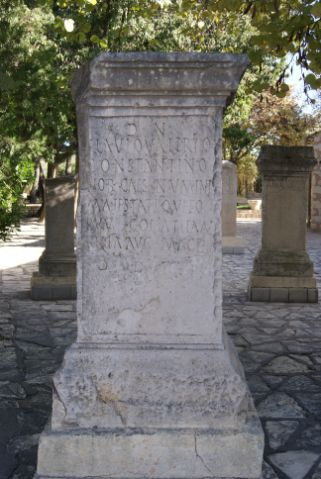
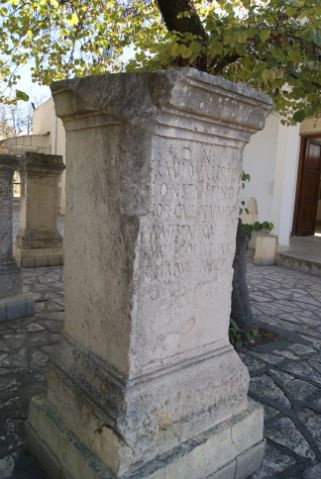
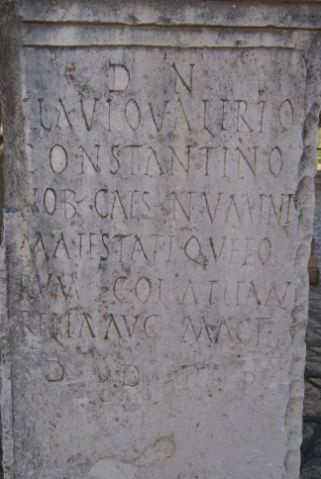
Inscription
D(omino) n(ostro), / Flavio Valerio / Constantino, / nob(ilissimo) Caes(ari), numini / (5) maiestatique eo/rum (sic), col(onia) Aelia Au/relia Aug(usta) Mact(aris), / d(ecreto) d(ecurionum), p(ecunia) p(ublica).
Inscription translation
To our lord Flavius Valerius Constantinus, the most noble Caesar, [and] to their divine spirit and majesty. The colony Aelia Aurelia Augusta Mactaris [set this up] by decree of the councillors, with public funds.
Bibliography
- Corpus Inscriptionum Latinarum; , VIII, 11804
Discussion
INSCRIPTION
In eight lines:
D(omino) n(ostro), / Flavio Valerio / Constantino, / nob(ilissimo) Caes(ari), numini / (5) maiestatique eo/rum (sic), col(onia) Aelia Au/relia Aug(usta) Mact(aris), / d(ecreto) d(ecurionum), p(ecunia) p(ublica).
'To our lord Flavius Valerius Constantinus, the most noble Caesar, [and] to their divine spirit and majesty. The colony Aelia Aurelia Augusta Mactaris [set this up] by decree of the councillors, with public funds.'
For the anomalous use of 'their (eorum)' in lines 5-6, see 'Further Discussion' below.
Letter height: 8 cm.
DESCRIPTION
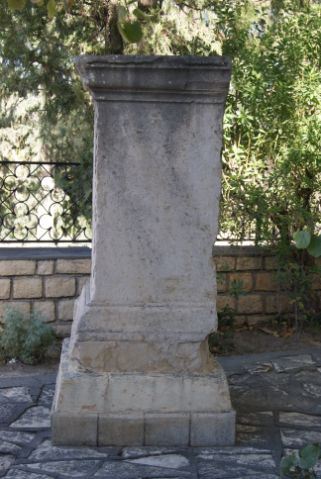
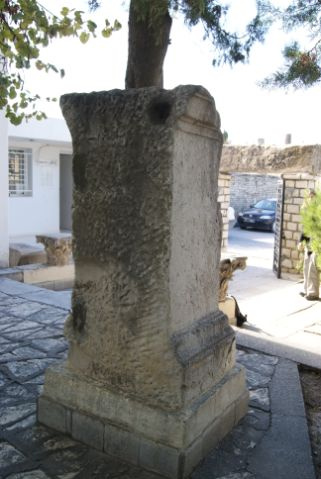
Rectangular base of limestone, with plinth and crown: H 138, W 74, D 66 cm. The upper surface has two holes in it for securing the statue, which was probably in bronze. The back, which is rough, has three holes in it. The base was intended to be placed against a wall.
PROVENANCE AND CURRENT LOCATION
The base was found in 1889 by Bordier, re-used in the walls of the Christian basilica of Rutilius, just north of the amphitheatre of Mactaris (http://www.trismegistos.org/place/17236). This, and other imperial statue bases, were used in the foundations of what was apparently the apse of the church (N. Duval, 1985, 41). Picard dated its construction to the mid-4th century (Picard 1984, 27), but the presence of statue bases to Valens and Valentinian (LSA-1756 and LSA-1757) in its foundations rules this out. Duval provides a less precise, but more plausible, dating of 4th- or 5th-century (Duval 1985, 44), and suggests that it may have been the cathedral of Mactaris.
It is now in the Mactar museum.
HONORAND, AWARDER AND DATE
Although our honorand, Constantine, was proclaimed Augustus in York in 306, this claim was not universally recognized until 310. Before 310, outside his own areas of control, he was generally recognized only as a Caesar, as on our inscription (Kienast 1996, 298-9). The terminus post quem for our base is the recognition of Constantine as Caesar by Galerius in 306, and the terminus ante quem the usurpation of Domitius Alexander in 308. After this, Constantine would have been honoured as an Augustus in Africa, since Domitius Alexander recognized him as such. The most likely date for our base is 306-7, during the reign of Severus as Augustus (and effective ruler of Africa). Constantine served officially as Severus' Caesar (junior emperor), a circumstance that might well have led to a dedication to him in Africa.
The awarder was the city, as usual in Africa for imperial statues.
FURTHER DISCUSSION
The plural eorum (in lines 5-6) suggests that this base once formed part of a group of statues, erected to all the members of the imperial college. No evidence of the others has yet been found, but since our base was later re-used as building material (in the Christian basilica) it could very well have become separated from its companions.
Discussion references
- Bulletin archéologique du Comité des Travaux Historiques et Scientifiques, Paris, 1889, p. 362
- Duval N., Une hypothèse sur la basilique de Rutilius à Mactar et le temple qui l'a précédée. Etudes d' archéologie chrétienne nord-africaine, Revue des Etudes Augustiniennes, Paris, 1985, XXXI, n°1-2, p. 20-45
- Kienast, D., Römische Kaisertabelle : Grundzüge einer römischen Kaiserchronologie, Darmstadt, 1996, 298-9
- Lassère, J.-M., Manuel d'épigraphie romaine, Paris, 2005, p. 607
- Picard, G., "Le temple du musée à Mactar", Revue archéologique, Paris, 1984, p. 27
Cite: Last Statues of Antiquity, LSA-1743 (Gabriel de Bruyn).