
LSA-1746
Base for statue of benefactor (a major restorer of buildings), possibly a governor of Campania. Beneventum (Campania). Late third to fifth century.
Record details
Photographs
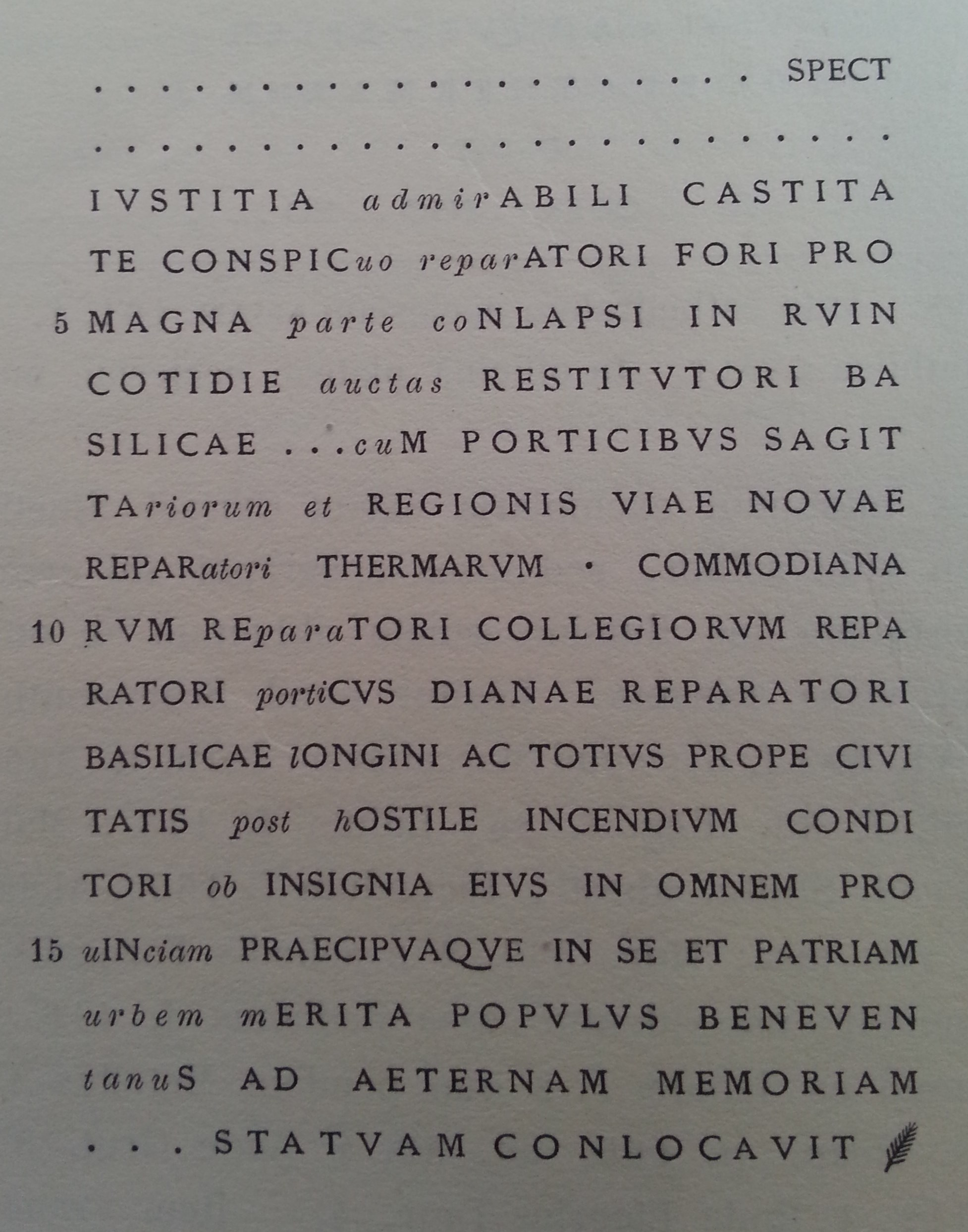
Inscription
[---] spect/[------]/ iustitia, [admir]abili castita/te, conspic[uo repar]atori fori pro / (5) magna [parte co]nlapsi in ruin(as), / cotidie [auctus] restitutori ba/silicae [--- cu]m porticibus Sagit/ta[riorum et] regionis viae novae, / (9) repar[atori] thermarum Commodiana/rum, re[para]tori collegiorum, repa/ratori [porti]cus Dianae, reparatori / (12) basilicae [L]ongini ac totius prope civi/tatis [post h]ostile incendium condi/tori, [ob] insignia eius in omnem pro/[v]in[ciam] praecipuaque in se et patriam /(16) [urbem m]erita, populus Beneven/[tanu]s ad aeternam memoriam / [---] statuam conlocavit.
Inscription translation
To (...) of spectabilis rank (?), of (...) justice, of admirable purity, conspicuous restorer of the forum in large part collapsed into ruins, every day (...) restorer of the basilica (…) with the porticoes of the Sagittarii and the region of the Via Nova, restorer of the baths of Commodus, restorer of the guilds, restorer of the portico of Diana, restorer of the basilica of Longinus and founder of almost the whole city after a hostile fire; on account of his remarkable and outstanding services towards the whole province and particularly towards themselves and his native city, the people of Beneventum placed [this] statue for the eternal memory (…)
Bibliography
- Corpus Inscriptionum Latinarum; , IX, 1596
- Dessau, H., Inscriptiones latinae selectae, Berlin 3rd ed. 1962, 5511
- Torelli, M. R., Benevento Romana, Rome 2002, pp. 259-261, 288 sg., 301
Discussion
INSCRIPTION
In 18 lines:
[--- viro (?)] spect/[abili (?) ------]/ iustitia, [admir]abili castita/te, conspic[uo repar]atori fori pro / (5) magna [parte co]nlapsi in ruin(as), / cotidie [----] restitutori ba/silicae [--- cu]m porticibus Sagit/ta[riorum et] regionis viae novae, / (9) repar[atori] thermarum Commodiana/rum, re[para]tori collegiorum, repa/ratori [porti]cus Dianae, reparatori / (12) basilicae [L]ongini ac totius prope civi/tatis [post h]ostile incendium condi/tori, [ob] insignia eius in omnem pro/[v]in[ciam] praecipuaque in se et patriam /(16) [urbem m]erita, populus Beneven/[tanu]s ad aeternam memoriam / [---] statuam conlocavit.
’To (...) of spectabilis rank (?), of (...) justice, of admirable purity, conspicuous restorer of the forum in large part collapsed into ruins, every day (...) restorer of the basilica (…) with the porticoes of the Sagittarii and the region of the Via Nova, restorer of the baths of Commodus, restorer of the guilds, restorer of the portico of Diana, restorer of the basilica of Longinus and founder of almost the whole city after a hostile fire; on account of his remarkable and outstanding services towards the whole province and particularly towards themselves and his native city, the people of Beneventum placed [this] statue for the eternal memory (…)’.
Letter height 2.5 - 3.5 cm.
We reproduce the inscription with completions suggested by Epigraphic Database Roma (EDR).
DESCRIPTION (from EDR)
Rectangular marble statue base, H 167, W 60, D 55 cm. The left lateral face is damaged; there is a sacrificial bowl (patera) carved on the right face (from viewer). This suggests an original use as a funerary or votive altar. There is no published image.
PROVENANCE AND CURRENT LOCATION
The inscription was first recorded in the late 17th century in a workshop in the vicinity of the church of Santa Maria di Costantinopoli, then church of the Holy Spirit, in Benevento, ancient Beneventum, by the local scholars Iordanes de Nicastro and Marinus Verusius.
The inscription is now in Benevento, built into the house at Corso Garibaldi 167, to the right of the entrance.
HONORAND, AWARDER AND DATE
The name and title of the honorand are lost on our inscription. He was apparently a native of Beneventum (line 15-16: in se et patriam urbem. He is celebrated for his justice and purity (lines 3-4), and extensively for his building activities (lines 4-13) which he conducted after a devastating fire (post hostile incendium, line 13). Both, justice and purity are virtues constantly associated with high ranking imperial office holders, most notably provincial governors, in late antiquity. Building activities in the cities fell also into the competence of these office holders; last, but not least, the record of our honorand’s benefactions for the entire province (in omnem provinciam, lines 14-15) suggest that he was a provincial governor (PLRE I, 1016 Anonymus 65). spect in line 1 possibly records a spectabilis rank, the second of the three senatorial rank classes. If so, this would suggest a date in the late 4th or 5th century, when the provincial governorship of Campania was upgraded to this rank (for inscriptions where this rank predicate is spelled out, see LSA-2057 and LSA-2451). However, a date later than the mid-5th century, though not impossible, is highly unlikely, since the statue habit in southern Italy had apparently disappeared by then..
The record of the entire province (see last paragraph) secures a late antique date for our inscription, after the peninsula was split into provinces in the wake of the tetrarchic reforms, probably in the 290s (Chastagnol 1982, 170). Unfortunately, the name of the province to which Beneventum belonged at the time when the inscription was set up is not recorded (Beneventum belonged to Samnium before 333, and to Campania after that date; Torelli 2002, 249-53)
The inscription was set up by the people (populus) of Beneventum (line 16).
Discussion references
- Chastagnol, A., La carrière sénatoriale du Bas-Empire depuis Diocletien, Epigrafia e ordine senatorio, 1. Atti del Colloquio intenazionale AIEGL, Roma 14 - 20 maggio 1981, pp. 167-92, Roma 1982, 170
- Jones, A. H. M. et al., The Prosopography of the Later Roman Empire. Vol. I 260-395, Cambridge et al. 1971 (1975), 1016 Anonymus 65
Cite: Last Statues of Antiquity, LSA-1746 (discussion added 3/15 (UG)).