
LSA-1748
Base for statue of Vesedius Rufinus, advocatus fisci and patron of city and corporations. Beneventum (Campania). Later third to fourth century.
Record details
Photographs
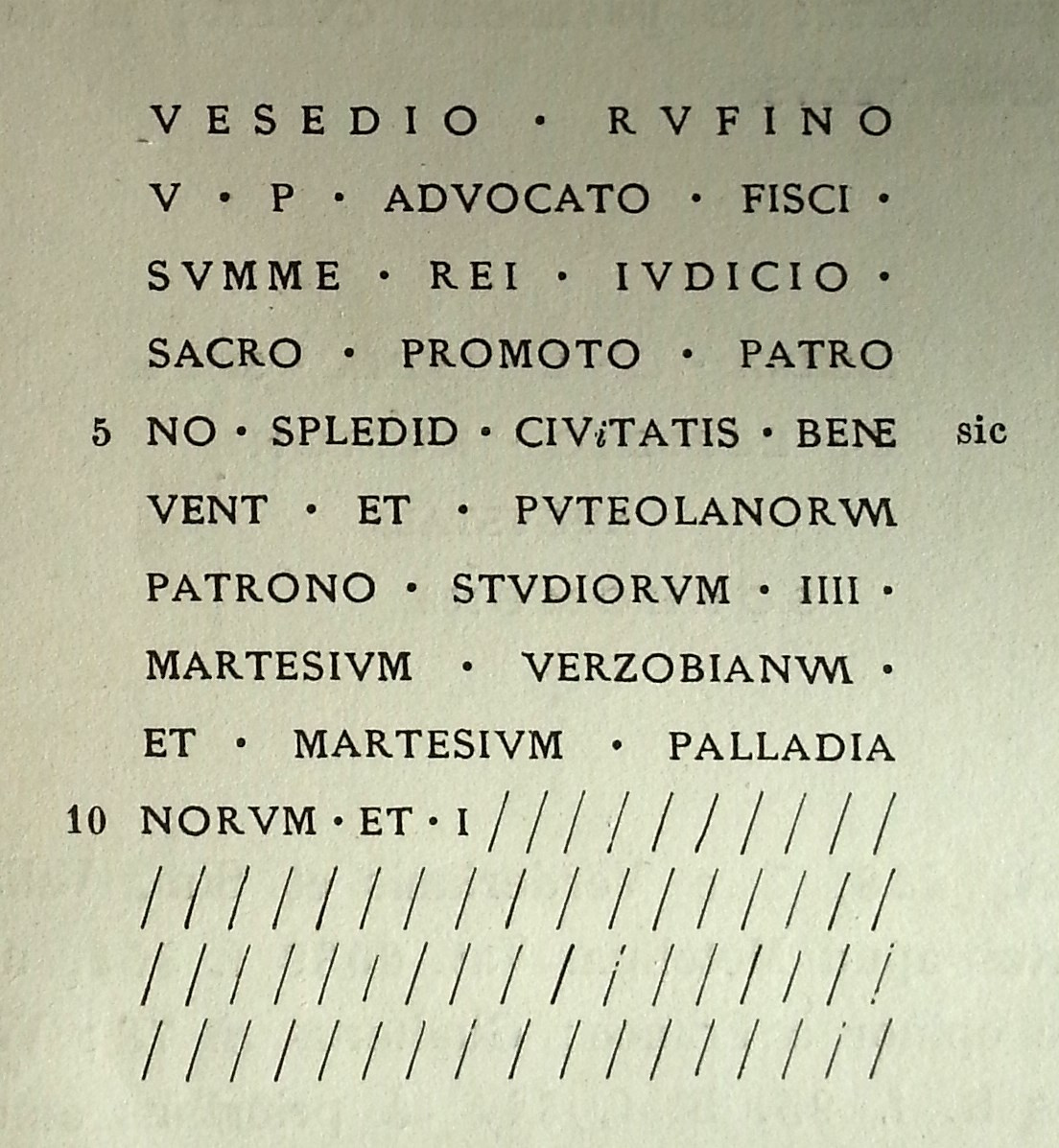
Inscription
Vesedio Rufino, / v(iro) p(erfectissimo), advocato fisci / summ(a)e rei iudicio /(4) sacro promoto, patro/no sple(n)did(issimo) civ[i]tatis Bene/vent(anorum) et Puteolanorum, / patrono studiorum IIII / Martesium Verzobianum / (9) et Martesium Palladia/norum et I[---].
Inscription translation
To Vesedius Rufinus, of perfectissimus rank, advocate of the imperial fisc (advocatus fisci summae rei) promoted by imperial decision, most splendid patron of the citys of Beneventum and Puteoli, patron of the four guilds of the Martesium Verzobianum, the Martesium Palladianorum…
Bibliography
- Corpus Inscriptionum Latinarum; , IX, 1682
- Dessau, H., Inscriptiones latinae selectae, Berlin 3rd ed. 1962, 6502
Discussion
INSCRIPTION
Partly preserved in ten lines:
Vesedio Rufino, / v(iro) p(erfectissimo), advocato fisci / summ(a)e rei iudicio /(4) sacro promoto, patro/no sple(n)did(issimo) civ[i]tatis Bene/vent(anorum) et Puteolanorum, / patrono studiorum IIII / Martesium Verzobianum / (9) et Martesium Palladia/norum et I[---].
’To Vesedius Rufinus, of perfectissimus rank, advocate of the imperial fisc (advocatus fisci summae rei) promoted by imperial decision, most splendid patron of the cities of Beneventum and Puteoli, patron of the four guilds of the Martesies Verzobianes, the Martesies Palladiani, the (…).’
Letter height not recorded.
DESCRIPTION (from CIL)
CIL, the only modern publisher of the inscription so far, gives no description of the block. No measurements are published, and there is no published image.
PROVENANCE AND CURRENT LOCATION
The inscription was first recorded in Benevento, ancient Beneventum, in the late 17th/ early 18th century by the local antiquarian and scholar Marinus Verusius (Beneventi prope porticum Rotundorum). At roughly the same period it was recorded in a private house by the local scholar and nobleman Iordanes de Nicastro (presso la casa di Capobianchi, che fu degli Mascanbruni). In this same location it was seen by the later archbishop of Benevento Francesco Pacca around the middle of the 18th century. Likewise in a private house, it was recorded by the clergyman and scholar Johannes de Vita around the middle of the 18th century (in atrio aedium de Vitae).
There is no recent record of its location.
HONORAND, AWARDER AND DATE
Vesedius Rufinus, the honorand, was of equestrian (perfectissimus) rank. He was a local man, as is evident from a further statue base to him in Benevento (LSA-1749). He held the office of advocate of the imperial fisc, to which he was promoted by imperial decision (lines 2-4); this office could be the entry into a career in the imperial office (see the long career of Caius Caelius Saturninus, LSA-1266, which started with such an office). Vesedius Rufinus was patron of the cities of Beneventum and Puteoli (lines 6-7), and of a group of four corporations (studiorum IIII, line 7). The character of these studia is not clear; they were possibly of religious character, or they were funerary colleges (corporations are often called studia in Beneventum, see CIL IX, 1663, 1681-3).
The awarder is lost on our inscription; the dedication was possibly a cooperation of Vesedius‘ clients recorded in our inscription.
Dates in the late 3rd (PLRE; Ausbüttel 1988, 54) or in 4th century (PIR III, 407 V 295; Torelli 2002, 270) have been suggested for our inscription. The office of advocatus fisci was integrated into the equestrian career after Gallienus (Pflaum 1960, 940); this suggests a rough terminus post quem in the mid-later 3rd century. Local notables boasted of their perfectissimus rank still in the later 4th century; I can see no hint in the inscription that could suggest a narrower date.
Discussion references
- Prosopographia imperii romani saec. I. II. III, Berlin & Leipzig 1933-, III, 407 V 295
- Ausbüttel, F.M., Die Verwaltung der Städte und Provinzen im spätantiken Italien, Frankfurt/ Main 1988, 54
- Jones, A. H. M. et al., The Prosopography of the Later Roman Empire. Vol. I 260-395, Cambridge et al. 1971 (1975), 781
- Pflaum, H. G., Les carrières procuratoriennes équestres sous le Haut-Empire romain. Vol. I, II, III, Paris 1960, p. 940
- Torelli, M. R., Benevento Romana, Rome 2002, 269-70
Cite: Last Statues of Antiquity, LSA-1748 (discussion added 3/15 (UG)).