
LSA-175
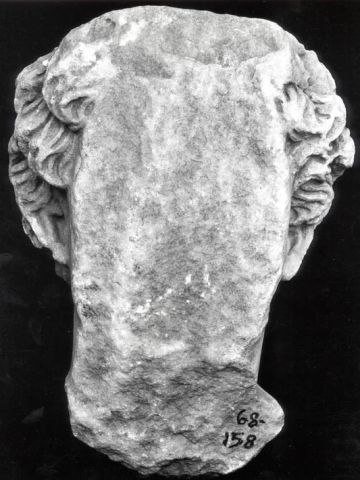
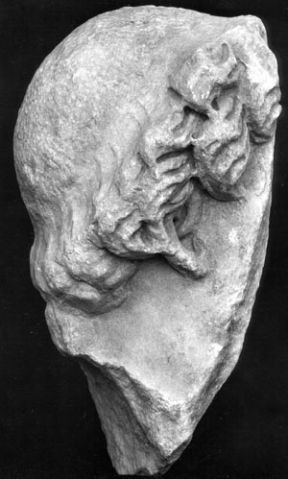
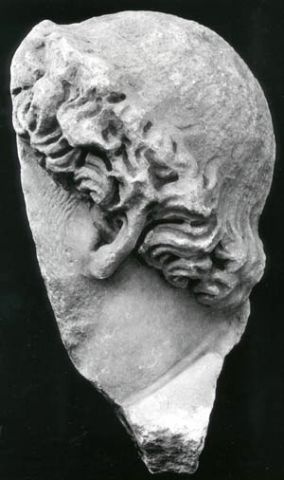
Back of male portrait head from statue wearing chlamys. Aphrodisias (Caria). Fifth century.
Record details
Photographs
Bibliography
- Inan, J. & E. Alföldi-Rosenbaum, Römische und frühbyzantinische Porträ̈tplastik aus der Türkei : neue Funde, Mainz 1979, no. 201
- Smith, R.R.R., "Statue life in the Hadrianic Baths at Aphrodisias, AD 100-600: Local context and historical meaning", in F.A. Bauer, C. Witschel (eds.), Statuen und Statuensammlungen in der Spätantike - Funktion und Kontext (Spätantike, Frühes Christentum, Byzanz: Kunst im ersten Jahrtausend), Wiesbaden 2007, 228 no. A 31
Discussion
DESCRIPTION (Object)
Head, missing face. H: 31, W: 22.3 cm. White marble.
The head is broken unevenly through the neck and in a backward slanting plane from the forehead down to the neck. A neck pillar is partially preserved as is a large fold on the proper left. These demonstrate that the head once belonged to a statue.
The hair is worked with a drill around the brow; there are small struts or ‘bridges’ over some of the drill channels. Above the brow, it is only summarily indicated by large parallel grooves of a flat chisel. Behind the ears it has not been drilled.
PROVENANCE
It was found in 1968 in room 3 of the Hadrianic Baths. This is the room south of the central hall.
DESCRIPTION (Subject)
The head was once part of statue which wore a chlamys. The large flat fold of drapery on the proper left side could only belong to that encompassing and concealing garment.
The hair forms a ‘wreath’ of full tousled locks around the head at the level of the ears. The ears are not entirely covered. A beard is engraved onto the cheeks.
DATE
The ‘wreath’ hairstyle with the short beard place this head best in the fifth century. A good parallel for this hairstyle and its technique, also from Aphrodisias, can be found on the statue of Pytheas (LSA-147 and LSA-148). Pytheas has been placed with good probability in the late fifth century.
One minor detail might suggest that this portrait slightly pre-dates that of Pytheas. At the back of the head, at the base of the skull, the hair here indents. This is more in the tradition of heads such LSA-178 and LSA-182 rather than the later mop styles of LSA-173 andLSA-199.
Cite: Last Statues of Antiquity, LSA-175 (J. Lenaghan).