
LSA-1750
Base for statue of Fabius Maximus, governor of Samnium and city patron. Allifae (Samnium). 352-357 .
Record details
Photographs
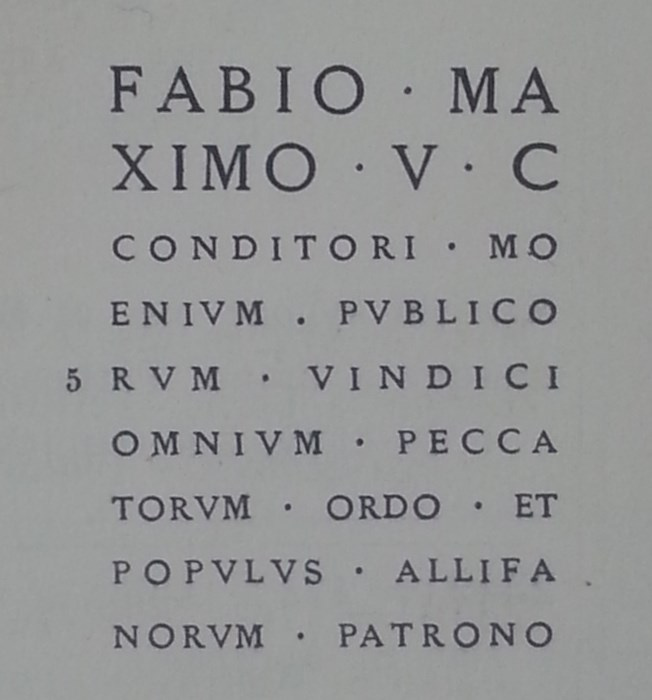
Inscription
Fabio Ma/ximo, v(iro) c(larissimo), / (3) conditori mo/enium publico/rum, vindici / (6) omnium pecca/torum, ordo et / populus Allifa/norum patrono.
Inscription translation
To Fabius Maximus, of clarissimus rank, founder of public buildings, protector against all transgressors; the council and people of Allifae [set this up] to their patron.
Bibliography
- Corpus Inscriptionum Latinarum; , IX, 2337
- Dessau, H., Inscriptiones latinae selectae, Berlin 3rd ed. 1962, 1247
Discussion
INSCRIPTION
In nine lines:
Fabio Ma/ximo, v(iro) c(larissimo), / (3) conditori mo/enium publico/rum, vindici / (6) omnium pecca/torum, ordo et / populus Allifa/norum patrono.
’To Fabius Maximus, of clarissimus rank, founder of public buildings, protector against all transgressors; the council and people of Allifae [set this up] to their patron.’
Letter height not recorded.
DESCRIPTION (from CIL)
CIL, the only modern publisher of the inscription so far, gives no description of the block. No measurements are published, and there is no published image.
PROVENANCE AND CURRENT LOCATION
The inscription was first recorded in the church of the S. Salvatore at Piedimonte Matese, in the vicinity of ancient Allifae (http://www.trismegistos.org/place/14443), in the mid-16th century by the bishop of Alifa, Antonius Augustinus. In the 18th century it was recorded in the church of S. Rocco in Piedimonte Matese by the clergyman and scholar Giovanni Francesco Trutta.
There is no recent record of its location; the inscription is now probably lost.
HONORAND, AWARDER AND DATE
Fabius Maximus, the honorand, was of clarissimus rank (PLRE I, 587 Fabius Maximus 35). He is praised in our inscription as founder of public buildings (conditori moenium publicorum, lines 3-5) and protector against all transgressors (vindici omnium peccatorum). The allusions to building activity and jurisdiction suggest that he was a provincial governor; the term conditor (line 3) probably refers to a new structure raised from the ground, not to repair works (see below, ’Further Discussion’, and LSA-1783). Fabius Maximus is known from more than 15 inscriptions in the province of Samnium, among them six probable statue bases (see below, ’Further Discussion’). Three inscriptions (but none of the statue base inscriptons) explicitly style him rector provinciae - ’provincial governor’ (CIL IX 2212, 2338, 2447). This is not an official title. The governor of Samnium was a praeses, and it cannot be completely excluded that Maximus was a governor of Campania to which a large portion of the later province of Samnium had earlier belonged. However, the distribution of Maximus’ inscriptions exclusively in the area of the province of Samnium, strongly supports the hypothesis that he was indeed a governor of the new province.
Maximus was also a patron of the city of Allifae (line 9).
The inscription was set up by the civic institutions of Allifae, the council (ordo, line 7) and the people (populus, line 8).
One of the statue bases to Maximus, LSA-1777 in Aesernia, has a consular date, if mutilated, on one of its lateral faces, which gives a date of 352/7 for Maximus‘ time in office in Samnium (see LSA-1777 for a more detailed discussion of the date).
FURTHER DISCUSSION
Fabius Maximus was apparently keen on public honours and statue honours. There are six statue bases to him in our records, all in the province of Samnium, and all with similar epigraphic formula (our inscription, LSA-1753, LSA-1754, LSA-1777, LSA-1783, LSA-2861). Maximus was also active in the (re-)dedication of statues as ornament of late antique cities, cf. LSA-1773 (Saepinum). Most (or all) of the other inscriptions recording his name (see above, ’Honorand, Awarder and Date’) are building inscriptions (CIL IX, 2212 (Telesia), 2338 (Allifae), 2447-8 and AE 1930, 120 (Saepinum), CIL IX 2640 (Aesernia), 2842-3 (Histonium) 2957 (Iuvanum), AE 1996, 475 (Bovianum Undecimanorum)).
It is a widely held view that the province of Samnium was established in response to heavy damage caused by the earthquake of 346, and that Maximus‘ building programme in the cities of Samnium was to repair this damage (Camodeca 1971). However, as Soricelli 2009 pointed out, the evidence of Maximus’ inscriptions rather suggests that the building programme he launched followed the need to establish an administrative and juridical infrastructure for the new province - only two of the inscriptions mention an earthquake (CIL IX, 2338 = EDR 105474 (Allifae) and AE 1972, 150 = EDR 075275 (Telesia)), while others refer to the old age of the collapsed buildings, or, like our inscription, to structures built from the ground. Moreover, archaeological evidence suggests that the earthquake of 346 had less impact in the region than previously thought (Galadini and Galli 2004). The political, administrative or economic considerations for the foundation of a new province in the mid-4th century should be re-considered.
Discussion references
- Camodeca, G., "Fabius Maximus e la creazione della provincia del Samnium", Atti dell'Accademia di Scienze Morali e Politiche di Napoli, 82, 1971, 249-64
- Galadini, F. and P. Galli, The 346 A.D. earthquake (Central-Southern Italy): an archaeoseismological approach, Annals of Geophysics, Vol. 47, N. 2/3, April/June 2004, 885-905
- Jones, A. H. M. et al., The Prosopography of the Later Roman Empire. Vol. I 260-395, Cambridge et al. 1971 (1975), 587
- Soricelli, G., La Provincia del Samnium e il Terremoto del 346 D.C., Interventi Imperiali in Campo Economico e Sociale, a cura di A. Storchi Marino e G. D. Merola, Bari 2009, 245-62
Cite: Last Statues of Antiquity, LSA-1750 (Carlos Machado and Ulrich Gehn; discussion added 3/15 (UG)).