
LSA-1751
Plaque from base for statue of empress Helena, mother of Constantine I. Saepinum (Samnium). 324-330, probably 324-325.
Record details
Photographs
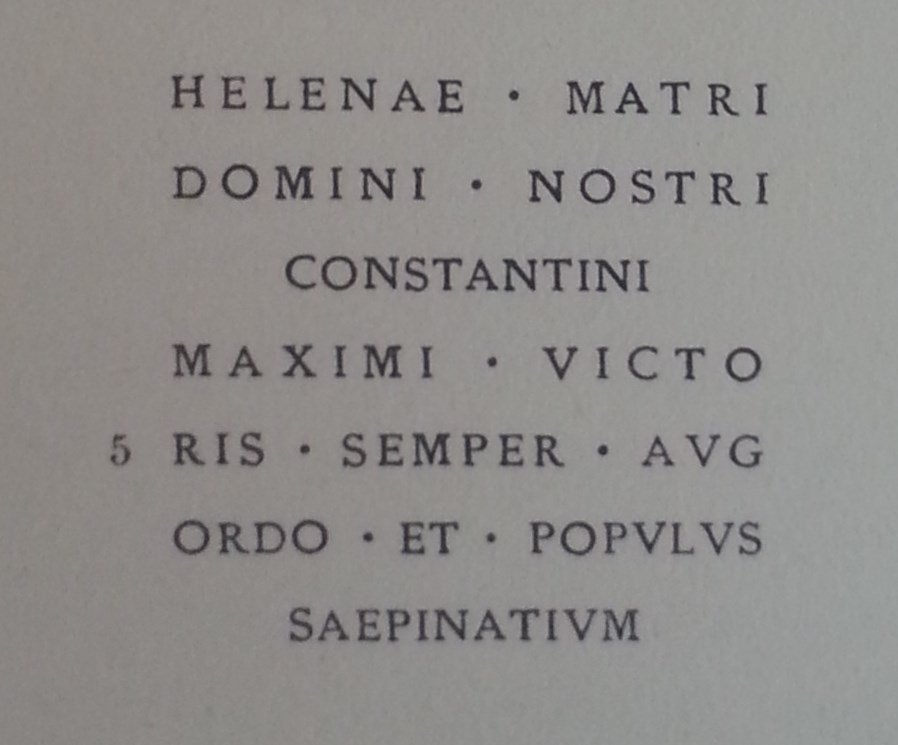
Inscription
Helenae, matri / domini nostri / Constantini /(4) maximi, victo/ris, semper Aug(usti), / ordo et populus / Saepinatium.
Inscription translation
To Helena, mother of our lord Constantinus the greatest, victor, forever Augustus; the council (ordo) and people of Saepinum [set this up].
Bibliography
- Corpus Inscriptionum Latinarum; , IX, 2446
Discussion
INSCRIPTION
In seven lines:
Helenae, matri / domini nostri / Constantini / (4) maximi, victo/ris, semper Aug(usti), / ordo et populus / Saepinatium.
’To Helena, mother of our lord Constantinus the greatest, victor, forever Augustus; the council (ordo) and people of Saepinum [set this up].’
Letter height 5 – 5.5 cm.
The epigraphic formula with the honorand in the dative and an awarder in the nominative suggest that this was a statue base inscription (see below, ’Description’).
DESCRIPTION (from Epigraphic Database Roma (EDR))
Plaque of local stone, H 86, W 61, D 5.5 cm. The dimensions of the plaque suggest that it once covered the front of a statue base in different material; this is supported by the epigraphic formula (see above, ’Inscription’).
PROVENANCE AND CURRENT LOCATION
The inscription was excavated in Altilia, ancient Saepinum (http://www.trismegistos.org/place/14467), in the area of the ancient forum, in the later 19th century; it was first recorded for CIL IX in 1883. The inscription was found together with fragments of a statue.
The inscription is now in Sepino, in the storerooms of the Museo Documentario dell'Altilia (without published inv. no.); we are not aware of any record of the location of the statuary fragments found with it.
HONORAND, AWARDER AND DATE
Flavia Iulia Helena (Helena in our inscription), the honorand, was the mother of the emperor Constantine (Augustus 306-37).
Helena’s son Constantine is styled victor in our inscription (victoris, lines 4-5). This title replaced the earlier victoriosissimus in the imperial titulature after Constantine’s defeat of his rival Licinius in 324; this is the terminus post quem for our inscription. A terminus ante quem of 325 is suggested by the absence of the Augusta-title in our inscription. Helena was elevated to Augusta in 325; all inscriptions to her from the Latin West in our sample record this title (see below, ’Further Discussion’). Helena died in 329/30.
The inscription was set up by the civic institutions of Saepinum, the council (ordo) and people (populus) (line 6).
FURTHER DISCUSSION
With 21 records, Helena is the best documented woman in our entire sample (11 inscriptions, mostly from Rome and southern Italy: our inscription; LSA-262, LSA-263, LSA-2098 (Side); LSA-853, LSA-1261, LSA-1540 (Rome); LSA-1847 (Salernum); LSA-1875, LSA-1876 (Neapolis); LSA-1887 (Sicca Veneria); seven literary testimonies: LSA-2785, LSA-2788, LSA-2795, LSA-2800, LSA-2811, LSA-2814, LSA-2822 (all Constantinople); three sculpture: LSA-965, LSA-966, LSA-967 (all from Italy)).
Almost all inscriptions in the West record the title of Augusta that was bestowed on Helena in 325; strikingly, our inscription is the single exception to that rule (of LSA-1540 only a few fragments exist). It is possible that the bestowal of the Augusta-title triggered a series of statues to Helena, mostly in Rome and South Italy.
Cite: Last Statues of Antiquity, LSA-1751 (preliminary version, discussion added 3/15 (UG)).