
LSA-1756
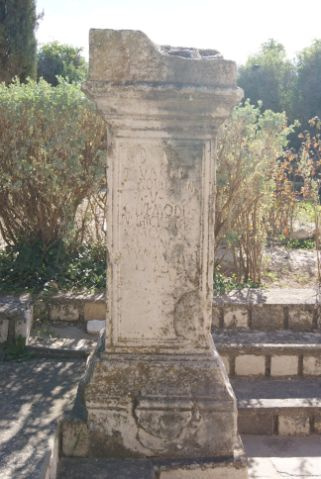
Base for statue of Valens, emperor. Mactaris (Byzacena). 364-375
Record details
Photographs
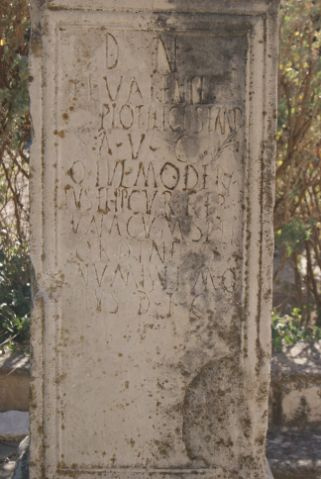
Inscription
D(omino) n(ostro) / Fl(avio) Valenti, pio, felici, semp(er) / Aug(usto), / Q(uintus) Iul(ius) Modera/tus, fl(amen) p(er)p(etuus), cur(ator) re(i) p(ublicae), / (6) una cum sple(ndidissimo) / ordine, / numini m(aiestati)q(ue) / eius dic(atus).
Inscription translation
To our lord Flavius Valens, the pious, fortunate and forever Augustus. Quintus Iulius Moderatus, priest in perpetuity, curator of the city [of Mactaris], devoted to his divine spirit and majesty [set this up], along with [the city's] most splendid council (ordo).
Bibliography
- Corpus Inscriptionum Latinarum; , VIII 11807
Discussion
INSCRIPTION
In nine lines:
D(omino) n(ostro) / Fl(avio) Valenti, pio, felici, semp(er) / Aug(usto), / Q(uintus) Iul(ius) Modera/tus, fl(amen) p(er)p(etuus), cur(ator) re(i) p(ublicae), / (6) una cum sple(ndidissimo) / ordine, / numini m(aiestati)q(ue) / eius dic(atus).
'To our lord Flavius Valens, the pious, fortunate and forever Augustus. Quintus Iulius Moderatus, priest in perpetuity, curator of the city [of Mactaris], devoted to his divine spirit and majesty [set this up], along with [the city's] most splendid council (ordo).'
Letter height : 4 cm.
DESCRIPTION
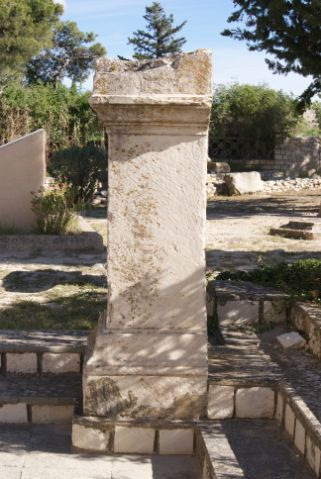
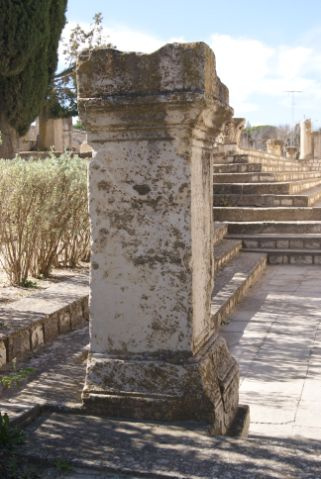
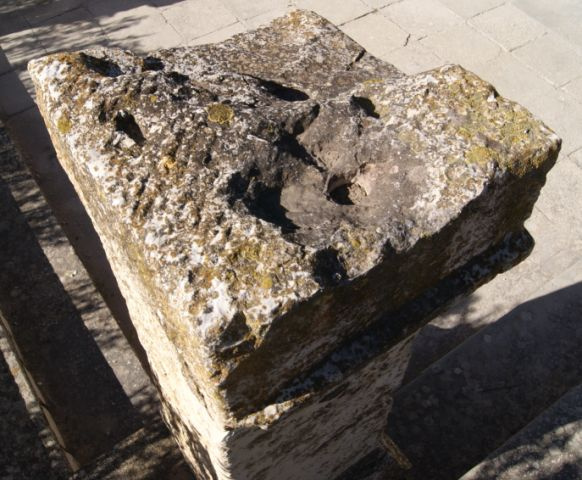
Rectangular base of limestone, with plinth and crown on three sides: H 174, W 66, D 61 cm. The upper surface, which is roughly dressed, and damaged, has several holes in it for securing the statue. The inscription is framed with a moulding.
PROVENANCE AND CURRENT LOCATION
The base was found in 1889 by Bordier, re-used in the walls of the Christian basilica of Rutilius, just north of the amphitheatre. This, and other imperial statue bases, were used in the foundations of what was apparently the apse of the church (N. Duval, 1985, 41). Picard dated its construction to the mid-4th century (Picard 1984, 27), but the presence of statue bases in its foundations to Valens, Valentinian and Gratian (this base, LSA-1757 and LSA-1759) rules this out. Duval provides a less precise, but more plausible, dating of 4th- or 5th-century (Duval 1985, 44), and suggests that it may have been the cathedral of Mactaris.
The base is now in the Mactar museum.
HONORAND, AWARDER AND DATE
The honorand, Valens, was Augustus from 364 to 378.
The awarder, Quintus Iulius Moderatus, priest in perpetuity and curator of Mactaris, is known only from our two inscriptions (this one, and LSA-1757).
Another base, also in Mactaris, was dedicated by the same awarder to Valens' brother and colleague Valentinian I (CIL VIII 11806, LSA-1757). These two bases must have been dedicated at the same time, and can therefore be reliably dated before the death of Valentinian in 375. A third base was dedicated to Gratian with the same formula (CIL VIII 11808; LSA-1759), but by a different curator of the city. It may have been added to the pair to Valens and Valentinian, when Gratian joined the imperial college in 367. If so, our base (and that to Valentinian) can be dated to before Gratian's elevation (R. Stichel 1982, 79).
Discussion references
- Bulletin archéologique du Comité des Travaux Historiques et Scientifiques, Paris, 1889, p. 362
- Duval N., Une hypothèse sur la basilique de Rutilius à Mactar et le temple qui l'a précédée. Etudes d' archéologie chrétienne nord-africaine, Revue des Etudes Augustiniennes, Paris, 1985, XXXI, n°1-2, p. 20-45
- Picard, G., "Le temple du musée à Mactar", Revue archéologique, Paris, 1984
- Picard, G., "Le temple du musée à Mactar", Revue archéologique, Paris, 1984, p. 27
- Stichel, R. H. W., Die römische Kaiserstatue am Ende der Antike, Roma 1982, p. 79
Cite: Last Statues of Antiquity, LSA-1756 (Gabriel de Bruyn).