
LSA-1759
Base for statue of Gratian, emperor. Mactaris (Byzacena). 367-383, perhaps 367/8
Record details
Photographs
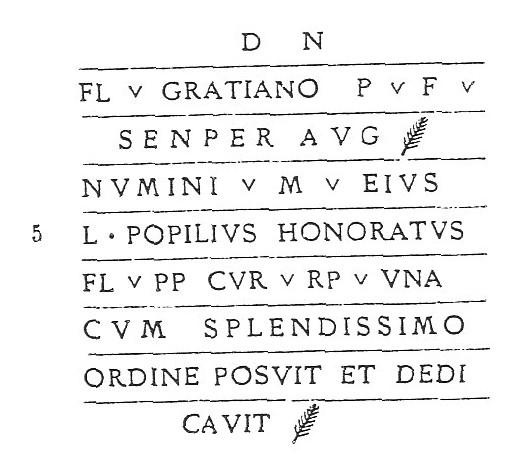
Inscription
D(omino) n(ostro) / Fl(avio) Gratiano, p(io), f(elici), / senper (sic) Aug(usto) (palm), / numini m(aiestatique) eius. / (5) L(ucius) Popilius Honoratus, / fl(amen) p(er)p(etuus), cur(ator) r(ei) p(ublicae), una / cum splendi(di)ssimo / ordine, posuit et dedi/cavit (palm).
Inscription translation
To our lord Flavius Gratianus, pious, fortunate, forever Augustus [and] to his divine spirit and majesty. Lucius Popilius Honoratus, priest in perpetuity, curator of the city, along with the most splendid council (ordo), set this up and dedicated it.
Bibliography
- Corpus Inscriptionum Latinarum; , VIII 11808
Discussion
INSCRIPTION
In nine lines:
D(omino) n(ostro) / Fl(avio) Gratiano, p(io), f(elici), / senper (sic) Aug(usto) (palm), / numini m(aiestatique) eius, / (5) L(ucius) Popilius Honoratus, / fl(amen) p(er)p(etuus), cur(ator) r(ei) p(ublicae), una / cum splendi(di)ssimo / ordine, posuit et dedi/cavit (palm).
'To our lord Flavius Gratianus, pious, fortunate, forever Augustus [and] to his divine spirit and majesty. Lucius Popilius Honoratus, priest in perpetuity, curator of the city, along with the most splendid council (ordo), set this up and dedicated it.'
Letter height : 8 cm.
DESCRIPTION
There are no published descriptions or measurements of this base, and no published image.
PROVENANCE AND LOCATION
The base was found in 1889 by Bordier, re-used in the walls of the Christian basilica of Rutilius, just north of the amphitheatre. This, and other imperial statue bases, were used in the foundations of what was apparently the apse of the church (N. Duval, 1985, 41). Picard dated its construction to the mid-4th century (Picard 1984, 27), but the presence in its foundations of bases to Valens, Valentinian and Gratian (LSA-1756, LSA-1757, and our base) rules this out. Duval provides a less precise, but more plausible, dating of 4th- or 5th-century (Duval 1985, 44), and suggests that it may have been the cathedral of Mactaris.
There is no recent record of the base's location.
HONORAND, AWARDER AND DATE
The honorand, Gratian, was Augustus from 367 to 383.
The awarder, Lucius Popilius Honoratus, priest in perpetuity and curator of Mactaris, is known only from this inscription.
Two bases dedicated to Valentinian I and Valens were set up in Mactaris, with the same formula but by another curator, at some point between 364 and 375 (LSA-1756, LSA-1757). If our base to Gratian was an up-dating of this imperial group, which seems likely, then the statues to Valentinian and Valens were probably set up between 364 and 367, and that to Gratian added soon after his accession (as hypothesised by R. Stichel, 1982, 79, no. 24).
Discussion references
- Bulletin archéologique du Comité des Travaux Historiques et Scientifiques, Paris, 1889, p. 362
- Duval N., Une hypothèse sur la basilique de Rutilius à Mactar et le temple qui l'a précédée. Etudes d' archéologie chrétienne nord-africaine, Revue des Etudes Augustiniennes, Paris, 1985, XXXI, n°1-2, p. 20-45
- Picard, G., "Le temple du musée à Mactar", Revue archéologique, Paris, 1984, p. 27
- Stichel, R. H. W., Die römische Kaiserstatue am Ende der Antike, Roma 1982, p. 79, n. 24
Cite: Last Statues of Antiquity, LSA-1759 (Gabriel de Bruyn).