
LSA-176
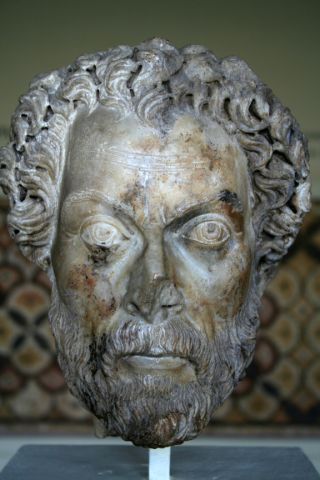
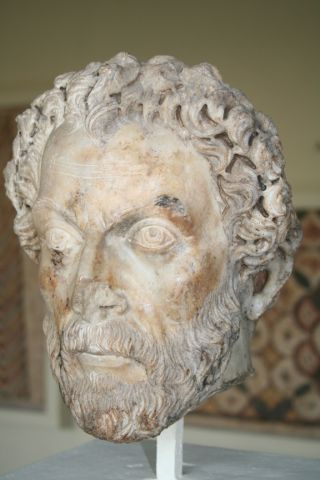
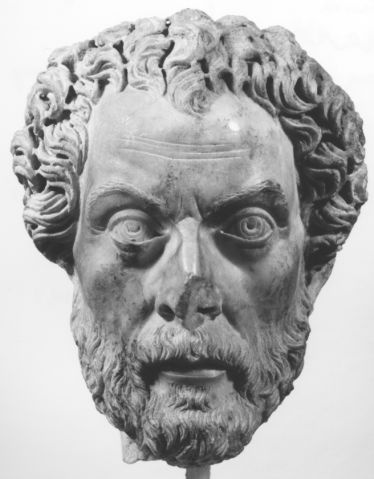
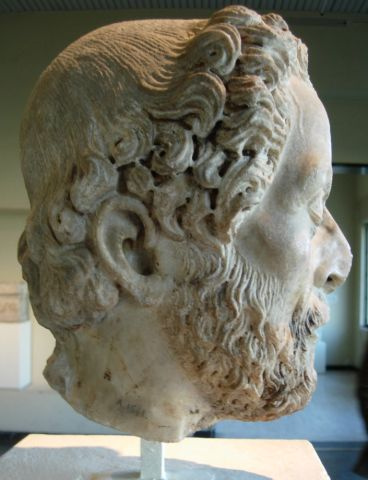
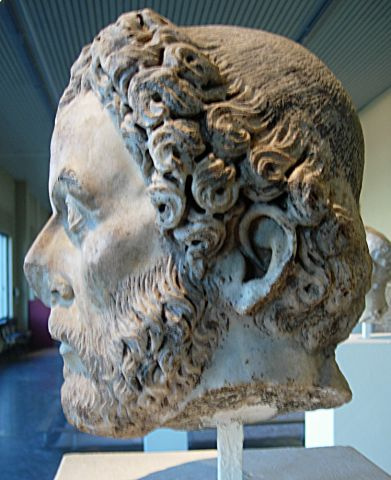
Bearded male portrait head with tall brow (and concealed Christian inscription). From Aphrodisias (Caria). Fifth century.
Record details
Photographs
Bibliography
- Inan, J. & E. Alföldi-Rosenbaum, Römische und frühbyzantinische Porträ̈tplastik aus der Türkei : neue Funde, Mainz 1979, 232-4, no. 204, pl. 257 (Erim: mid 5th)
- Smith, R.R.R., "Statue life in the Hadrianic Baths at Aphrodisias, AD 100-600: Local context and historical meaning", in F.A. Bauer, C. Witschel (eds.), Statuen und Statuensammlungen in der Spätantike - Funktion und Kontext (Spätantike, Frühes Christentum, Byzanz: Kunst im ersten Jahrtausend), Wiesbaden 2007, 228 no. 32
Discussion
DESCRIPTION (Object)
Life-size head. H: 29, W: 20 cm. White marble.
The head is broken at the base of the neck. The tip of the nose is chipped. An edge of drapery at the back of the neck is preserved and more visible on the left side.
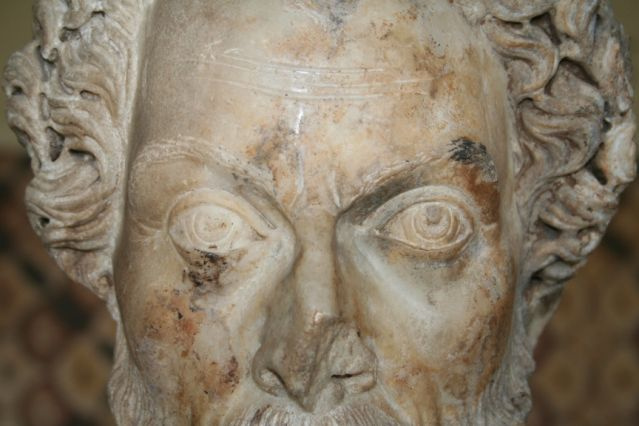
The hair around the brow is masterfully drilled three tiers of stacked curls. ‘Bridges’, tiny marble struts, have been left over the deep channels. The hair at the top and back of the head is indicated by long parallel lines of a claw chisel. Over the claw chiseled surface, behind the front row of curls, two lines have been inscribed.
Χ(ριστὸς ἐξ) Μ(αρίας) γ(εννηθείς)
Θ(ε)ὲ Βοήθ(ε)ι
Christ was born to Mary. God, may you come to the rescue
The beard also uses a combination of claw chisel and drill to render realistically and vividly the textured surface. Fine lines are engraved across the brow, above the root of the nose, and at the corners of the eyes. The eyes have deeply drilled inner canthi. The pupils are drilled out in a U-shape, and the irises are defined by two engraved lines.
PROVENANCE
Found in 1904 by Gaudin at the Hadrianic Baths. It was found in an underground passage, possibly beneath the central area of the forecourt. It was acquired by Museum in Brussels in 1908.
DESCRIPTION (Subject)
The portrait is a powerful rendering of a distinctive older man which combines a court hairstyle, some traditional elements of classical thinkers that stress the intellect, and a new (late antique) emphasis on the eyes. It almost assuredly came from a statue wearing a chlamys.
The honorand wears his hair in a ‘wreath’ fashion. The wreath consists of three layers of thick curls that come forward at the centre of the brow. His beard and moustache are also full and curly.
The brow is particularly striking. It is tall, has a bulging vein at the right temple, fine creases across it, and lines of contraction above the nose. Flaring eyebrows arching over large staring eyes give the figure a frozen stare. The fine aquiline nose and narrow cheeks which hang loosely from the marked cheekbones contribute an ascetic quality.
The drapery at the back of the neck rises to touch the hair. It is a single garment which would fall on both shoulders. This (in conjunction with the court hairstyle) strongly suggest a chlamys. As the facial features, it is assymetrical (it falls more sharply on the right side) and suggests a turn to the right.
HONORAND
The portrait wears a carefully coiffed hairstyle and has the ascetic aspect that is commonly associated with the hard-working, tireless governors. He also almost securely comes from a statue wearing a chlamys, the costume of the governor.
INSCRIPTION
The head has been marked discretely by Christian abbreviations, the purpose of which is unclear. Perhaps a Christian sculptor wished to protect himself or the man represented. The abbreviation Chi Mu Gamma appears also on the head of Oecumenius LSA-150, who can be loosely dated to the late fourth or early fifth century. It appears also prominently on the base of a statue of a priest resurrected by Fl. Anthemius Isodorus LSA-662 in the first or second decade of the fifth century and, perhaps less prominently, on the side of a contemporary base for Anthemius the father LSA-224, as well as on the base for a second statue of Maximus of Stratoniceia LSA-1200, which again assuredly belongs in the fifth century.
DATE
The hairstyle which builds in volume over the brow indicates a fifth century date. The same virtuoso technique and style can be noted on a series of portraits found at Aphrodisias in the area of the Hadrianic Baths and west stoa of the Agora; for example, the ‘Elder Magistrate’ statue (LSA-169, LSA-176, LSA-182, and LSA-184. These suggest a flourish in sculptural activity and competence in the fifth century.
Discussion references
- Erim, K.T., "De Aphrodisiade'", AJA 71 (1967), 236, especially fn. 10, pl . 66, fig. 7
- Smith, R.R.R. 'Late antique portraits in a public context: Honorific statuary at Aphrodisias in Caria, AD 300-600' , Journal of Roman Studies, 89 (1999), 155-89, 184, pl. 8, figs. 1-2
Cite: Last Statues of Antiquity, LSA-176 (J. Lenaghan).