
LSA-1763
Base for statue of Constantine I, emperor. Muzuc (Byzacena). 307-324
Record details
Photographs
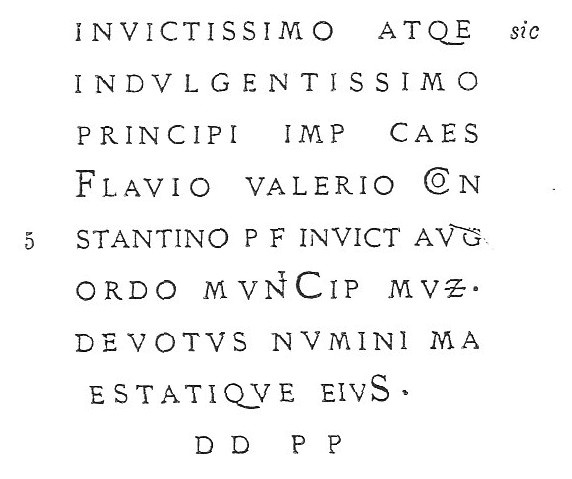
Inscription
Invictissimo atq(u)e / indulgentissimo / principi, imp(eratori) Caes(ari) / (4) Flavio Valerio Con/stantino, p(io), f(elici), invict(o) Aug(usto), / ordo municip(ii) Muz(ucensis), / devotus numini ma/(i)estatique eius, / d(ecreto) d(ecurioum), p(ecunia) p(ublica).
Inscription translation
To the most unconquered and most merciful ruler, the emperor Caesar Flavius Valerius Constantinus, pious, fortunate and unconquered Augustus. The council of the city (ordo municipii) of Muzuc, devoted to his divine spirit and majesty, [set this up] by decree of the councillors, with public funds.
Bibliography
- Corpus Inscriptionum Latinarum; , VIII 12063
Discussion
INSCRIPTION
In eight lines :
Invictissimo atq(u)e / indulgentissimo / principi, imp(eratori) Caes(ari) / (4) Flavio Valerio Con/stantino, p(io), f(elici), invict(o) Aug(usto), / ordo municip(ii) Muz(ucensis), / devotus numini ma/(i)estatique eius, / d(ecreto) d(ecurioum), p(ecunia) p(ublica).
'To the most unconquered and most merciful ruler, the emperor Caesar Flavius Valerius Constantinus, pious, fortunate and unconquered Augustus. The council of the city (ordo municipii) of Muzuc, devoted to his divine spirit and majesty, [set this up] by decree of the councillors, with public funds.'
Letter height : 6 cm.
DESCRIPTION (from J. Poinssot)
Limestone base, with mouldings top and bottom. There are no published measurements.
PROVENANCE AND CURRENT LOCATION
Our inscription was found in 1882-3 with four other imperial bases (one of them a dedication to Constantine's father, Constantius, LSA-1762) at the east end of a rectangular square which may have been the forum of the city.
The base was last recorded, still on the square, in 1884 (by J. Poinssot) .
HONORAND AND DATE
The honorand,Constantine I, was proclaimed Augustus in York in 306, and recognized as such by Maxentius (the ruler of Africa) in 307 (Kleinast 1996, 298).
The awarder was the city, as usual with imperial statues in Africa.
In 324, Constantine replaced invictus, which has pagan connotations and appears on our base, with victor (Lassère 2005, 607). The formula 'invictissimo atque indulgentissimo, the most unconquered and most merciful' is most likely to date from after the victory of Constantine over Maxentius in 312. Our base must therefore date between 307 and 324, but is most likely to have been erected in 312 or soon after.
Discussion references
- Lassère, J.-M., Manuel d'épigraphie romaine, Paris, 2005, p. 607
- Poinssot, J., Inscriptions inédites recueillies pendant un voyage exécuté en 1882-1883, Bulletin trimestriel des antiquités africaines, Paris, 1884, p. 75, n°281
Cite: Last Statues of Antiquity, LSA-1763 (Gabriel de Bruyn).