
LSA-1766
Base for statue, perhaps originally for Constantius Gallus, emperor (later adapted for Constantius II). Pheradi Maius (Byzacena). Perhaps 351-354 (adapted 354-361).
Record details
Photographs
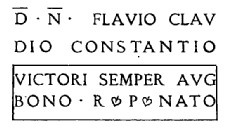
Inscription
D(omino) n(ostro) Flavio Clau/dio Constantio, / victori, semper Aug(usto), / bono r(ei) p(ublicae) nato.
Inscription translation
To our lord Flavius Claudius Constantius, victor, forever Augustus, born for the good of the commonwealth (res publica).
Bibliography
- L'Année épigraphique, , 1927, 27
- Merlin, A., Inscriptions latines de la Tunisie, Paris, 1944, n°248
Discussion
INSCRIPTION
In four lines:
D(omino) n(ostro) Flavio Clau/dio Constantio, / victori, semper Aug(usto), / bono r(ei) p(ublicae) nato.
'To our lord Flavius Claudius Constantius, victor, forever Augustus, born for the good of the commonwealth (res publica).'
Letter height : 6 - 8 cm
DESCRIPTION (from L. Poinssot)
Of this base Poinssot gives no description, other than its measurements and to say that the base has mouldings at top and bottom : "moulurée en haut et en bas" (Poinssot). H 120, W 62, D 53 cm.
PROVENANCE AND CURRENT LOCATION
The base was found in 1926 by Poinssot, on the square near the nymphaeum, which was possibly the forum. It was situated against the steps, at the west end of the square. There is no recent published record of its location.
HONORAND, AWARDER AND DATE
The name of the honorand would perfectly fit Gallus, Caesar in the East between 351 and 354, whose full name was 'Flavius Claudius Constantius' (exactly as on our inscription). However our inscription is to an Augustus, a title that Gallus never held (and he is rightly entitled 'Caesar' in a dedication to him in the neighbouring province of Proconsularis).
Poinssot suggested that the inscription was first dedicated to Gallus, but, after his fall from grace and execution, emended to suit the Augustus Constantius II (who died in 361), while leaving the name 'Claudius' unaltered from the earlier dedication. Only a careful examination of the original, if it survives, would be able to test this hypothesis.
No awarder is named in the inscription, which is unusual for a statue base. However the dimensions of the block strongly suggest that it was for a statue, and it appears to have been local practice at Pheradi Maius not to name the awarder (see also LSA-1764, and LSA-1765). It was probably set up by the city itself (the usual practice for imperial bases in Africa).
FURTHER DISCUSSION
The dimensions of this base are very similar to those of one found nearby dedicated to Valens (ILT 249, LSA-1764). The latter was possibly made to be associated with our base, to show the continuity of imperial power.
Discussion references
- Bulletin archéologique du Comité des Travaux Historiques et Scientifiques, Paris, 1927, p. 57
- Lepelley C., Les cités de l'Afrique romaine au Bas-Empire, t. 2, Notices d'histoire municipale, Paris 1981, p. 300, n°2, n. 8
Cite: Last Statues of Antiquity, LSA-1766 (Gabriel de Bruyn).