
LSA-1768
Base for statue of Licinius, emperor. From Pupput (Byzacena). 312-323.
Record details
Photographs
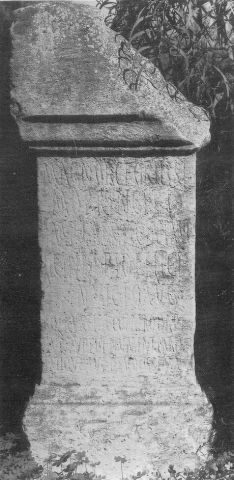
Inscription
Magno ac fortissi/mo principi, / imp(eratori) Caes(ari) Liciniano / Licinio, pio, felici, / invicto Aug(usto), / col(onia) Aurelia Commoda, p(ia), f(elix), / aug(usta) Pupput numini maies/tatique eius devotissima.
Inscription translation
To the great and most powerful ruler, the emperor Caesar Licinianus Licinius, pious, fortunate, unconquered Augustus; the colony Aurelia Commoda, pious, fortunate, [and] imperial Pupput, most devoted to his divine spirit and majesty, [set this up].
Bibliography
- Corpus Inscriptionum Latinarum; , VIII suppl. 4, 24093
- Ben Abdallah, Z. B., Catalogue des inscriptions latines païenne du Musée du Bardo, Rome 1986, n°416
- L'Année épigraphique, , 1899, 162
Discussion
INSCRIPTION
In eight lines:
Magno ac fortissi/mo principi, / imp(eratori) Caes(ari) Liciniano / Licinio, pio, felici, / (5) invicto Aug(usto), / col(onia) Aurelia Commoda, p(ia), f(elix), / aug(usta) Pupput numini maies/tatique eius devotissima.
'To the great and most powerful ruler, the emperor Caesar Licinianus Licinius, pious, fortunate, unconquered Augustus; the colony Aurelia Commoda, pious, fortunate, [and] imperial Pupput, most devoted to his divine spirit and majesty, [set this up].
Letter height : 0.4 - 0.6 cm
The grandiloquent description of Pupput as 'colonia Aurelia Commoda, pia, felix, augusta Pupput' refers to the elevation of this small settlement to the status of an honorary colony under the emperor Commodus at the end of the second century. The string of adjectives to describe the city, 'pia, felix, augusta', echoes the description of the honorand Licinius, 'pio, felici, invicto Augusto'.
DESCRIPTION (from ILPB and the photo)
Limestone base with plinth and crown, broken at the top right corner: H 150, W 48 cm, depth unrecorded.
PROVENANCE AND CURRENT LOCATION
Found in 1898 by du Paty de Clam. There is no published record of precisely where on the site it was found. Now in the Bardo Museum (inv. no. D 953).
HONORAND, AWARDER AND DATE
The honorand, Licinius, was Augustus from 308 to 324.
The awarder was the city, as usual with imperial statues in Africa.
Licinius was never in charge of Africa, so our inscription must date from the period when he was recognised in the West, under Constantine between 312 and 323. Ben Abdallah suggests a more precise dating, to the period of close alliance between Constantine and Licinius, 314-23. However, a statue base to Licinius in Ureu (in neighbouring Africa Proconsularis) can be precisely dated to December 312 (LSA-1954), showing that Licinius could be honoured in Africa before 314.
FURTHER DISCUSSION
Since Licinius never exercised direct rule over Africa, it is very likely that our base was set up alongside a statue of the western emperor, Constantine.
Discussion references
- Bulletin archéologique du Comité des Travaux Historiques et Scientifiques, Paris, 1899, p. CLXXXIX
- Comptes-rendus de l'Académie des Inscriptions et Belles-Lettres, Paris, 1899, p. 366
- Lepelley, C., Les cités de l'Afrique romaine au Bas-Empire, t. 2, Notices d'histoire municipale, Paris 1981, p. 303, n°2, n. 5
Cite: Last Statues of Antiquity, LSA-1768 (Gabriel de Bruyn).