
LSA-177
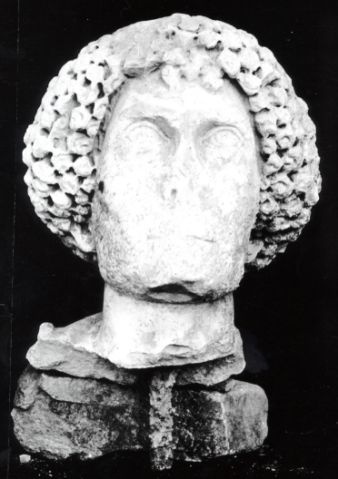
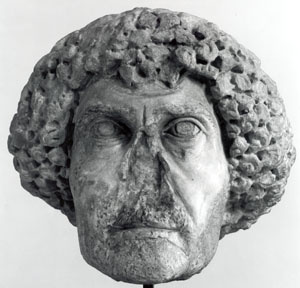
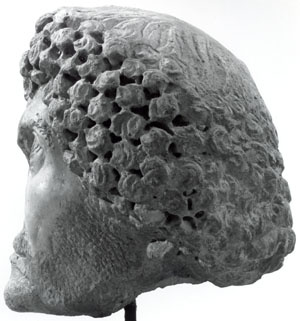
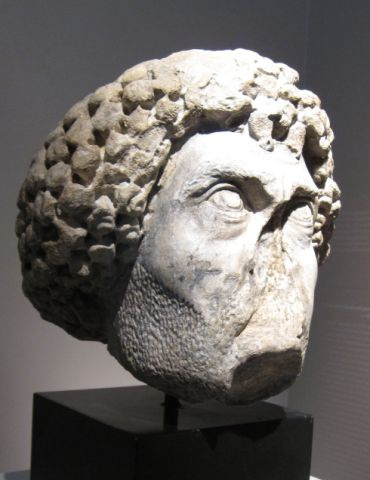
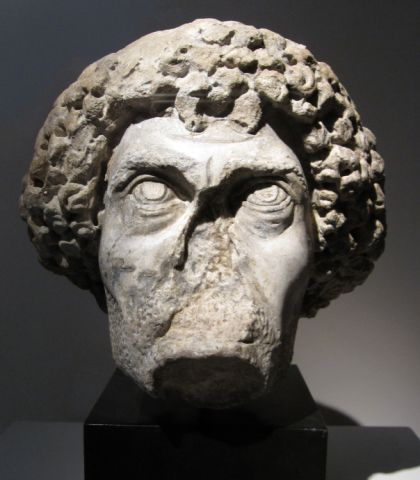
Portrait head of man with stubble beard and mop hairstyle. From Aphrodisias (Caria). Late fifth to early sixth century.
Record details
Photographs
Bibliography
- Inan, J. & E. Alföldi-Rosenbaum, Römische und frühbyzantinische Porträ̈tplastik aus der Türkei : neue Funde, Mainz 1979, no. 207
- Smith, R.R.R., "Statue life in the Hadrianic Baths at Aphrodisias, AD 100-600: Local context and historical meaning", in F.A. Bauer, C. Witschel (eds.), Statuen und Statuensammlungen in der Spätantike - Funktion und Kontext (Spätantike, Frühes Christentum, Byzanz: Kunst im ersten Jahrtausend), Wiesbaden 2007, 228 no. A 33
- Smith, R.R.R. 'Late antique portraits in a public context: Honorific statuary at Aphrodisias in Caria, AD 300-600' , Journal of Roman Studies, 89 (1999), 155-89, pl. 10.1
Discussion
DESCRIPTION (Object)
Life-size head. H: 21 cm. White marble.
The head is preserved in one piece without neck. The surface is battered, and the nose is missing.Originally found with neck, with an iron dowel through the neck, and part of the drapery (chlamys) on the right shoulder.
PROVENANCE
Found in the excavations of 1904-1905 at the Hadrianic Baths by Paul Gaudin. The head is documented in photos at Aphrodisias still with its neck.
DESCRIPTION (Subject)
The portrait subject has an austere square face, with light stubble pecked into the cheeks, and a heavy, deeply drilled and deeply under cut ‘mop’ hairstyle composed of tight curls ‘bridged’ together in a tight lattice or honeycomb.
He has a broad, thin-lipped unsmiling mouth, a crescent-shaped furrow in the brow, a deep vertical furrow at the root of the nose, thick carved eyebrows, and large, heavily accented, heavily-contoured eyes. The center of the eyeball is treated in a distinctive manner—a flat ‘disc’ outlined by a deep U-shaped line that corresponds to the usual position of the iris. The eye form is found also on LSA-173, LSA-198, LSA-219.
The old photograph of the piece at Aphrodisias in 1904-1905 when it still had part of the neck and right shoulder shows two important details: (1) the head was from a statue and not from a bust, and (2) it wore a tunic and outer garment, certainly a chlamys (compare LSA-169 and LSA-170). A small protruberance on the chlamys at the right shoulder is probably the remains (the upper end) of a cross-bow fibula; here carved with the statue instead of added separately (as LSA-150, LSA-169, and LSA-170).
DATE
The head probably dates to the late fifth-early sixth century: the hairstyle and eye technique are close to those of Flavius Palmatus, LSA-198.
Cite: Last Statues of Antiquity, LSA-177 (R.R.R. Smith).