
LSA-1771
Base for statue of Constantine I, emperor. Upenna (Byzacena). 307-324.
Record details
Photographs
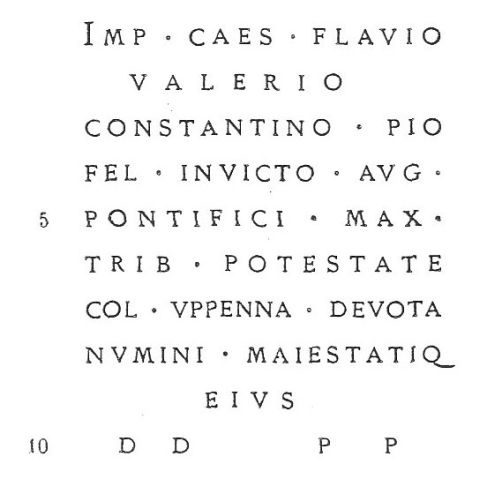
Inscription
Imp(eratori) Caes(ari) Flavio / Valerio / Constantino, pio / fel(ici), invicto Aug(usto), / (5) pontifici max(imo), / trib(unicia) potestate, / col(onia) Uppenna, devota / numini maiestatiq(ue) / eius, / d(ecreto) d(ecurionum), p(ecunia) p(ublica).
Inscription translation
To the emperor Caesar Flavius Valerius Constantinus, pious, fortunate, unconquered Augustus, highest priest (pontifex maximus), holding tribunician power; the colony of Uppenna, devoted to his divine spirit and majesty, [set this up] by decree of the councillors, with public funds.
Bibliography
- Corpus Inscriptionum Latinarum; , VIII 11157
Discussion
INSCRIPTION
In ten lines:
Imp(eratori) Caes(ari) Flavio / Valerio / Constantino, pio / fel(ici), invicto Aug(usto), / (5) pontifici max(imo), / trib(unicia) potestate, / col(onia) Uppenna, devota / numini maiestatiq(ue) / eius, / d(ecreto) d(ecurionum), p(ecunia) p(ublica).
'To the emperor Caesar Flavius Valerius Constantinus, pious, fortunate, unconquered Augustus, highest priest (pontifex maximus), holding tribunician power; the colony of Uppenna, devoted to his divine spirit and majesty, [set this up] by decree of the councillors, with public funds.'
Letter height : 4 cm
DESCRIPTION (from R. Cagnat)
Cagnat describes the base as 'decorated' ('ornamentée'), but without providing further detail: H 160, W 70 cm, depth unrecorded.
PROVENANCE AND CURRENT LOCATION
Found buried in the ground by Cagnat in the Henchir Chigarnia in 1881-2. There is no recent published record of its location.
HONORAND, AWARDER AND DATE
The honorand, Constantine I, was Augustus 306-37.
The awarder was the city, as usual with imperial statues in Africa.
Constantine was proclaimed Augustus in York in 306, but recognized as such by Maxentius (the ruler of Africa) only in 307 (Kleinast 1996, 298). Our base could therefore be from 307 or soon after, but a date after 312 (when Constantine assumed direct rule of Africa) is more plausible. In 324, he replaced invictus, which has pagan connotations (and which appears on our base), with victor (Lassère 2005, 607).
Discussion references
- Comptes-rendus de l'Académie des Inscriptions et Belles-Lettres, Paris, 1882, p. 12
- Kienast, D., Römische Kaisertabelle : Grundzüge einer römischen Kaiserchronologie, Darmstadt, 1996, p. 298
- Lassère, J.-M., Manuel d'épigraphie romaine, Paris, 2005, p. 607
Cite: Last Statues of Antiquity, LSA-1771 (Gabriel de Bruyn).