
LSA-1772
Base for statue of Gratian, emperor. Vazi Sarra (Byzacena). 367-383.
Record details
Photographs
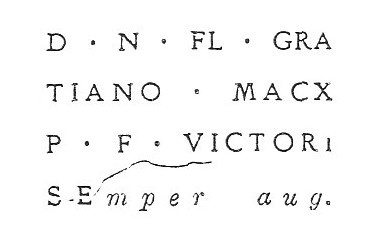
Inscription
D(omino) n(ostro) Fl(avio) Gra/tiano, macx(imo) (sic), / p(io), f(elici) victori, / se[mper Aug(usto) | ------
Inscription translation
To our lord Flavius Gratianus, greatest, pious [and] fortunate victor, forever Augustus ...
Bibliography
- Corpus Inscriptionum Latinarum; , VIII 12008
Discussion
INSCRIPTION
In four surviving lines:
D(omino) n(ostro) Fl(avio) Gra/tiano, macx(imo) (sic), / p(io), f(elici) victori, / se[mper Aug(usto) | ------
'To our lord Flavius Gratianus, greatest, pious [and] fortunate victor, forever Augustus ...'
Letter height : 4 cm
DESCRIPTION (from J. Poinssot)
Poinssot does not describe the base, but, from the dimensions he recorded and from the way he set out the inscription, it is clear that its lower part was broken and lost: H 25, W 35 cm, depth unrecorded.
PROVENANCE AND CURRENT LOCATION
The inscription was found in 1882-3 by Poinssot, probably from a building converted into a fortress during the Byzantine period, located next to the spring feeding the city. There is no recent published record of its location.
HONORAND, AWARDER AND DATE
The honorand, Gratian, was Augustus from 367 to 383.
Although not all statue bases carry the name of the awarder, or awarding body, here it is apparently absent because broken off and lost. Much the most likely dedicator for an imperial statue at this date in Africa was the city itself, or one of its officials.
Discussion references
- Bulletin trimestriel des antiquités africaines, recueillies par les soins de la Société de géographie et d'archéologie de la province d'Oran, Paris, 1884, p. 245, n°556
Cite: Last Statues of Antiquity, LSA-1772 (Gabriel de Bruyn).