
LSA-1777
Base for statue of Fabius Maximus, governor of Samnium. Aesernia (Samnium). 352-357 .
Record details
Photographs
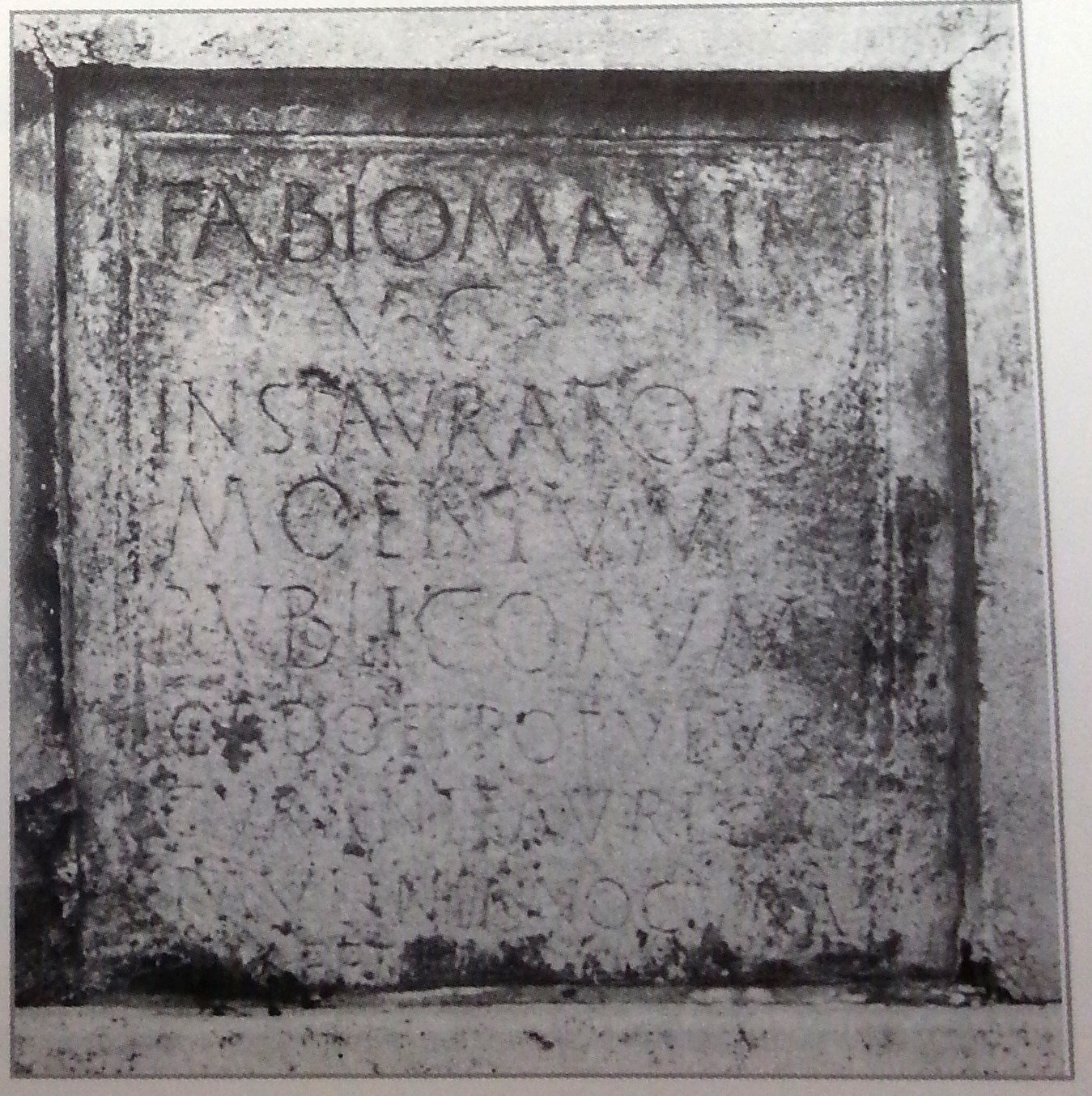
Inscription
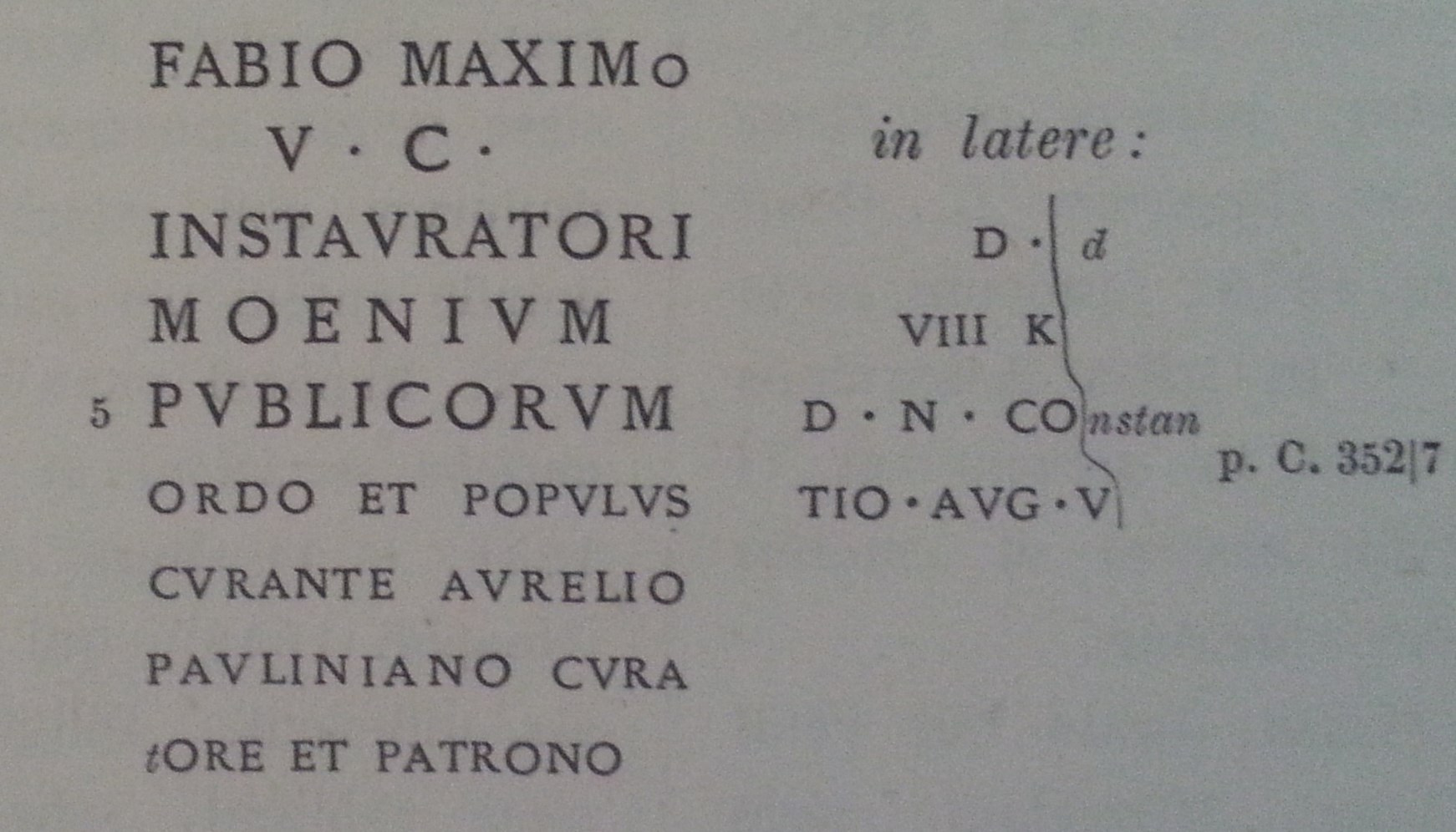
Fabio Maximo, / v(iro) c(larissimo), / instauratori / moenium /(5) publicorum, / ordo et populus, / curante Aurelio / Pauliniano, cura/tore et patrono. // D(e)[d(icata)] / VIII k(alendas) [---], / D(omino) n(ostro) Co[nstan]/tio Aug(usto) V[---co(n)s(ule)].
Inscription translation
To Fabius Maximus, of clarissimus rank, renewer of public buildings; the council and people [set this up], under the supervision of Aurelius Paulinianus, curator and patron. [On right side] Dedicated on the 8th day before the kalends…, during the … consulship of our lord Constantius Augustus.
Bibliography
- Corpus Inscriptionum Latinarum; , IX, 2639
- Buonocore, M., Molise. Repertorio delle Iscrizioni Latine. V.2: Aesernia , Campobasso 2003, n. 16
- Inscriptiones Latinae Selectae, , 1248
Discussion
INSCRIPTION
In nine lines:
Fabio Maximo, / v(iro) c(larissimo), / instauratori / moenium /(5) publicorum, / ordo et populus, / curante Aurelio / Pauliniano, cura/tore et patrono. // D(e)[d(icata)] / VIII k(alendas) [---], / D(omino) n(ostro) Co[nstan]/tio Aug(usto) V[---co(n)s(ule)].
‘To Fabius Maximus, of clarissimus rank, renewer of public buildings; the council and people [set this up], under the supervision of Aurelius Paulinianus, curator and patron. [On right side] Dedicated on the 8th day before the kalends of …, during the … consulship of our lord Constantius Augustus.‘
Letter height 1 - 5 cm.
The inscription on the right side is today invisible because the block is built into a wall of the episcopal palace of Isernia; however, it was recorded in the earlier 18th century (see below, ‘Provenance and Current Location‘).
DESCRIPTION (from Epigraphic Database Roma (EDR), and the published image)
Rectangular base of local stone, H 125, W 78 cm. The depth is not visible.
PROVENANCE AND CURRENT LOCATION
The find spot of our inscription is unknown. It was first recorded in Isernia, the location of ancient Aesernia, in the earlier 18th century by the local scholar Ricci; at this time Ricci was still able to read the inscription on the right lateral face. In 1883, for CIL IX, it was recorded built into an outer wall of the Isernia cathedral, facing the court of the episcopal palace, only the front face visible; it is still there today.
HONORAND, AWARDER AND DATE
Fabius Maximus, the honorand, was provincial governor of Samnium (PLRE I, 587 Fabius Maximus 35). He is known from more than 15 inscriptions, all from the province of Samnium (LSA-1750). A large majority refer to building activities (LSA-1773, LSA-1750); three of them explicitly style him rector provinciae - ’provincial governor’ (CIL IX 2212, 2338, 2447). Fabius Maximus is recorded in our sample with six honorific statues bases (LSA-1750, LSA-1753, LSA-1754, LSA-1783, LSA-2861, and our inscription).
Our inscription was set up under the 5th (Latin V), 6th (VI), 7th (VII), 8th (VIII) or 9th (VIIII) consulship of Constantius II, in 352, 353, 354, 356, or 357 respectively. This dates Maximus‘ time in office to 352/7. We adopt this date for all inscriptions to Maximus, although it cannot be completely excluded that some of them were set up before or after his time in office.
The inscription was set up by the civic institutions of Aesernia, the council (ordo) and people (populus) (line 6), under the auspices of Aurelius Paulinianus. Paulinianus was probably a leading member of the local nobility; he was curator rei publicae of Aesernia, an office that was held only after the complete municipal cursus (Codex Theodosianus 12, 1, 20), and he was patron of the city.
FURTHER DISCUSSION
It is a widely held view that Fabius Maximus was the first or one of the first provincial governors of Samnium (for a discussion of the sequence of governors in Samnium see e.g. Gaggiotti 1978). The province was established in the mid-4th century, the exact date is unknown. It has been the established view that this was in response to the earthquake of 346; however, Soricelli 2009 justly pointed out that there is little evidence for this in Maximus’ epigraphic record (see discussion under LSA-1750; the archaeological evidence is discussed by Galadini and Galli 2004). It is well possible that the foundation of the province was motivated by political, administrative, or economic considerations, and that Maximus’ building programme had the purpose of providing the new province with the official buildings it needed.
Discussion references
- Gaggiotti, M., Le iscrizioni della basilica di Saepinum e i rectores della provincia del Samnium, Athenaeum. Studi Periodici di Letteratura e Storia dell’Antichità, Nuova Serie 56 (Anno 66 della Rivista), Pavia 1978, 145-69
- Galadini, F. and P. Galli, The 346 A.D. earthquake (Central-Southern Italy): an archaeoseismological approach, Annals of Geophysics, Vol. 47, N. 2/3, April/June 2004, 885-905
- Jones, A. H. M. et al., The Prosopography of the Later Roman Empire. Vol. I 260-395, Cambridge et al. 1971 (1975), 587
- Soricelli, G., La Provincia del Samnium e il Terremoto del 346 D.C., Interventi Imperiali in Campo Economico e Sociale, a cura di A. Storchi Marino e G. D. Merola, Bari 2009, 245-62
Cite: Last Statues of Antiquity, LSA-1777 (Carlos Machado and Ulrich Gehn; discussion added 3/15 (UG)).