
LSA-1779
Lost base for statue of Flavius Iulius Innocentius, governor of Samnium. Aesernia (Samnium). Mid-fourth to early fifth century.
Record details
Photographs
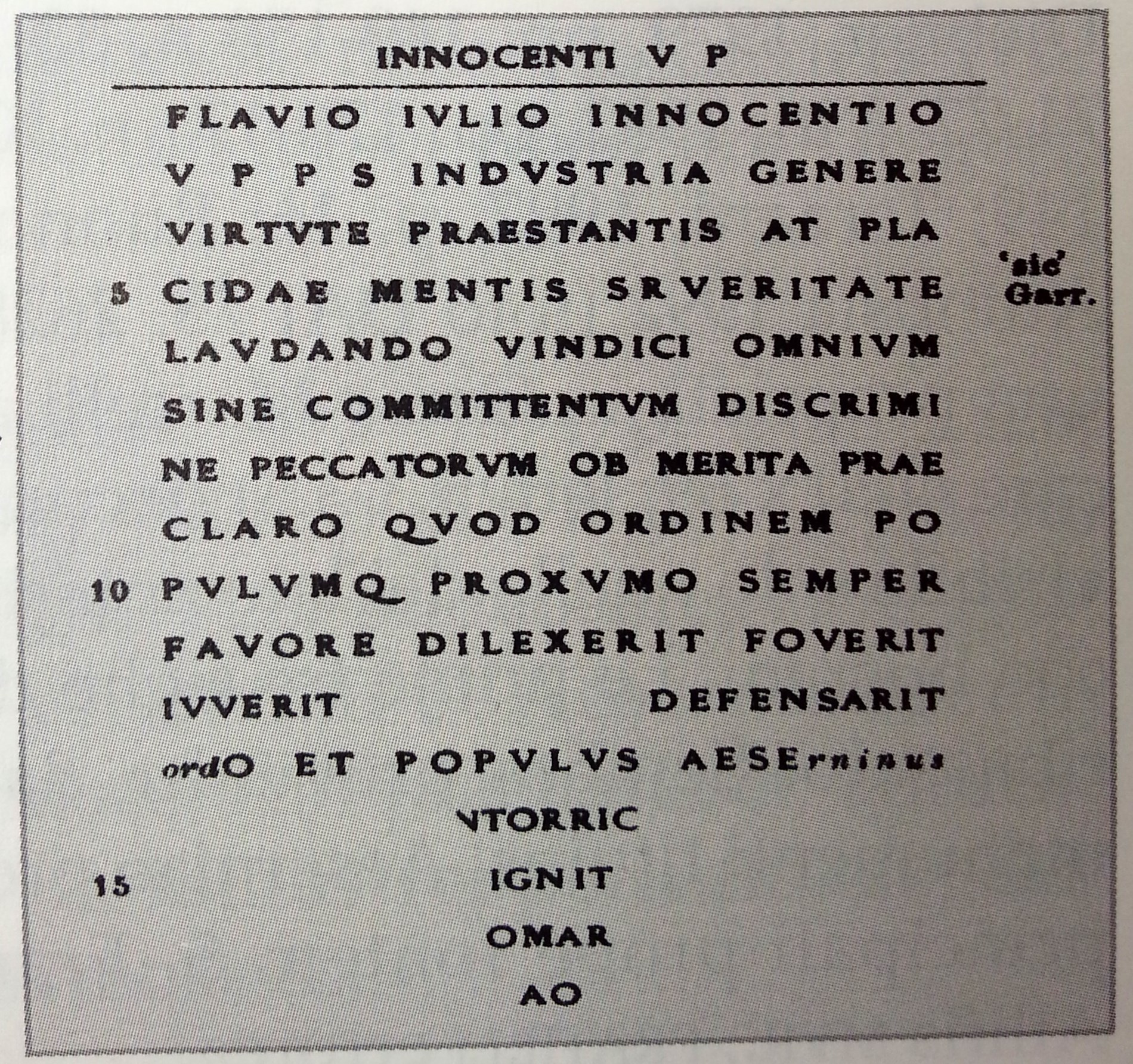
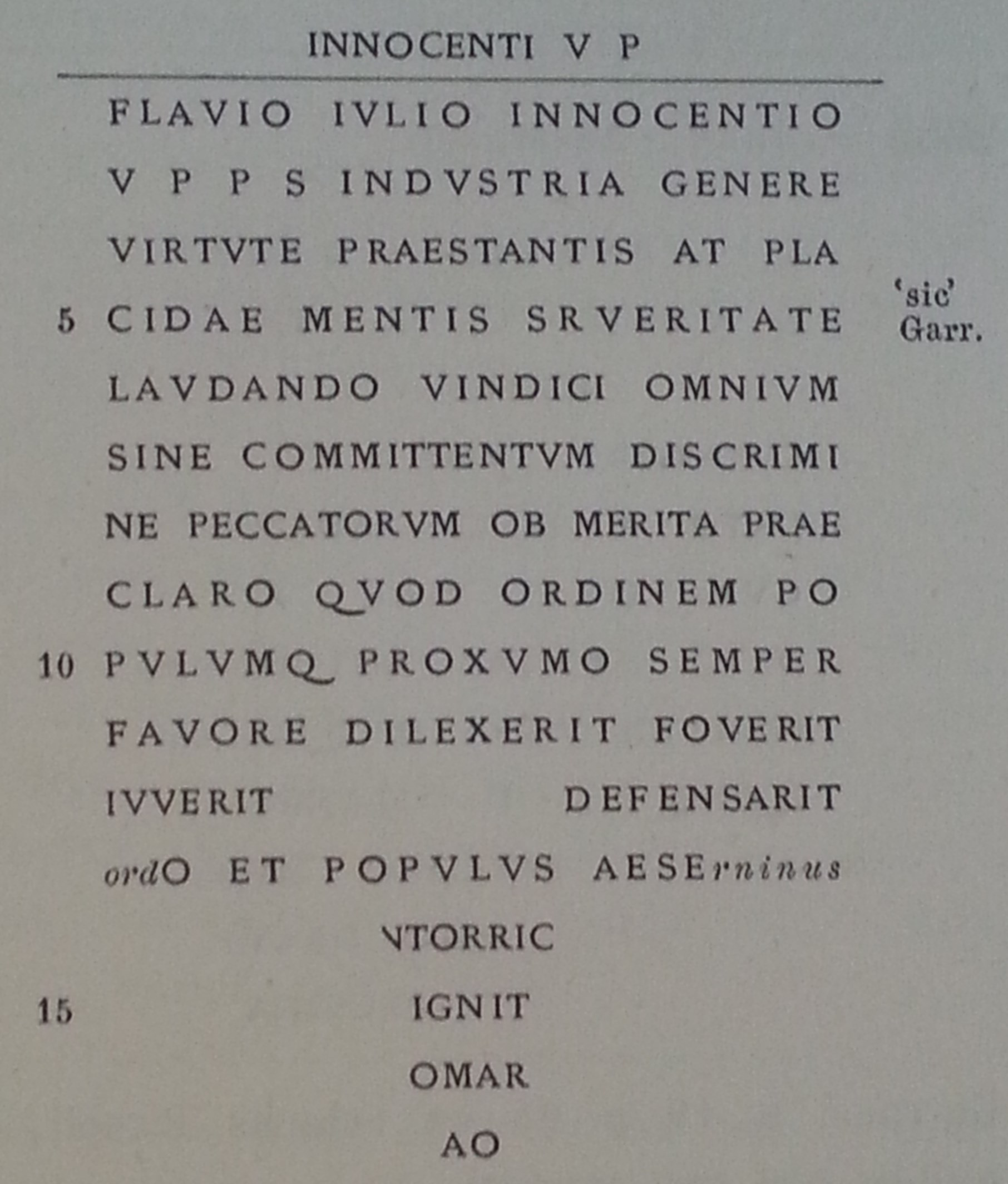
Inscription
Innocenti, v(iri) p(erfectissimi). / Flavio Iulio Innocentio, / v(iro) p(erfectissimo), p(raesidi) S(amnii), industria, genere, / virtute, praestantis at pla/cidae mentis, srveritate (sic) /(5) laudando, vindici omnium / sine committentum discrimi/ne peccatorum, ob merita prae/claro, quod ordinem po/pulumq(ue) proxumo (sic) semper /(10) favore dilexerit foverit / iuverit defensarit. / [Ord]o et populus Aese[rninor(um)] / [---]NTORRIC[---] / [--- d]ignit[---] /(15) [---]OMAR[---] / [---]AO[---].
Inscription translation
[Statue of] Innocentius, of perfectissimus rank. To Flavius Iulius Innocentius, of perfectissimus rank, governor (praeses) of Samnium, commended for his diligence, family, manliness, outstanding and peaceful disposition and severity, punisher without any discrimination of all who are committing crimes, distinguished on account of his services, who always esteemed, assisted, supported and protected with most ready favour the council and people. The council and people of Aesernia (…).
Bibliography
- Corpus Inscriptionum Latinarum; , IX, 2641
- Buonocore, M., Molise. Repertorio delle Iscrizioni Latine. V.2: Aesernia , Campobasso 2003, no. 19
Discussion
INSCRIPTION
In 17 lines:
Innocenti, v(iri) p(erfectissimi). / Flavio Iulio Innocentio, / v(iro) p(erfectissimo), p(raesidi) S(amnii), industria, genere, / virtute, praestantis at pla/cidae mentis, srveritate (sic) /(5) laudando, vindici omnium / sine committentum discrimi/ne peccatorum, ob merita prae/claro, quod ordinem po/pulumq(ue) proxumo (sic) semper /(10) favore dilexerit foverit / iuverit defensarit. / [Ord]o et populus Aese[rninor(um)] / [---]NTORRIC[---] / [--- d]ignit[---] /(15) [---]OMAR[---] / [---]AO[---].
‘[Statue of] Innocentius, of perfectissimus rank. To Flavius Iulius Innocentius, of perfectissimus rank, governor (praeses) of Samnium, commended for his diligence, family, manliness, outstanding and peaceful disposition and severity, punisher without any discrimination of all who are committing crimes, distinguished on account of his services, who always esteemed, assisted, supported and protected with most ready favour the council and people. The council and people of Aesernia (…).‘
Letter height not recorded.
DESCRIPTION (from CIL and Buonocore 2003)
There is no description of the block available (see below, ‘Provenance and Current Location‘). No measurements are published, and there is no published image.
PROVENANCE AND CURRENT LOCATION
CIL, the first publisher of the inscription in 1883, records that it was seen built into a modern wall by the scholar Raphael Garrucci in 1848 (‘era murata in una cantonata della casa di Emilio Lauretti‘). This record is obscure since Garrucci saw another inscription, possibly of the earlier imperial period, on the back side of ours (CIL IX, 2691). This second inscription was recorded in the cathedral of Isernia by the local scholar Galantius in the later 18th century (in ecclesia cathedrali, CIL IX, 2691).
The publishers of CIL could not trace our inscription in the late 19th century. There is no recent record of its location; it is possibly now lost.
HONORAND, AWARDER AND DATE
Flavius Iulius Innocentius signo Innocentius, the honorand, was of equestrian (perfectissimus) rank (PLRE I, 458 Flavius Iulius Innocentius 6). He was governor (praeses, line 3) of the province of Samnium; the province was established at an unknown date in the mid 4th century which gives an approximate terminus post quem for our inscription (cf. the discussion on Fabius Maximus, LSA-1750 and LSA-1777). It is now an established view that the perfectissmate was abolished by 412 (Russi 1971, 333-7); this is a possible terminus ante quem for our inscription.
The inscription was set up by the civic institutions of Aesernia, council (ordo) and people (poulus) (line 13).
Discussion references
- Jones, A. H. M. et al., The Prosopography of the Later Roman Empire. Vol. I 260-395, Cambridge et al. 1971 (1975), 548
- Russi, A., L’amministrazione del Samnium nel IV e V secolo d.C., Miscellanea Greca e Romana 3, Roma 1971, 307-46
Cite: Last Statues of Antiquity, LSA-1779 (preliminary version, discussion added 4/15 (UG)).