
LSA-178
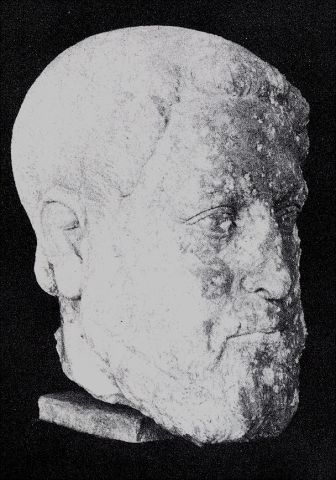
Portrait head of bearded man (lost). From Aphrodisias (Caria). Fourth century.
Record details
Photographs
Bibliography
- Erim, K.T., "De Aphrodisiade'", AJA 71 (1967), 237-8, pl. 69 fig. 16
- Smith, R.R.R., "Statue life in the Hadrianic Baths at Aphrodisias, AD 100-600: Local context and historical meaning", in F.A. Bauer, C. Witschel (eds.), Statuen und Statuensammlungen in der Spätantike - Funktion und Kontext (Spätantike, Frühes Christentum, Byzanz: Kunst im ersten Jahrtausend), Wiesbaden 2007, 228 no. A 34
Discussion
DESCRIPTION (Object)
Head, life-size or over life-size. White marble.
Only a single photograph currently exists of the head. The photograph shows a head in excellent condition (the nose is fully preserved) on a larger scale than the head next to it which is most likely not a portrait. It also shows a head broken off its body at the top of the neck. There seems to be a trace of drapery at the back of the neck.
PROVENANCE
Found in 1904 by Gaudin at the Hadrianic Baths. It was found in the service corridors probably beneath the central area of the forecourt. It is now lost.
DESCRIPTION (Subject)
The portrait shows a man with a full beard and combed forward hair. The hair indents at the base of the skull and recedes at the right corner of the brow. There is a trace of drapery visible around the neck.
DATE
The combed forward hairstyle and full beard were fashionable in the fourth century and continued in use in the fifth century. Dated examples from the fourth century include Caius Caelius Saturninus signo Dogmatius (see LSA-903, LSA-1266) and Virius Audentius Aemilianus (LSA-41, LSA-46); a late fourth to early fifth century example is provided by Oecumenius (LSA-150, LSA-151). The Obelisk of Theodosius in Istanbul also shows comparable hairstyles and provides further confirmation of the date.
Cite: Last Statues of Antiquity, LSA-178 (J. Lenaghan).