
LSA-1780
Base for statue of Flavius Severus, local notable and patron. Aufidena (Samnium). Late third to Fourth century.
Record details
Photographs
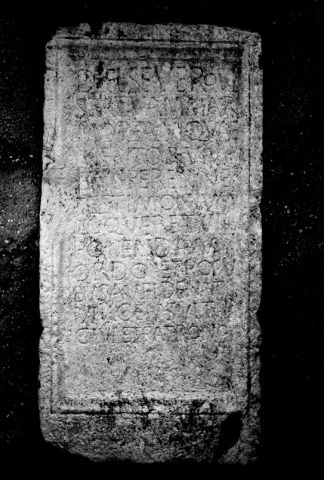
Inscription
D(omino) Fl(avio) Severo, v(iro) p(erfectissimo), / statuam mar/moream quae / meritorum /(5) eius perenne / testimonium / loqueretur / ponendam, / (9) ordo et popu/lus Aufidenati/um censuit / civi et patrono.
Inscription translation
To the lord Flavius Severus, of perfectissimus rank, the councillors and people of Aufidena decreed the setting up of the marble statue as an eternal testimonial of his services, to a fellow citizen and patron.
Bibliography
- Corpus Inscriptionum Latinarum; , IX, 2803
- Buonocore, M., Aufidena, Supplementa Italica. Nuova serie 8, 47-69, Roma 1991, 53-4
Discussion
INSCRIPTION
In twelve lines:
D(ecimo) Fl(avio) Severo, v(iro) p(erfectissimo), / statuam mar/moream quae / meritorum /(5) eius perenne / testimonium / loqueretur / ponendam, / (9) ordo et popu/lus Aufidenati/um censuit / civi et patrono.
'To the lord Flavius Severus, of perfectissimus rank, the councillors and people of Aufidena decreed the setting up of the marble statue as an eternal testimonial of his services, to a fellow citizen and patron'.
Letter height 3 – 6.5 cm.
We reproduce the inscription with the completions suggested by Splendore 1983. Buonocore 1991, following de Ruggiero 1897, suggested to complete the first letter to D(omino) instead of D(ecimo) (see below, 'Further Discussion').
DESCRIPTION (from Buonocore 1991)
Rectangular limestone block (stele in calcare); H 114, W 58, D 38 cm. There are some chips at the bottom right and at the left margin.
PROVENANCE AND CURRENT LOCATION
The inscription was found in the mid-19th century in the area of Castel di Sangro; this is the location of ancient Aufidena (http://www.trismegistos.org/place/14471).
The inscription was recorded in Castel di Sangro by Buonocore in 1985 (without published inv. no.).
HONORAND, AWARDER AND DATE
Flavius Severus (or Decimus Flavius Severus, see above, 'Inscription', and below, 'Further Discussion'), the honorand, was a citizen of Aufidena and a patron of the city (line 12). He was of equestrian (perfectissimus) rank (line 1).
The inscription was tentatively dated to the later imperial period by Mommsen (for CIL: sequioris aetatis); CIL mentions the badly carved letters (cf. Buonocore 1991: 'a causa, sopratutto, della natura della pietra'). The record of the honorand's perfectissimus rank suggests a date not earlier than the later 2nd century. The nomen Flavius of the honorand suggests that he held office in the imperial administration in the late 3rd or 4th century.
The inscription was set up by the civic institutions (ordo et populus) of Aufidena.
FURTHER DISCUSSION
As Mommsen (in CIL) pointed out, it would be a rare case, indeed unparalleled in our sample, as far as I see, to address a local notable as dominus - 'lord'; this title is reserved to emperors. I think the completion suggested by Splendore 1983 (see above, 'Inscription') is much more reasonable.
Discussion references
- Splendore, E., Le antichità di Castel di Sangro. Guida illustrata alle epigrafi, Castel di Sangro 1983, 38-40 no. 12
- Vaglieri, D., Sylloge Epigraphica Orbis Romani Cura et Studio Hectoris de Ruggiero Edita. Volumen II. Inscriptiones Italiae Continens, Roma 1897, Fasc. 16 no. 3971
Cite: Last Statues of Antiquity, LSA-1780 (preliminary version, discussion added 2/15 (U)).