
LSA-1783
Base for statue of Fabius Maximus, governor of Samnium and city patron. Iuvanum (Samnium). 352-357.
Record details
Photographs
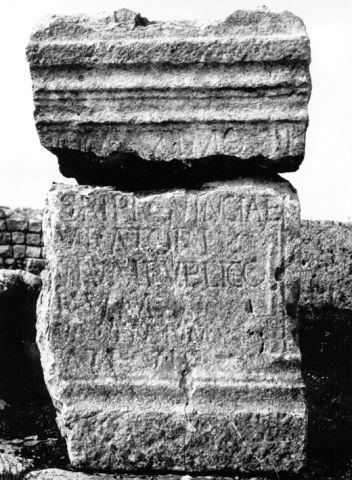
Inscription
Fabio Maximo, / [v(iro) c(larissimo)], / rectori provinciae, / restauratori / moenium publico/rum, / ordo Iuvanensium / patrono.
Inscription translation
To Fabius Maximus, of clarissimus rank, governor (rector) of the province, restorer of public buildings; the councillors (ordo) of Iuvanum [set this up] to [their] patron.
Bibliography
- Corpus Inscriptionum Latinarum; , IX, 2956
- Dessau, H., Inscriptiones latinae selectae, Berlin 3rd ed. 1962, 5341
Discussion
INSCRIPTION
In eight lines:
Fabio Maximo, / [v(iro) c(larissimo)], / rectori provinciae, / restauratori / (5) moenium publico/rum, / ordo Iuvanensium / patrono.
’To Fabius Maximus, of clarissimus rank, governor (rector) of the province, restorer of public buildings; the councillors (ordo) of Iuvanum [set this up] to [their] patron.’
Letter height not recorded.
DESCRIPTION (from CIL and the published image)
Rectangular base with mouldings at top and bottom. There is a horizontal break between lines 1 and 3, line 2 is now lost. No measurements are published.
PROVENANCE AND CURRENT LOCATION
The inscription was first recorded in a 15th-century codex, the so-called Redianus, in the church of Santa Maria de Palatiis in Torricella Peligna in the vicinity of ancient Iuvanum (in S. Mariae de Palatiis prope Turricellam). There is no recent record of its location.
HONORAND, AWARDER AND DATE
Fabius Maximus, the honorand, was governor of the province of Samnium (rector provinciae in our inscription), he is known from more than 15 inscriptions, all in the province of Samnium (see discussion under LSA-1750). He was of senatorial (clarissimus) rank (PLRE I, 587 Fabius Maximus 35). He is praised for building activities in the city of Iuvanum; the term moenia publica, re-occurring in Maximus’ epigraphic record refers to public buildings rather than to city walls. The term restaurator (line 4) refers to restoration work rather than to new buildings raised from the ground (contrast LSA-1750 where he is styled conditor). Maximus was patron of the city of Iuvanum (line 8).
A date of 352/7 for his time in office is suggested by LSA-1777, an honorific inscription to Maximus in Aesernia (see discussion there).
The inscription was set up by the city council (ordo, line 7) of Iuvanum.
Discussion references
- Jones, A. H. M. et al., The Prosopography of the Later Roman Empire. Vol. I 260-395, Cambridge et al. 1971 (1975), 587
Cite: Last Statues of Antiquity, LSA-1783 (Carlos Machado and Ulrich Gehn; discussion added 4/15 (UG)).