
LSA-1784
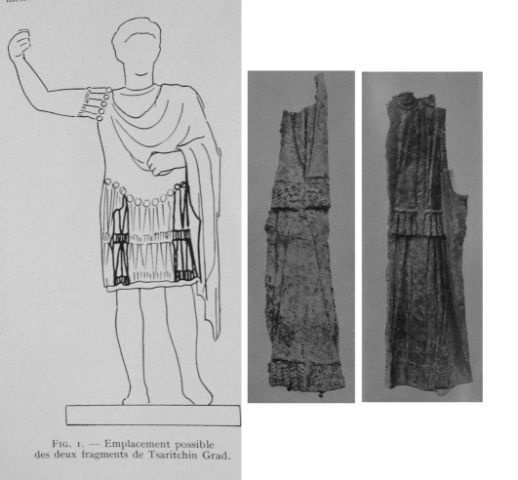
Fragments of bronze cuirassed statue of Emperor, probably Justinian I. Justiniana Prima (Dacia Mediterranea). Earlier to mid sixth century
Record details
Photographs
Bibliography
- Bavant, B. & V. Ivanišević, Ivstiniana Prima (Caričin Grad) – Eine spätantike Stadt vom Reissbrett
, Brandl, U. & M. Vasić, Roms Erbe auf dem Balkan. Spätantike Kaiservillen und Stadtanlagen in Serbien, 108-29, Mainz 2007, 118 fig. 7
Discussion
DESCRIPTION (Object)
Two fragments from a bronze cuirassed statue. Preserved are portions of two rows of fringed butts (pteryges) and at the top of the butts semicircular segments of the lower seam of the leather cuirass; one is decorated with a bearded mask.
PROVENANCE AND CURRENT LOCATION
The fragments were found in the area of the central square on the acropolis of Justiniana I (map Bavant & Ivanišević 2007, 113 fig. 2; the square is no. 10 on that map. Caričin Grad is widely assumed to be Iustiniana I although this is not yet proven; Mano-Zisi 1979; Snively 1999; Bavant & Ivanišević 2003). Bavant & Ivanišević 2007 believe that our fragments belonged to a cuirassed statue of an emperor once set up on the square (see also below, 'Description (Subject)' and 'Date'). There is no published record of their present location.
DESCRIPTION (Subject)
The find spot on the central square of Iustiniana I makes it certain that this was a statue of an emperor, most likely Justinian I (527-65) who was born in the city and was eager to decorate and upgrade his native city.
DATE
Iustiniana Prima (Caričin Grad) was built 'from the drawing table' in the 6th century, starting in the 520s/30s. The building process developed in several phases into the 570s. After the 570s the city declined and was sacked by the Slavs in the early 7th century. Our statue dates to the city's heyday in the earlier-mid 6th century.
Discussion references
- Bavant, B. & V. Ivanišević, Ivstiniana Prima - Caričin Grad, Belgrade 2003
- Mano-Zisi, Dj., Caričin Grad – Iustiniana Prima, 1979
- Snively, C. S. Iustiniana Prima (Caričin Grad), Reallexikon für Antike und Christentum vol. 19, 638-68, Stuttgart 2001
Cite: Last Statues of Antiquity, LSA-1784 (Ulrich Gehn).