
LSA-1785
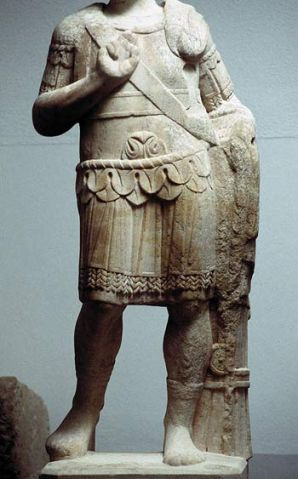
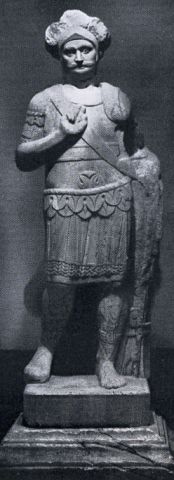
Portrait statue, without original head, in armour. Celeia (Noricum Mediterraneum). Later third to earlier fourth century
Record details
Photographs
Bibliography
- Stemmer, K., Untersuchungen zur Typologie, Chronologie und Ikonographie der Panzerstatuen, Berlin 1978, 114, no. XI 6, pl. 77.5
- Vermeule, C.C.C. 'Hellenistic and Roman cuirassed statues' , Berytus 13, Beirut 1959, 72 no. 315
Discussion
DESCRIPTION (Object)
Coarse grained white marble statue worked from one block with its plinth. Total height 174, W (plinth) 60 cm. The attached head has been found along with the statue (Conze 1877, 5); however, it is not part of the original but was attached by a modern restaurator, probably in the 18th century (Schober 1954, 193). The left hand and wrinkle are broken off. The surface of the cloak at the left arm and of the left shin is worn. The back face is only summarily executed.
PROVENANCE AND CURRENT LOCATION
The statue was found in the earlier 19th century in the river Voglajna in Celje, the area of ancient Celeia (on discovery and subsequent fate Conze 1877, 5; Schober 1954, 192). It is today in the lapidarium of the Pokrajinski Muzej in Celje (without published inv. no.).
DESCRIPTION (Subject)
The statue is standing over its left leg, the right foot put outwards with the heel raised. The left arm is bent in the elbow and holding the cloak (sagum). The right hand is raised in front of the breast in a gesture of communication (porrecti digiti tres, 'three fingers (thumb, index and middle) stretched out'), the palm opened towards the beholder.
The portrayed is wearing a cuirass over a tunic, his feet are clad in plain boots with four horizontal bands at the shins. A military cloak (sagum) is attached to the left shoulder and held by the left arm. A broad plain belt (cingulum) is laid horizontally over the belly; it has seams on both sides. From the right shoulder to the left hip is running another belt (balteus) on which the sword is fixed; it is likewise broad, but without seams. The sword's hilt is visible above the left hip; it ends in a round knob. The cuirass is plain safe an akanthus leaf below the cingulum. It is edged by a twisted band at the hips and at the upper arms. Below that band, there is a double row of leaf-shaped tabs (pteryges) with a simple triangular decoration in low relief; at the upper arms there is only one such band of tabs. Below the tabs, a row of buttstraps ending in thick woolly fringes is hanging down. At the left leg, an angular bundle of scrolls (scrinium) is attached as support. It is held by a horizontal band with seams on both sides. In front of the scrinium there is a small round plate surrounded by a seam and with a knob in the centre. This has been identified as a seal capsule (bulla) by Schober 1954, 194-6 and is possibly an allusion to the actual rank or occupation of the portrayed (see also below, 'Honorand and Date'). The horizontal breakline in front of the scrinium is either from a tip of the cloak, or from another, rod-shaped, attribute.
HONORAND AND DATE
The statue was dated by Conze 1877, 7 to the early 4th century by comparison to the cuirassed statue of Constantine I on the Piazza di Campidoglio in Rome (LSA-555) which he considered similar in proportions and iconography. Schober 1954, 196 suggested the statue of a governor (praeses) of Noricum Mediterraneum of the mid-4th century; this was, however, a civic office holder who would not have been depicted in armour. Vermeule 1959 dated to the 3rd century, likewise Stemmer 1978.
While the statue of Constantine in Rome is similar in the trunk-like proportions of the body, it is different in almost every detail of the cuirass. A more valid comparison in iconographic terms is provided by the statue groups of the tetrarchs in Venice (LSA-4, LSA-439) and Rome (LSA-840, LSA-841). Both groups have undecorated cuirasses with a horizontal row of pteryges; both show, moreover, the pteryges at the upper arms, a feature which seems to characterize armoured statues in the period of the tetrarchy. The Venice Tetrarchs, moreover, have a plain cingulum (instead of the traditional looped senatorial general’s belt which is displayed on Constantine’s statue) wrapped around the body and sketched out in the same way as with our statue.
The iconographic and stylistic similarities to the tetrarchic figures in Rome and Venice suggest a date in the later 3rd or early 4th century for our statue.
The portrayed was an army officer as is indicated by his cuirass. He is not an emperor, since different from the quoted imperial statues there is no indication of jewellery on the belts, and the hilt is in the form of a round knob (not of an eagle’s head). Officers’ ranks were held by men of equestrian (not senatorial) rank at that period; this could explain the dismissal of the traditional senatorial officer’s belt (cingulum, cinctorium).The shoes, on the other hand, do possibly show one feature of the senatorial army officers' shoe (calceus), namely the four horizontal straps at the shin. Different from other representations of the senatorial calceus, however, they do not display neither the kinked bands hanging down (corrigiae), nor the crossed straps on the foot.
The attributes (scrinium and seal) possibly allude to the portrayed's actual occupation in the army (in the enrollment of recruits, or in the administration?); or it is a general allusion to his education and virtue.
FURTHER DISCUSSION
Wether this was a honorific or a funerary statue is unclear; there is however, some argument in favour of the latter: given our assumptions concerning honorand and date, there is no evidence for honours to military men in the epigraphic record. Moreover, the findspot of the statue was probably a funerary area of Celeia (Schober 1954, 197).
Discussion references
- Conze, A., Römische Bildwerke einheimischen Fundorts in Österreich. III. Heft. Sculpturen in Cilli, Pettau und Seckau, Wien 1877, 5-8 pl. XI. XII
- Schober, A., Der "Norische Krieger" von Celje, Vjesnik za Arheologiju i Historiju Dalmatinsku 56, 1954, 192-7
Cite: Last Statues of Antiquity, LSA-1785 (Ulrich Gehn).