
LSA-1786
Base for statue of Constans, emperor. Pinna (Samnium). 337-350
Record details
Photographs
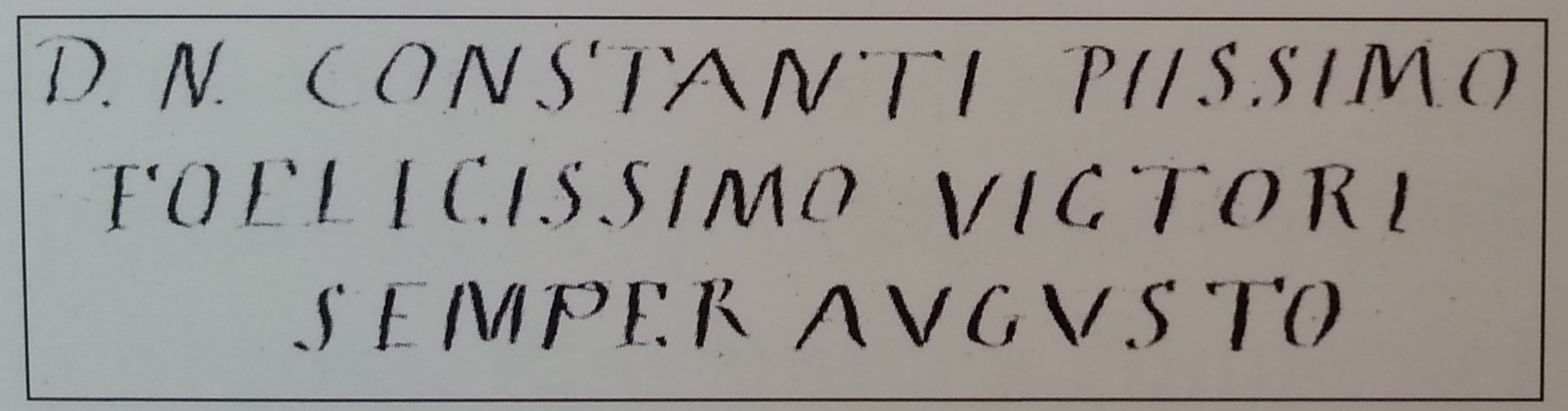
Inscription
D(omino) n(ostro) Constanti, piissimo, / felicissimo, victori, / semper Augusto.
Inscription translation
To our lord Constans, most pious, most fortunate, victorious, forever Augustus.
Bibliography
- Corpus Inscriptionum Latinarum; , IX, 3348
- Buonocore, M., Storia, amministrazione, società, economia di Penne in età romana, Pinna Vestinorum la città romana (a cura di L. Franchi dell’Orto), Roma 2010, 218-65; 234 no. 14
Discussion
INSCRIPTION
In three lines:
D(omino) n(ostro) Constanti, piissimo, / felicissimo, victori, / semper Augusto.
To our lord Constans, most pious, most fortunate, victorious, forever Augustus.
Letter height not recorded.
DESCRIPTION (from CIL and Buonocore 1984)
There is no description of the block; no measurements are published, and there is no published image.
PROVENANCE AND CURRENT LOCATION
The inscription was seen built into an outer wall of the chapel of the blessed Anastasius of the cathedral of Penne, the location of ancient Pinna (http://www.trismegistos.org/place/14416), under a marble angel, by the scholar Niccolò Toppi in the mid-17th century (Buonocore 2010, 234).
Buonocore 2010 could not trace the inscription.
HONORAND, AWARDER AND DATE
Constans, the honorand, was Constantine’s youngest son; he was Augustus 337-50. He assumed the title of victor after the defeat of his older brother Constantine II in 340; this is the terminus post quem for our inscription.
The awarder is lost on our inscription, or was never recorded.
Discussion references
- Buonocore, M., Varia epigraphica Abruzzesi, Nona Miscellanea Greca e Romana, Roma 1984, 227-71
Cite: Last Statues of Antiquity, LSA-1786 (preliminary version, discussion added 4/15 (U)).