
LSA-18
Part of columnar base for statue of Theodorus, possibly a governor. Corinth (Achaea). Late third to fourth century
Record details
Photographs
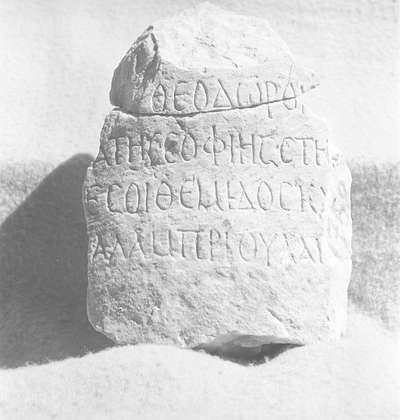
Inscription
[---]
[---] Θεόδωρον̣[---]
[---]α τῆς σοφίης στη[---]
[---]εσοι Θέμιδος κα̣[---]
[---]α λαμπρίου λαι[---]
Inscription translation
'.. [set up to] Theodorus ... [because of] wisdom ... of Themis and(?) ... of brilliant stone(?) ...'
Bibliography
- Kent, J. H., The inscriptions, 1926-1950: Corinth VIII, 3, Princeton 1966, no. 517
Discussion
INSCRIPTION
Parts of four lines of verse survive, from the end of the inscription:
[---]
[---] Θεόδωρον̣[---]
[---]α τῆς σοφίης στη[---]
[---]εσοι Θέμιδος κα̣[---]
[---]α λαμπρίου λαι[---]
'.. [set up to] Theodorus ... [because of] wisdom ... of Themis and(?) ... of brilliant stone(?)...'
Our translation follows Kent's reading of λαμπρίου as an adjective, 'of brilliant'. Robert 1966 instead proposed to read it as a name, Λαμπρίου, the genitive of Λαμπρίας, Lamprias (see below, 'Honorand, Awarder and Date'). Feissel 1985 points out that this word form does not fit into the dactylic structure of the verse inscription.
Themis was a goddess of Justice, often invoked in late antique inscriptions that praise just officials.
DESCRIPTION (From Corinth VIII and the published photo)
Three adjoining fragments of a white marble column, broken on all sides and at the back: H 37, W 29, D 16 cm. The surface is very roughly finished and the letters contain traces of red paint.
PROVENANCE AND CURRENT LOCATION
Found in 1936 in a modern house in Old Corinth. Today in the Corinth Museum, inv. no. 1768.
HONORAND, AWARDER AND DATE
A date in the late 3rd or early 4th century was proposed in Corinth VIII.3 on the basis of the lettering. A late date is indeed strongly suggested by the verse form, and by some of the characteristic wording which the inscription, though very fragmentary, reveals. 'Themis', a goddess of Justice, is mentioned as a suitably erudite way of praising the justice of an official (Robert 1948, 13-22, and on mythological comparisons, p. 99; Robert 1966, 760-1; see also the dedication to the governor Proclianus in Argos, LSA-998); while 'sophia (wisdom)' praises the intellectual brilliance of the honorand, which can also be associated - through knowledge of the law - with Justice (cf. Robert 1948, 91). The inscription was clearly set up to a late antique imperial official, such as a governor.
A governor (proconsul) of Achaea named Theodorus (PLRE I, 898 Theodorus 16) was honoured with a marble statue (LSA-2), and probably a bronze statue (LSA-423), in Athens under Theodosius I (379-95); and the same governor was probably awarded a further statue in Troizen (LSA-600). Given the poor condition of our monument, however, an identification of the Theodorus at Corinth with the man at Athens and Troizen can only be tentative.
If in line 4 λαμπρίου is a form of the name Λαμπρίας, as Feissel 1985 proposed, this name probably refers to the awarder. Feissel 1985 considered a possible identification with an Argive philosopher Lamprias mentioned in the emperor Julian's Letter 198.
Discussion references
- Feissel, D. & Philippidis-Braat, A., Inventaires en vue d’un recueil des inscriptions historiques de Byzance, 3. Inscriptions du Péloponnèse, (à l’exception de Mistra)., Travaux et mémoires, 9, Paris 1985, 267-395, pp. 364-5 (appendix) no. 51
- Jones, A. H. M. et al., The Prosopography of the Later Roman Empire. Vol. I 260-395, Cambridge et al. 1971 (1975), p. 898 Theodorus 16
- Robert, L., Epigrammes du Bas-Empire (Hellenica IV), Paris 1948
- Robert, L., Inscriptions de l'Antiquité et du Bas-Empire a Corinthe, Revue des Études grecques 79, 1966, 733-770, pp. 760-1
Cite: Last Statues of Antiquity, LSA-18 (Ulrich Gehn).