
LSA-181
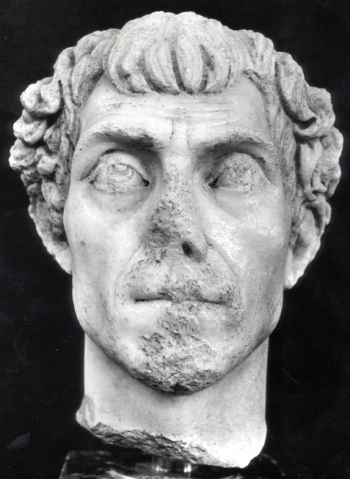
Portrait head of guant man with thick hair and neck pillar. Aphrodisias (Caria). Fifth century.
Record details
Photographs
Bibliography
- Inan, J. & E. Alföldi-Rosenbaum, Römische und frühbyzantinische Porträ̈tplastik aus der Türkei : neue Funde, Mainz 1979, no. 199
- Smith, R.R.R., "Statue life in the Hadrianic Baths at Aphrodisias, AD 100-600: Local context and historical meaning", in F.A. Bauer, C. Witschel (eds.), Statuen und Statuensammlungen in der Spätantike - Funktion und Kontext (Spätantike, Frühes Christentum, Byzanz: Kunst im ersten Jahrtausend), Wiesbaden 2007, 229 no. A 40, fig. 33
- Smith, R.R.R. 'Late antique portraits in a public context: Honorific statuary at Aphrodisias in Caria, AD 300-600' , Journal of Roman Studies, 89 (1999), 155-89, pl. 7
Discussion
DESCRIPTION (Object)
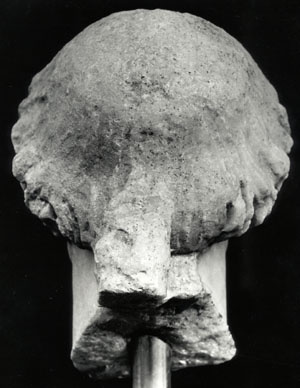
Life-size head. H: 26, W: 23, D: 24 cm. Diam of neck: 12 cm. Thickness of neck pillar: 7 cm. Fine-grained white marble.
The head, originally worked in one piece with a statue, has broken through the base of the neck and neck pillar. The tip of the nose is missing. The ridge of the nose, the lips, and the chin are chipped. The surface shows traces of burial encrustation and has been heavily cleaned over the face, probably with some acidic agent.
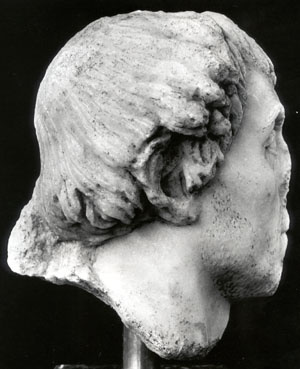
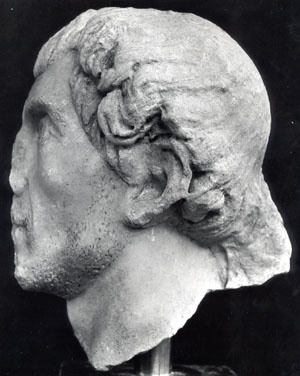
The head was supported at back by a neck pillar which is roughly finished with a broad point chisel. The front and sides of the neck as well as the face are carefully separated from the hair and ears; they are carved at a lower level and fully finished. A continuous line of raised surface runs from the neck pillar, around the ears, and around the hair over the brow. Behind the ears this leaves an unusual bit of uncarved, non-representational raised surface between the ends of hair and the neck and between the lobe of the ear and the head .
Drill work differentiates the ends of the locks of hair. The rest of the hair is indicated with engraved lines of the flat chisel. A fine flat chisel has been use to engrave the beard and moustache. Deep drill lines define the upper edge of the upper eyelids; the iris is an engraved arc which does not touch the lower lid; and the pupil has been cut-out and takes the shape of a crescent.
PROVENANCE
The head was excavated in the South Agora in 1969. It lay in the southern end of the west stoa of the Agora.
DESCRIPTION (Subject)
The life-size portrait head represents a gaunt man of mature age with a light growth of facial hair and full hair. The presence of the neck pillar indicates that the head broke from a statue.
The relatively short brow is marked by four fine horizontal lines and two vertical ones above the nose. The eyebrows have high arches and project. The eyes are deeply set beneath them. The cheekbones protrude, and the jaw juts forward. Thus, the skin of the face is pulled tight and makes strong curving naso-labial folds. The mouth is broad, straight, and thin-lipped.
The hair is combed to all sides from the crown of the head. At its ends individual strands of hair turn different ways, effectively breaking up the unified mass. At the corners of the brow, the hair does recede slightly. Between the recessions and the ears, the locks have the greatest volume and curl. The cheeks, upper lip, and chin show a light growth which has been pecked into the surface with a fine chisel.
DATE
The hairstyle belongs best in the fifth century. The rendering of the eyes, the use of fine-grained marble and the small size are typical of late-antique statuary at Aphrodisias.
The shape and rendering of the eyes and mouth as well as the general aesthetic are similar to the ‘Elder Magistrate’ LSA-169 found in the same stoa. This, however, does not help to specify the date.
HONORAND
The above comparison to the ‘Elder Magistrate’ LSA-169 suggests that this tight-lipped mature man may have come from a similar monument, perhaps to a governor. The epigraphic and sculptural record from the west stoa of the South Agora and the forecourt of the Hadrianic Baths attests to many such monuments. Moreover, the portrait seemingly fits with the hard-working and self-sacrificing biographies given on bases of governors.
Cite: Last Statues of Antiquity, LSA-181 (J. Lenaghan).